

Circuitde Pedralbes
 SpainBarcelonaEntry 1951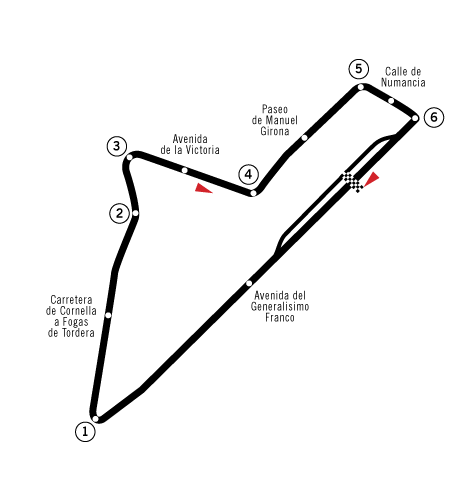
Career timeline
Signature numbers
- Career
- 1951 – 1954
Era
About Circuit de Pedralbes
Pedralbes was a wide-open street circuit on the avenues of Barcelona's Pedralbes neighborhood, hosting the Spanish Grand Prix in 1951 and 1954. With its long straights and right-angle corners on broad, tree-lined boulevards, it was one of the fastest circuits of the early 1950s — a place where Alberto Ascari and Juan Manuel Fangio battled at speeds approaching 280 km/h on what were essentially residential streets. Pedralbes lasted only two championship Grands Prix before changes in safety thinking after the 1955 Le Mans disaster killed the era of true street circuits, but it produced one of Mike Hawthorn's earliest great victories and crowned Fangio his second world title.
Origins
Pedralbes is an upper-class district of Barcelona, developed in the early 20th century with broad avenues that the Spanish Royal Automobile Club identified as ideal for racing. The first race on the layout was held in 1946. The Spanish Grand Prix returned to the championship in 1951 after wartime hiatus and used Pedralbes — 6.316 km of public roads, mostly straight, with sweeping right-angle bends.
Layout
The layout was simple: long straights down Avenida Diagonal, a couple of fast right-handers at the boundaries, and a final hairpin returning to the start. Top speeds were enormous — Fangio recorded over 280 km/h in 1954, extreme for the era. The corners were taken at relatively low speed compared to today, but with no run-off — just curbs, trees, and occasionally houses. The challenge was managing the long straights' demands on engines and tyres while braking very late for the few real corners.
Legendary Moments
1951 was Fangio's coronation: he won in the Alfa Romeo 159 ahead of Alberto Ascari's Ferrari, sealing his first World Championship. The race demonstrated the power of the supercharged Alfa over the naturally aspirated Ferraris on a circuit where straight-line speed was paramount. 1954 brought a Mercedes versus Ferrari battle, with Fangio in the new Mercedes W196 streamliner taking pole and leading early — but his car suffered electrical issues and Mike Hawthorn took the Ferrari 553 to victory. It was Hawthorn's second F1 win and one of his finest drives. The race also saw the unveiling of streamliner aerodynamics that would dominate the high-speed circuits of the period.
Quirks & Curiosities
Spectators stood behind hay bales — yes, hay bales — separating them from cars passing at 280 km/h. Photographs from the period show people calmly leaning against the temporary barriers, drinks in hand, as the cars roared past. The circuit's start-finish was on the Avenida Generalísimo Franco (now Diagonal), and the pits were a row of canvas tents. The 1954 race was the first time many Europeans saw the streamlined Mercedes W196 in full bodywork — a sleek silver missile that Fangio admitted was harder to drive than the wheels-out version because peripheral vision was reduced. The circuit's wide nature meant overtaking was actually possible, unusual for street layouts.
Modern Era
Pedralbes has not hosted a championship race since 1954. The 1955 Le Mans disaster led to the cancellation of the 1955 Spanish Grand Prix and ended serious consideration of true street circuits at the avenues' speed. Spain went without a championship Grand Prix until 1968 when Jarama opened. The roads of Pedralbes remain in daily use as Barcelona's main residential district — Avinguda Diagonal is now one of the city's busiest commuter routes, and the layout could not safely host modern F1 even with extensive modification. Occasional historic demonstrations have occurred, but Pedralbes belongs to Spanish motorsport history as a snapshot of an era when racing courage outweighed regulation, and where Fangio joined the pantheon by winning the world championship on a Barcelona avenue.