2026 Hungarian GP: Norris dismantled Mercedes' perfect season
Why Norris won, how Ferrari beat itself, the real state of Mercedes and Alpine's slump — telemetry, FIA upgrades and the press record, cross-checked.
Post-race technical analysis · F1pedia · Data: F1 Official timing + OpenF1 (CC-BY 4.0) · Round 11/22 · Hungaroring, 26 July 2026
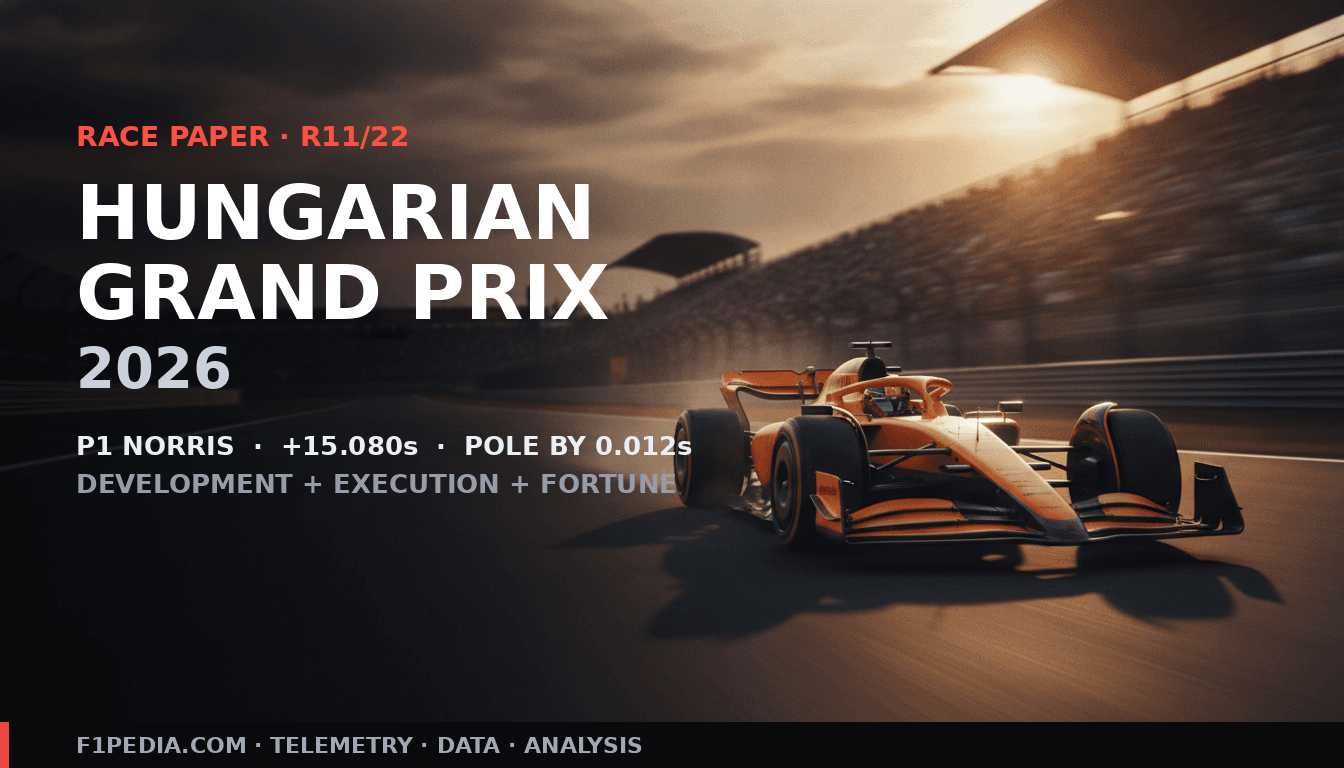
Lando Norris won in Hungary and broke three streaks in one afternoon: Mercedes' ten consecutive poles, a championship that had been an Antonelli monologue, and his own — the reigning champion had opened the 2026 regulatory era with ten winless races, and got it done at the eleventh attempt. It was also McLaren's first win of the year. The bare result (Norris, Verstappen at 15.080s, Antonelli at 18.728s) says little about how it was built. After crossing telemetry, lap data, FIA-declared upgrades and the press record, this article's thesis is that the win was assembled in three layers: development (the floor package McLaren brought to Hungary made it the best slow-corner car in the field, at the calendar's most slow-corner-dominated track), execution (pole by 12 thousandths and a surgical overcut on Piastri), and only then fortune (Piastri's gearbox and a VSC that turned a hard-earned win into a comfortable one). Running alongside it, the other story: Ferrari had the pace to win — Friday was theirs, the fastest lap was theirs — and left with a fourth and a fifth through an entirely avoidable chain of unforced errors.
Let's take it apart, numbers on the table.
Context: Mercedes' year, until now
To weigh this race properly you need the season around it. Across the previous ten rounds Mercedes took every pole and had the best race-pace median at 7 of those ten. Antonelli arrived in Hungary with 6 wins and 6 poles; the constructors' table read Mercedes 379, Ferrari 307, McLaren 220 before this round... and nearly the same after it. Hungary is the first round of the year where Mercedes secured neither pole, nor best race pace, nor the win.
Did Mercedes break? No — the data below says otherwise. What happened is more interesting: for the first time, another team out-developed them for a specific circuit type, on the wrong week for them and the right one for McLaren.
Qualifying: 12 thousandths and two penalties
Norris took pole with 1:17.207, Hamilton 0.012s behind — the first non-Mercedes pole of 2026. Then Leclerc (+0.238), Antonelli (+0.272), Piastri (+0.477) and a Verstappen (+0.518) who ended Q3 spinning at the final corner and describing his car over the radio as "undriveable".
Two penalties reshuffled the grid: Hamilton lost 3 places for impeding Piastri — Vasseur accepted the team's responsibility; Hamilton said he was warned "literally when he was at the apex behind me" — and Antonelli lost 3 for not lifting under the yellows for Verstappen's spin. The resulting grid: Norris, Leclerc, Piastri, Verstappen, Hamilton, Russell, Antonelli. (Method note: the official grid document isn't in our database; this reconstruction crosses Q order with the published penalties, matches the race-start feed order, and matches the press-published grid.)
That detail matters for the Ferrari thesis: the car that missed pole by 12 thousandths started fifth.
The race in five acts
Act 1 — The start. Piastri took the position from Norris with a Turn 2 cutback (Norris went in deep, per the F1.com and Sky accounts) and controlled the first half. Russell suffered a rev-control/anti-stall problem at lights-out and fell from sixth to the back of the field (P19 at the end of lap 1 in our timing; the press placed him 21st at the start); his recovery to P7 was the drive-back of the day. Ferrari, having started both cars on SOFTs (against MEDIUMs for most of the front), extracted no net gain from the tyre offset in the opening laps.
Act 2 — First stint. Piastri managed it from the front: 0.9–1.9s over Norris through the first 15 laps. Nobody could do much about anyone: in the no-DRS era, Turn 1 is the Hungaroring's only genuine overtaking spot, and the sector data shows why cars of similar pace couldn't pass.
Act 3 — The overcut that decided the winner (laps 33–41). This is the heart of the race. Norris asked to stop first; McLaren refused and pitted Piastri first (lap 33) to cover Hamilton — Piastri later accepted the logic: the live threat was Ferrari. Norris stayed out until lap 39 — six laps longer than his team-mate, leading in clean air — and once his cycle completed he was ahead: by the end of lap 41 the margin was ~4s. The decomposition of that margin is the finest-grained number of the race:
Norris's stop cycle (in-lap plus out-lap) was over a second cheaper than Piastri's.
Piastri was clawing back on fresh rubber (laps 35–36 he was quicker than Norris), but lost ~2.9s across laps 37–38: backmarker traffic and the contact with Sainz (lap 38, per the stewards) broke his rhythm exactly inside the window where an overcut is won or lost.
Norris's first flying lap on fresh HARDs: 1:22.718 (lap 41), 1.7s faster than Piastri's on the same tour.
The Sainz incident deserves its own paragraph, because it's the cleanest crossover between incident and strategy in the whole race. Piastri was furious — "He was fighting Fernando for last place like it was the world championship," he said, and told Viaplay it was one of the dumbest things he'd ever seen on a racetrack — yet the stewards took a nuanced view: Sainz got only 5 seconds because Piastri "was not visible" from his position and the blue-flag system was malfunctioning that afternoon. Net effect: the incident didn't change the podium — but it helped decide which McLaren won the race.
Act 4 — Antonelli's long game. Meanwhile Antonelli ran a different race: two very long stints (MEDIUM to lap 22, HARD to lap 53). He led on the road between laps 41 and 45, until Norris — on tyres six laps fresher — took the lead back on lap 46. His lap-53 green-flag stop cost 18.9s, the cheapest among the leaders, and for a while a one-stop was genuinely alive. From P7 on the grid to P3 — extending his championship lead on his worst weekend of the year.
Act 5 — Piastri's gearbox and the VSC (laps 55–58). Piastri pulled off after completing lap 55, running second, with a gearbox failure. The lap 56–57 VSC handed Norris the bow on top: a free stop for SOFTs (~11–13s cheaper than a green-flag stop, by our calculation against the leaders' green stops). His lead over Verstappen went from 17.1s to 6.1s through the stop — and he rebuilt it to 15.080 at the flag. Hamilton and Leclerc also stopped under the VSC; Verstappen stayed out: he'd been on SOFTs since lap 42 — a 29-lap gamble on the softest compound that Mekies filed under "a number of quite spicy strategy calls" — and nursed them home for a P2 that puzzled even Max: "How the hell did I end up here?"
View data
| 33 | 34 | 35 | 36 | 37 | 38 | 39 | 40 | 41 | 42 | 43 | |
|---|---|---|---|---|---|---|---|---|---|---|---|
| Norris | 85.414 | 84.624 | 84.668 | 84.736 | 84.461 | 84.507 | 87.437 | 102.596 | 82.718 | 83.051 | 83.162 |
| Piastri | 88.013 | 104.099 | 83.896 | 84.135 | 85.506 | 86.364 | 84.873 | 84.629 | 84.385 | 84.272 | 84.082 |
The pace numbers: McLaren first, Ferrari a tenth and a half away
Median clean lap by team (excluding lap 1, pit in/out laps, the VSC window and laps outside 107%):
| McLaren | 1:24.714 | 0.000 |
| Ferrari | 1:24.872 | +0.158 |
| Red Bull | 1:25.172 | +0.458 |
| Mercedes | 1:25.210 | +0.496 |
| Aston Martin | 1:26.157 | +1.443 |
| Alpine | 1:26.297 | +1.583 |
| Audi | 1:26.399 | +1.685 |
| Racing Bulls | 1:26.404 | +1.690 |
| Haas | 1:26.962 | +2.248 |
| Williams | 1:27.188 | +2.474 |
| Cadillac | 1:27.492 | +2.778 |
Notes: Ferrari was McLaren's only real threat; Aston Martin posted its best race pace of the year; Cadillac's median comes from only 9 clean laps (double DNF).
By driver: Norris 1:24.502 median — +0.247 over Hamilton, +0.419 over Leclerc, +0.563 over Antonelli, +0.592 over Verstappen. The race's fastest lap belonged to Leclerc: 1:22.000 on lap 58 on the fresh VSC softs.
Two finer readings:
The flattest degradation among the leaders belonged to Hamilton and Antonelli: Hamilton's HARD stints ran slopes of 2.7 and 6.5 ms/lap, and Antonelli's 31-lap HARD stint actually ran negative (−2.6: fuel-burn gains outrunning wear). That pace was real and sustainable. Compare Hadjar (106.9 ms/lap on his first HARD stint, the worst front-running degradation) or Gasly's final SOFT (+121.5 ms/lap: the Alpine chewed through it).
By race thirds (delta to the field median, which already absorbs fuel burn): McLaren was the most even (−1.08/−1.06/−1.12); Ferrari improved all day (−0.81→−1.03→−1.15); and the fastest car of the final third was Mercedes (−1.33) — a key datum against the "decline" hypothesis. The fallers: Racing Bulls and Williams.
View data
| Ferrari | Red Bull | Mercedes | Aston Martin | Alpine | Audi | Racing Bulls | Haas | Williams | Cadillac | |
|---|---|---|---|---|---|---|---|---|---|---|
| Gap (s/lap) | 0.158 | 0.458 | 0.496 | 1.443 | 1.583 | 1.685 | 1.69 | 2.248 | 2.474 | 2.778 |
Slow corners, fast corners, straights: where it was actually won
We classified the 16 corner apexes in our Hungaroring database (the 14 numbered turns plus 1A and 12A) by minimum apex speed (field median in qualifying): slow (<140 km/h: T1 at 90.5, T13 at 95.5, the T6–T7 complex at 106.5, T12, T2, T14), medium (T5, T8, T9, 12A) and fast (>200: T3, T4, T10 at 240, T11, 1A). The Hungaroring is, in essence, a slow-and-medium-corner circuit — hence the cliché that this is where pure downforce gets measured.
Average minimum-speed delta to the field's best, by corner class (qualifying, km/h; all 11 teams, ordered by slow-corner delta — the circuit's dominant class):
| McLaren | −2.9 | −5.2 | −5.6 |
| Racing Bulls | −3.0 | −8.3 | −12.4 |
| Ferrari | −3.8 | −2.1 | −4.8 |
| Mercedes | −4.3 | −5.2 | −7.1 |
| Red Bull | −4.6 | −6.2 | −3.2 |
| Haas | −5.3 | −6.7 | −10.7 |
| Alpine | −5.6 | −9.9 | −6.9 |
| Audi | −6.3 | −8.2 | −9.5 |
| Cadillac | −7.4 | −11.6 | −17.4 |
| Aston Martin | −8.0 | −8.0 | −12.2 |
| Williams | −10.3 | −15.7 | −15.0 |
Sample notes: midfield and back-of-grid rows use one reference driver (one lap per corner); Haas and Cadillac use the faster of their two cars per corner, which flatters them slightly against the single-driver rows.
The picture is sharp: McLaren was the best slow-corner car (Norris set the field-best speed at T2, T4 and T5), Ferrari the best medium-corner car (Hamilton field-best at T12, 12A and T14; Leclerc at T9 and T11), and Mercedes' relative weakness sits in fast corners (−7.1) — which barely matter at the Hungaroring, and they still lost: a signal that McLaren's package worked in the circuit's core. In the midfield there's a surprise: Racing Bulls is the field's second-best slow-corner car (Lawson set the field-best speed through the T6–T7 complex) and beats Alpine in slow and medium corners; Alpine only wins the fast class — where Gasly even holds the field-best 1A, consistent with their skinny wings. At the back the pattern is uniform: losses grow with corner speed (aerodynamic load is where the field spreads out). Haas is genuinely competitive in slow corners (Bearman just −5.0 off the best at T1, and −0.8 at 12A), while Cadillac is the worst car in all three classes, with its worst individual corners at the fast T4 (−27.2) and T11 (−24.0). In race trim, by sectors: Ferrari was fastest through S1 (McLaren at +0.071) and McLaren owned S2 and S3 — the twisty ones.
And in race trim? The race telemetry feed came through degraded (a known issue at this GP): applying a per-lap health filter, only 6% of front-runner laps are usable — and all of them fall in laps 2–6, before the feed degraded for the rest of the race. That early window, on full tanks with the field running in a train, yields three signals (small samples — read with care): McLaren's slow-corner edge holds in race trim (−1.6 km/h, best among full-sample teams); Ferrari's medium-corner edge does not reproduce on full tanks (tied with McLaren, −3.2 vs −3.0); and Mercedes' fast-corner weakness is consistent in both trims (−7.1 in Q, −8.6 in race) — the car's clearest signature. One surprise: the Red Bull was the best-balanced car by corner class in that window (Verstappen set the field-best speed at T5, T10, T13 and T14) — his pace deficit wasn't corner speed on full tanks. For the rest of the race, the spatial analysis remains sector-based, which comes from pure timing.
View data
| Slow (<140) | Medium (140-200) | Fast (>200) | |
|---|---|---|---|
| McLaren | -2.9 | -5.2 | -5.6 |
| Racing Bulls | -3 | -8.3 | -12.4 |
| Ferrari | -3.8 | -2.1 | -4.8 |
| Mercedes | -4.3 | -5.2 | -7.1 |
| Red Bull | -4.6 | -6.2 | -3.2 |
| Haas | -5.3 | -6.7 | -10.7 |
| Alpine | -5.6 | -9.9 | -6.9 |
| Audi | -6.3 | -8.2 | -9.5 |
| Cadillac | -7.4 | -11.6 | -17.4 |
| Aston Martin | -8 | -8 | -12.2 |
| Williams | -10.3 | -15.7 | -15 |
Straights and energy: a first read of the 2026 rules at the Hungaroring
Under the 2026 regulations (~50/50 combustion-electric split, active aero, no DRS), energy management is the new battleground. What our data shows — always labelled as a derived proxy from speed and throttle:
Trap speeds (qualifying, team medians): Alpine first at 335 km/h (Gasly's individual peak: 343), Williams/Mercedes/McLaren ~330, Ferrari 328, Aston last at 319. In the race everything compresses (Alpine/Mercedes 324, McLaren 322, Red Bull 320).
Full-throttle speed decay before braking (deploy-exhaustion proxy, Q lap): Verstappen −24.6 km/h sustained at 100% throttle — worst in the field — Hamilton −18.2, Norris and Antonelli −7, and Gasly and Albon 0 (holding power all the way to the braking zone). Verstappen's number now has a race cross-check: his trap deficit exists from lap 2, with no discrete step that would betray an in-race strike, and his Q traps were normal-to-good (330 km/h against a field median of 318) on the very laps of the decay. High peak + post-trap decay + normal race traps points to an aggressive deploy map exhausting itself mid-straight rather than a draggy car — though floor damage confined to cornering can't be excluded from straight-line data. (Max himself said the car was "completely broken aerodynamically" after kerb damage.)
In the race, nobody clipped — now quantified: over the 10 fastest clean laps of six reference drivers (NOR, VER, LEC, HAM, ANT, GAS), median full-throttle fade is 0.0 km/h and only 2 of 56 laps show a fade >3 km/h (isolated single-lap events). Clipping is a qualifying-mode phenomenon; at race pace the Hungaroring is "energy-rich" (The Race noted it — single source) and management shows up as lift-and-coast (Antonelli: median 1.0s lift before braking).
The 2026 engine context per the FIA's ADUO mechanism (via Sky/Motorsport): Red Bull Ford is the benchmark; Mercedes >2% behind; Ferrari, Audi and Honda >4% — though the paddock disputes that picture. At an energy-rich circuit those gaps shrink: part of why Hungary compressed the field.
Upgrades: the development race that explains the race
Declared to the FIA for Hungary (37 items across 11 teams): Aston Martin 16 (a full B-spec of nose, front wing and floor), McLaren 5, Mercedes 3, Red Bull 3, Racing Bulls 3, Ferrari 2, Williams 2, Haas 1, Audi 1, Cadillac 1... and Alpine 0.
McLaren's package is the technical protagonist of the weekend: a new floor with leading-edge splitters and revised vanes aimed at improving underfloor sealing (per the FIA submission and the technical analyses at The Race and Motorsport), a rear-wing endplate revision and rear brake-duct turning vanes. (The inverted "Macarena" rear wing trialled on Friday was not raced.) The cross against the metrics is emphatic: McLaren's qualifying gap had been running 0.87% (R9) → 0.42% (R10) → 0.00% (Hungary), race-pace gap 0.85% → 0.75% → 0.00%, with neutral trap speed: they bought corner speed without paying for it on the straights. The mandatory caution: it's one data point at a maximum-downforce track, and McLaren was poor at Monaco (R6), the other max-downforce venue — Zandvoort, where more parts are announced, is the second data point that confirms or kills the conclusion.
Ferrari brought only 2 items because their inflection came earlier: the 8-item Barcelona package (R7) — since then, qualifying gap 0.36→0.22% and race gap 0.37→0.19%, with wins for Hamilton (R7) and Leclerc at Silverstone (R9). The technical tell: their relative trap speed fell from −3.3 to −7.0 km/h against the field — corner speed bought with wing and drag, the right trade for tracks like the Hungaroring.
Mercedes brought 3 minor items and got out-developed on precisely the wrong week: their only major package of the year came at Canada (R5). Aston Martin validated its 16-item B-spec with its best race pace of the season (gap from 4.45% to 1.59%), though the Hungaroring hides its straight-line weakness (−6 km/h at the trap). And Cadillac logged its second double DNF in four races — Bottas with overheating brakes ("That new front duct was trying to address this issue... clearly we still need more airflow in the brakes," he admitted), Perez — who had started from the pit lane after setup changes — with a front-left suspension failure per later reports (not confirmed in the team's official report).
View data
| R1 | R2 | R3 | R4 | R5 | R6 | R7 | R8 | R9 | R10 | R11 | |
|---|---|---|---|---|---|---|---|---|---|---|---|
| McLaren | 1.098 | 0.528 | 0.399 | 0.439 | 0.208 | 0.795 | 0.431 | 0.588 | 0.869 | 0.422 | 0 |
| Ferrari | 1.03 | 0.381 | 0.591 | 0.393 | 0.4 | 0.316 | 0.086 | 0.357 | 0.199 | 0.51 | 0.016 |
| Mercedes | 0 | 0 | 0 | 0 | 0 | 0 | 0 | 0 | 0 | 0 | 0.352 |
| Red Bull | 1 | 1.019 | 1.352 | 0.189 | 0.453 | 0.06 | 0.458 | 0.548 | 0.721 | 0.304 | 0.671 |
| Alpine | 2.526 | 0.879 | 1.028 | 1.098 | 1.542 | 1.631 | 2.025 | 1.679 | 2.215 | 1.888 | 2.12 |
| Aston Martin | 4.395 | 3.41 | 4.357 | 3.759 | 3.607 | 4.577 | 5.462 | 5.792 | 5.393 | 5.405 | 3.369 |
| Williams | 3.086 | 2.447 | 2.421 | 1.984 | 2.335 | 2.409 | 2.949 | 3.235 | 2.782 | 2.315 | 4.422 |
| Audi | 2.169 | 1.401 | 1.365 | 1.869 | 1.802 | 2.569 | 1.458 | 1.785 | 1.532 | 1.214 | 1.855 |
| Racing Bulls | 1.851 | 1.848 | 1.499 | 1.937 | 0.967 | 1.889 | 1.213 | 1.274 | 1.349 | 0.749 | 1.391 |
| Haas | 2.284 | 1.231 | 1.725 | 1.756 | 2.532 | 3.707 | 2.29 | 2.133 | 2.712 | 2.317 | 3.273 |
| Cadillac | 5.205 | 3.663 | 3.861 | 4.363 | 3.928 | 3.742 | 3.838 | 4.284 | 3.536 | 3.317 | 4.765 |
Ferrari: the team to beat that beat itself
The "Ferrari favourites" narrative wasn't smoke: Leclerc topped FP1, Ferrari went 1-2 in FP2, and Leclerc himself summed it up afterwards: "We finished first and second where we expected to struggle, fourth and fifth where we expected to do well." The race-pace evidence (+0.158/lap as a team, Hamilton +0.247 to Norris, flat degradation, ownership of S1, the fastest lap) confirms the car could have fought for the win.
They lost it in execution, by accumulation:
Qualifying: 12 thousandths off pole — then −3 places for Hamilton for impeding Piastri; Vasseur accepted the team's responsibility. Saturday's second-fastest car started P5.
The start: both cars on SOFTs for no net gain (our data); The Race listed Ferrari's poor starts among the weekend's errors.
The pit lane: slow stops per The Race, plus 5 seconds for Hamilton for pit-lane speeding.
The VSC: Hamilton's stop under it was questioned as counterproductive by Sky; he crossed the line 4.3s ahead of Leclerc on the road and the penalty dropped him to P5.
Add up the pieces: without the grid penalty and the 5 seconds, Sunday's conversation is a different one. The consolation is thin: Hamilton (169) and Leclerc (138) sit 2nd and 4th in the championship, and Ferrari clawed back... one point on Mercedes in the constructors' (307 vs 379).
Mercedes: lost a battle, not the war
The data rejects any crisis reading: Mercedes had the best final third of the race (−1.33 to the field median — with the track cooling from ~53°C to 46–47°C across that stretch, conditions that suited them; correlation, not proven cause), Antonelli made the cheapest green-flag stop of the leaders and climbed from P7 to P3, extending his championship lead (219 vs Hamilton's 169). What actually happened is more specific and more uncomfortable for them: their relative weakness is in fast corners (−7.1 km/h), their development rate has slowed (one major package all year, at Canada), and at the first track where someone else's development mattered more than their own, they lost everything at once. The question for the rest of the year isn't whether Mercedes is quick — it is — but whether their development rate can hold off McLaren's and Ferrari's.
Alpine: the slump isn't the engine
The most eloquent number of Alpine's weekend: zero upgrades declared, Gasly P12, Colapinto P15 two laps down, both Audis ahead. Our season series dates the start of the fall precisely: Canada (R5), the round where they declared a completely new floor. Their qualifying gap deteriorated from there (1.10% at R4 → 1.54% → 1.63%) and from Barcelona (R7) onward it never dipped back below 1.68%, peaking at 2.21% — a net loss of ~1.0% of lap time versus R4 — while in race pace they lost "only" ~0.5%: the damage is mostly over one lap.
The cross-check against their direct neighbours makes it plain: on clean laps in Hungary, Alpine (+1.583 median) was virtually tied with Audi (+1.685) and Racing Bulls (+1.690) — all four drivers in that group within 0.034s of each other, a statistical dead heat — yet finished behind both Audis and both Racing Bulls in the classification. The explanation isn't pace: you start where you qualify, and at the no-DRS Hungaroring you stay there. Alpine's qualifying gap (2.12%) against Racing Bulls (1.39%) and Audi (1.86%) was the whole race.
The engine? No: Alpine runs the Mercedes PU in 2026, and their straight-line speed is the best in the field (Gasly's 343 km/h Q peak, zero derate). The technical picture in our data is a car with a downforce deficit masked by skinny wings: first at the speed trap, worst of the top eight in medium-speed corners (−9.9 km/h). The press points at an imprecise front end and a development line that has stalled — nothing declared at R9 or R11 — while they fight what Steve Nielsen calls a "development war" with Racing Bulls for fifth in the constructors' (66 to 61 in Faenza's favour).
Strategy: the model said one-stop, the track said otherwise
Our pre-race strategy model (fed with 2025 reference degradation and FP2 temperatures) recommended a one-stop MEDIUM→HARD, pitting around lap 34, for nearly everyone — with a 2023–25 history of zero SC/VSC. Reality: 52.8°C of track temperature at the start, peaking at 53.1°C in the opening minutes (minute-by-minute live-timing feed series, 83 samples; the track cooled to 46–47°C in the closing stint), the C3/C4/C5 nomination — Pirelli's softest trio — and rear thermal degradation that pushed the leaders onto two- and three-stop races. Two lessons for the model: real track temperature must become an input, and the neutralization history is a prior, not a promise.
Who read the race best?
Red Bull: Sunday's best strategy in the fourth-fastest car. SOFTs on lap 42 for a 29-lap stint (which ended with a negative slope — fuel-burn gains outrunning degradation) and the call to stay out under the VSC, trading fresh rubber for track position. P2.
Mercedes/Antonelli: the cleanest execution — long stints, the cheapest green stop (18.9s), positioned to inherit whatever happened ahead.
McLaren: won the race with the uncomfortable call (pitting Piastri first to cover Ferrari) and sealed it with the free VSC stop.
Ferrari: the best pace, worst administered — see above.
The hypotheses, one by one
"Norris won on luck (Piastri's gearbox + the VSC)" — Rejected as the primary cause. The overcut was already banked by lap 41, and Norris led Piastri by ~13s on the road when the gearbox let go (lap 55). Without the VSC he wins anyway, barring his own failure. Fortune fattened the margin and gifted him the final softs — not the win. (Honest nuance: Piastri's failure did spare him from managing a team-mate on fresher rubber over the last 15 laps.)
"Ferrari were the team to beat and lacked race pace" — Half right. The pace was there (+0.158/lap, flat degradation); the execution wasn't. Rejected in its second half: Ferrari didn't lose on car, they lost on operations.
"Mercedes is in decline" — Rejected. Best final third in the field, championship lead extended. They lost a single, circuit-type-specific development race.
"Alpine's slump is the power unit" — Rejected. Mercedes PU, best straight-line speed in the field. The regression is aerodynamic (dated to the R5 floor) and developmental (0 items at 3 of the last 5 rounds).
"The one-stop was the right strategy" — Rejected by the heat: real degradation broke the model. The best real-world strategy was flexibility: Verstappen's long softs, Antonelli's long stints, and the optionality McLaren banked with Norris.
What this data does NOT say (and open items)
The championship picture, and what's next
After 11 of 22: Antonelli 219, Hamilton 169, Russell 160, Leclerc 138, Norris 128, Verstappen 109. Constructors: Mercedes 379, Ferrari 307, McLaren 220, Red Bull 177. The calendar heads into the summer break with one concrete technical question: if McLaren's package repeats at Zandvoort (maximum downforce, more parts already announced), the second half of 2026 becomes a three-way development race against the points cushion of a 19-year-old who, on the day his team finished third, still stretched his lead.
Sources
- Sky Sports F1 — Hungarian GP qualifying report (Hamilton quote)
- Motorsport.com — Piastri on the Sainz incident (quotes)
- Motorsport.com — Stewards' reasoning on the Sainz penalty
- The Race — Everything we learned (Ferrari errors list, 'energy-rich' claim)
- The Race — McLaren upgrade tech analysis
- Formula1.com — Mekies on Red Bull's 'spicy' strategy calls (quote)
- Cadillac F1 Team — Official race report (Bottas/Perez quotes)
- Formula1.com — Nielsen's 'development war' quote
- Sky Sports F1 — FIA ADUO engine ratings
Every figure comes from reproducible queries; press claims are attributed.