2026 Austrian GP: Russell won with the slowest car on track
Mercedes won at the Red Bull Ring with the slowest car of the top four in a straight line and the only one with no weak corner class. All measured.
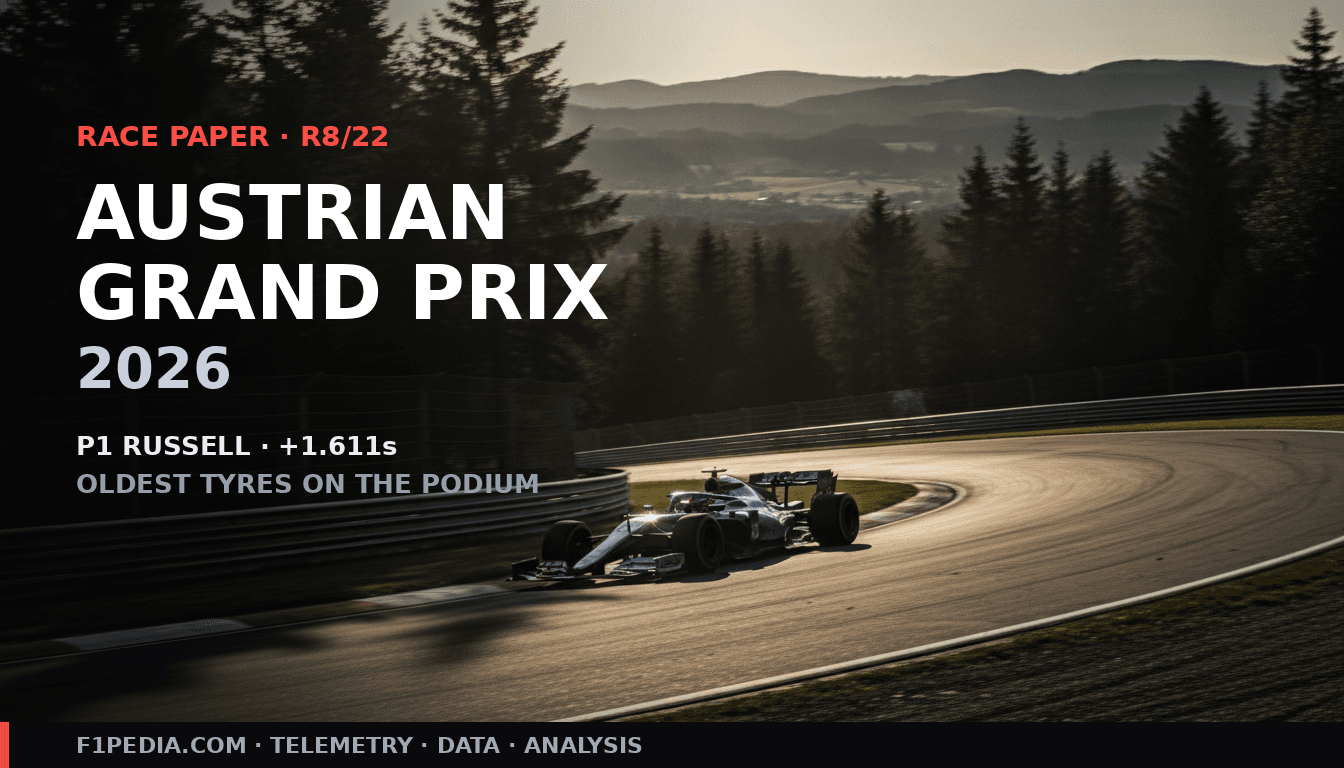
George Russell won the Austrian Grand Prix from pole by 1.611s over Max Verstappen, with Kimi Antonelli third at 1.986s. Three cars inside two seconds after 71 laps — and the fourth, Oscar Piastri, 21.809s back. But the number that explains the race isn't on the results sheet: Russell took the flag on 28-lap-old tyres, Verstappen on 22 and Antonelli on 20. He stopped first, banked track position, and then spent eighteen laps defending it on the oldest rubber on the podium.
The thesis of this paper: Mercedes won at the Red Bull Ring — a circuit built around three long full-throttle runs — with the slowest car in a straight line of the top four and the most complete car in the corners of the entire field. And under the 2026 rules, with no DRS, that combination turns a tyre disadvantage into a problem the chaser cannot solve. Verstappen was closing at 0.409s per lap at the end. He needed about four more laps.
Qualifying: the pole that Verstappen's crash left behind
Russell set 1:06.113 for pole. Behind him, a field as tight as any this year: Leclerc at +0.236, Hamilton at +0.295, Antonelli at +0.301, Verstappen at +0.362, Norris at +0.389 and Piastri at +0.398. Seven cars in four tenths. Verstappen crashed late in qualifying (Formula1.com, Motorsport.com) and started fifth on the time he already had banked.
By team, Saturday's picture was four constructors inside four tenths — Mercedes 1:06.113, Ferrari +0.236 (0.357%), Red Bull +0.362 (0.548%), McLaren +0.389 (0.588%) — and then a chasm: Racing Bulls +0.842, Alpine +1.110, Audi +1.180, Haas +1.410, Williams +2.139, Cadillac +2.832 and Aston Martin +3.829. It was Mercedes' eighth consecutive pole in eight rounds of 2026 — the streak would reach ten before McLaren ended it in Hungary — and they took it at Red Bull's own track.
View data
| R1 | R2 | R3 | R4 | R5 | R6 | R7 | R8 | |
|---|---|---|---|---|---|---|---|---|
| Mercedes | 0 | 0 | 0 | 0 | 0 | 0 | 0 | 0 |
| Ferrari | 1.03 | 0.381 | 0.591 | 0.393 | 0.4 | 0.316 | 0.086 | 0.357 |
| Red Bull | 1 | 1.019 | 1.352 | 0.189 | 0.453 | 0.06 | 0.458 | 0.548 |
| McLaren | 1.098 | 0.528 | 0.399 | 0.439 | 0.208 | 0.795 | 0.431 | 0.588 |
| Racing Bulls | 1.851 | 1.848 | 1.499 | 1.937 | 0.967 | 1.889 | 1.213 | 1.274 |
| Alpine | 2.526 | 0.879 | 1.028 | 1.098 | 1.542 | 1.631 | 2.025 | 1.679 |
| Audi | 2.169 | 1.401 | 1.365 | 1.869 | 1.802 | 2.569 | 1.458 | 1.785 |
| Haas | 2.284 | 1.231 | 1.725 | 1.756 | 2.532 | 3.707 | 2.29 | 2.133 |
| Williams | 3.086 | 2.447 | 2.421 | 1.984 | 2.335 | 2.409 | 2.949 | 3.235 |
| Cadillac | 5.205 | 3.663 | 3.861 | 4.363 | 3.928 | 3.742 | 3.838 | 4.284 |
| Aston Martin | 4.395 | 3.41 | 4.357 | 3.759 | 3.607 | 4.577 | 5.462 | 5.792 |
The race in five acts
Act 1 — The start. Russell got away cleanly from pole. Behind him there was movement: Hamilton passed Leclerc before the end of lap 1 (the lap-1 order was Russell, Hamilton, Leclerc, Antonelli, Verstappen), and Antonelli had a messy getaway, running wide several times according to Formula1.com. Verstappen, fifth, began clawing back immediately.
Act 2 — The first stop cycle (laps 19-25). Verstappen stopped first, on lap 19; Russell answered on lap 20; Antonelli stretched his MEDIUM stint to lap 25. All three fitted HARDs. That six-lap offset was the first sketch of what would decide the race.
Act 3 — Sainz's VSC (laps 25-26). Carlos Sainz's Williams stopped with an electrical failure and triggered the first Virtual Safety Car. Antonelli pitted right inside that window — and, against everything the manual says, it wasn't cheap: measuring the net cost against a car that ran through those laps without stopping (Piastri), the stop cost him 20.7 seconds. Hamilton made better use of the neutralisation for the second of his three stops and took softs.
Act 4 — The stop that won the race (laps 44-52). Russell made his final stop on lap 44. Verstappen waited until lap 50; Antonelli until lap 52 — exactly as the second VSC appeared, triggered by a bollard Albon had knocked off the track. Once again the neutralisation gave him nothing: 21.6 seconds of net cost, more expensive even than Verstappen's green-flag stop (19.2s). When the race went green again on lap 54, the order was written: Russell in front, Verstappen 8.6s back, Antonelli 13.4s back — but on tyres six and eight laps fresher respectively.
Act 5 — The last eighteen laps. That's where the real race started. Over the final green run (laps 56-71), Russell's median was 1:11.348, Verstappen's 1:10.932 and Antonelli's 1:10.659: the leader was the slowest of the three, by 0.42 and 0.69s per lap. The gap melted — lap 60: +5.68/+9.44; lap 64: +4.73/+8.09; lap 68: +3.16/+4.80; lap 70: +2.26/+2.82 — down to the official +1.611 and +1.986. Verstappen never got inside a second: his smallest gap in the entire final stint was the one at the chequered flag. At his closing rate (0.409s per lap) he needed four more laps; Antonelli, at 0.675s per lap, three.
View data
| 54 | 55 | 56 | 57 | 58 | 59 | 60 | 61 | 62 | 63 | 64 | 65 | 66 | 67 | 68 | 69 | 70 | 71 | |
|---|---|---|---|---|---|---|---|---|---|---|---|---|---|---|---|---|---|---|
| Verstappen | 8.624 | 8.327 | 8.18 | 7.16 | 6.772 | 6.137 | 5.676 | 5.391 | 5.306 | 5.174 | 4.729 | 4.186 | 3.72 | 3.63 | 3.157 | 2.766 | 2.261 | 1.675 |
| Antonelli | 13.393 | 12.941 | 12.591 | 11.558 | 11.18 | 10.411 | 9.441 | 8.77 | 8.5 | 8.483 | 8.087 | 7.146 | 6.263 | 5.737 | 4.797 | 3.779 | 2.816 | 1.917 |
The pace numbers
Clean-lap median by team (excludes lap 1, pit in/out laps, VSC windows and anything over 107%):
| Mercedes | 1:11.689 | 0.000 | 0.000 |
| Red Bull | 1:11.846 | +0.158 | 0.220 |
| McLaren | 1:11.939 | +0.251 | 0.349 |
| Ferrari | 1:11.954 | +0.266 | 0.370 |
| Racing Bulls | 1:12.999 | +1.311 | 1.828 |
| Audi | 1:13.034 | +1.346 | 1.877 |
| Alpine | 1:13.104 | +1.416 | 1.975 |
| Haas | 1:13.578 | +1.889 | 2.635 |
| Williams | 1:14.077 | +2.389 | 3.332 |
| Aston Martin | 1:14.619 | +2.931 | 4.088 |
| Cadillac | 1:14.862 | +3.173 | 4.426 |
Notes: Williams and Cadillac on reduced samples because of retirements (Sainz 16 clean laps, Pérez 2).
By driver, the lead group was tighter still: Russell 1:11.638 median, Antonelli +0.085, Verstappen +0.171, Hamilton +0.289, Piastri +0.299, Leclerc +0.333, Norris +0.496, Hadjar +0.549. Eight cars from four teams inside just over half a second — and then a 0.78s step down to ninth (Hülkenberg, +1.327). Rarely has 2026 Formula 1 looked this compressed at the front and this split in two at the same time. Fastest lap went to Antonelli: 1:10.374.
View data
| Mercedes | Red Bull | McLaren | Ferrari | Racing Bulls | Audi | Alpine | Haas | Williams | Aston Martin | Cadillac | |
|---|---|---|---|---|---|---|---|---|---|---|---|
| Gap (s/vuelta) | 0 | 0.158 | 0.251 | 0.266 | 1.31 | 1.345 | 1.415 | 1.889 | 2.389 | 2.93 | 3.173 |
Slow, medium and fast corners: where it was actually won
We classified the Red Bull Ring's apexes by minimum cornering speed (field median across each driver's best qualifying lap): slow (<140 km/h: T3 at 70.0, T4 at 101.5, T1 at 128.0), medium (T10 at 174.5, T6 at 175.5, T5 at 191.5) and fast (>200: T7 at 202.0, T9 at 226.0, T8 at 241.5). The circuit is short and corner-poor, with three long flat-out runs: on paper, an engine track that rewards skinny wings.
Average minimum-speed delta against the best in the field, by corner class (qualifying, km/h; all 11 teams, sorted by slow corners):
| Ferrari | −0.3 | −4.9 | +0.0 |
| Mercedes | −0.7 | −1.3 | −0.7 |
| McLaren | −0.7 | −7.1 | −3.7 |
| Red Bull | −3.0 | −6.2 | −2.7 |
| Haas | −3.0 | −9.2 | −8.4 |
| Racing Bulls | −3.7 | −8.6 | −7.4 |
| Audi | −3.7 | −6.5 | −7.7 |
| Alpine | −3.7 | −11.6 | −11.1 |
| Williams | −6.3 | −13.3 | −14.4 |
| Aston Martin | −6.7 | −20.9 | −27.0 |
| Cadillac | −7.7 | −16.9 | −20.4 |
Sample notes: one lap per driver (their best in qualifying); within each team we take the better of the two cars per corner. The apex labelled T2 in our database was excluded: the field minimum there is 306 km/h even at a 30 m radius — it is a flat corner in 2026 spec, not a braking point.
The reading is the clearest of the season: Mercedes was the only car with no weak class. It led none of the three, but its worst delta in any of them was 1.3 km/h — nobody else got below 2.7. Ferrari was the best car in fast corners (Leclerc set the field's best speed at T6, T7, T8 and T9, and at T1 as well) and effectively tied in slow ones, but paid −4.9 in medium corners, precisely the class that dominates sector 2. McLaren was as good as Mercedes in slow corners (Norris had the field's best speed at T3 and T4) and collapsed in the medium class (−7.1). Red Bull lost evenly everywhere (−3.0/−6.2/−2.7) — Verstappen's race pace came from somewhere other than cornering speed.
At the back the pattern repeats with brutal clarity: the losses grow with corner speed. Aston Martin goes from −6.7 in slow corners to −27.0 in fast ones and Cadillac from −7.7 to −20.4; Haas, by contrast, is genuinely competitive in the slow class (−3.0, level with Red Bull) and collapses in the other two; the worst of the midfield in fast corners is Alpine, at −11.1. It's the signature of downforce: in slow corners you can paper over it mechanically, in fast corners there is nowhere to hide.
View data
| Lentas | Medias | Rápidas | |
|---|---|---|---|
| Ferrari | -0.3 | -4.9 | 0 |
| Mercedes | -0.7 | -1.3 | -0.7 |
| McLaren | -0.7 | -7.1 | -3.7 |
| Red Bull | -3 | -6.2 | -2.7 |
| Haas | -3 | -8.6 | -10.7 |
| Racing Bulls | -3.7 | -8.6 | -7.4 |
| Audi | -3.7 | -7.5 | -7.7 |
| Alpine | -3.7 | -11.6 | -11.1 |
| Williams | -6.3 | -13.3 | -14.4 |
| Aston Martin | -6.7 | -20.9 | -27 |
| Cadillac | -7.7 | -16.9 | -20.4 |
Straights and energy: the slowest car of the top four in a straight line won
This is the heart of the paper. Qualifying trap speed, median by team: Williams 291 km/h, Red Bull 288, Cadillac 280, Ferrari 275, Racing Bulls 269, Alpine 268, Aston Martin 263, McLaren 261, Mercedes 259, Haas 259, Audi 255. Mercedes was, alongside Haas, the second slowest car in the field on the straights — 32 km/h down on Williams — and still took pole by 0.236s. (The highest individual peak of the weekend was also Russell's, 323 km/h, with a tow.)
In the race the pattern holds and becomes decisive. Median trap speed over the final stint (laps 55-71): Gasly 310, Norris 309, Hadjar 308, Lindblad 307, Antonelli 306, Verstappen 306, Piastri 305, Russell 304. In other words: through the eighteen laps in which Verstappen ate eight seconds, the Red Bull was 2 km/h faster down the straight than the Mercedes it was chasing — and under the DRS-free 2026 rules, two kilometres per hour is not enough to build an attack.
The sector breakdown over that same run (median, laps 56-71) says exactly where Russell was losing: S1 17.254 against Verstappen's 17.222 (+0.032), S3 21.891 against 21.783 (+0.108), and S2 32.121 against 31.905 (+0.216). Two thirds of his deficit sat in sector 2 — the medium and fast corner stretch where 28-lap-old tyres show up — not on the straights. Russell was defending where his car was good and losing where his rubber was old: the exact definition of a race run on the limit.
Strategy: the longest undercut of the year
All three podium finishers ran the same strategy — MEDIUM, HARD, HARD, two stops — and won or lost it on the clock:
| Russell | v20 | v44 | 28 vueltas |
| Verstappen | v19 | v50 | 22 vueltas |
| Antonelli | v25 | v52 | 20 vueltas |
Russell took the aggressive call: stop six laps before Verstappen and eight before Antonelli, cash in the track position, and accept finishing on the most worn tyres on the podium. The bet paid out by 1.611 seconds — and the real margin, measured in laps remaining, was four.
On the other side of the coin, Antonelli ran the fastest race of the three (best median of the trio in the final stint, the outright fastest lap, the freshest tyres) and finished third, because both of his stops fell inside the two VSCs and neither gave him a discount: 20.7s of net cost on the first and 21.6s on the second, against the 19.2s Verstappen paid to stop under green. A Virtual Safety Car normally makes a stop cheaper; here it made it dearer.
Hamilton and Leclerc tried the three-stop route and finished fifth and eighth. Leclerc's ended with fresh softs over the final twelve laps — which gave him the best compound median of the day (1:10.870 on SOFT) and no positions at all.
Upgrades: who brought what to Spielberg
The round carried 41 declared items, split in a way that says more about the championship than about the race: Cadillac 10, Audi 7, Red Bull 7, Alpine 5, Ferrari 4, Haas 2, McLaren 2, Mercedes 2, Racing Bulls 2 — and Williams and Aston Martin, zero. Mercedes again took pole and the win on two declared items, the same pattern they would repeat at Silverstone with none at all. Cadillac brought the biggest package of the weekend — 10 items, including brake cooling work — and had both cars out before lap 5, for brake overheating precisely.
The retirements
Four cars failed to finish: Bottas (lap 2) and Pérez (lap 4), both Cadillacs, with overheating brakes — the team's first double retirement of 2026, with Bottas stopping in the pit lane; Sainz (lap 23), Williams, with an electrical failure that also caused the first VSC; and Stroll (lap 45), Aston Martin, with a battery/ERS problem. The causes come from the press: our race-control log records the neutralisations, not the reasons. The context our own data does hold: Cadillac had already lost one car in R1, R5, R6 and R7 — Austria was the round where they lost both.
The hypotheses, in short
"Russell won on track position, not pace" — Confirmed, with a number. His clean-lap median was the best in the field (1:11.638), but in the stint that decided the race he was the slowest of the three podium finishers by 0.42 and 0.69s per lap. What held him up was having stopped first, and the margin was four laps.
"The Red Bull Ring rewards power" — Rejected for 2026. The winner was the slowest car of the top four on the straights (259 km/h qualifying median, 32 down on Williams), and it won by being the only one without a weak corner class (worst delta: 1.3 km/h). Without DRS, the straight-line advantage stopped converting into overtakes.
"The VSC helped Antonelli" — Rejected, which is what makes it interesting. Both of his stops landed in the two neutralisations and cost him 20.7 and 21.6 net seconds, dearer than Verstappen's green-flag stop (19.2). With the freshest tyres on the podium and the fastest lap, he finished third.
"Ferrari had the car to fight for it" — Partial. It was the best fast-corner car in the field (Leclerc, best speed at T6, T7, T8 and T9) and second in qualifying, but its −4.9 km/h medium-corner deficit lines up with the sector where race time is lost, and the three-stop call left them fifth and eighth.
What this data does NOT say
Sources
- Formula1.com — Russell seals victory in thrilling Austrian Grand Prix ahead of Verstappen and Antonelli
- Motorsport.com — F1 Austrian GP: George Russell holds off charging Max Verstappen
- FIA — Russell wins closely contested Austrian Grand Prix
Every figure comes from reproducible queries; press claims are attributed.