Antonelli, 2026 champion: the story of the youngest title and why he beat Russell in the same car
Champion at 20 years and 68 days, with four races to go and 130 points over his team-mate. From Bologna to Brackley, the year of the tears in 2025, the 19 races of 2026, and the question that matters, measured corner by corner: in the same car, where did Antonelli beat Russell.
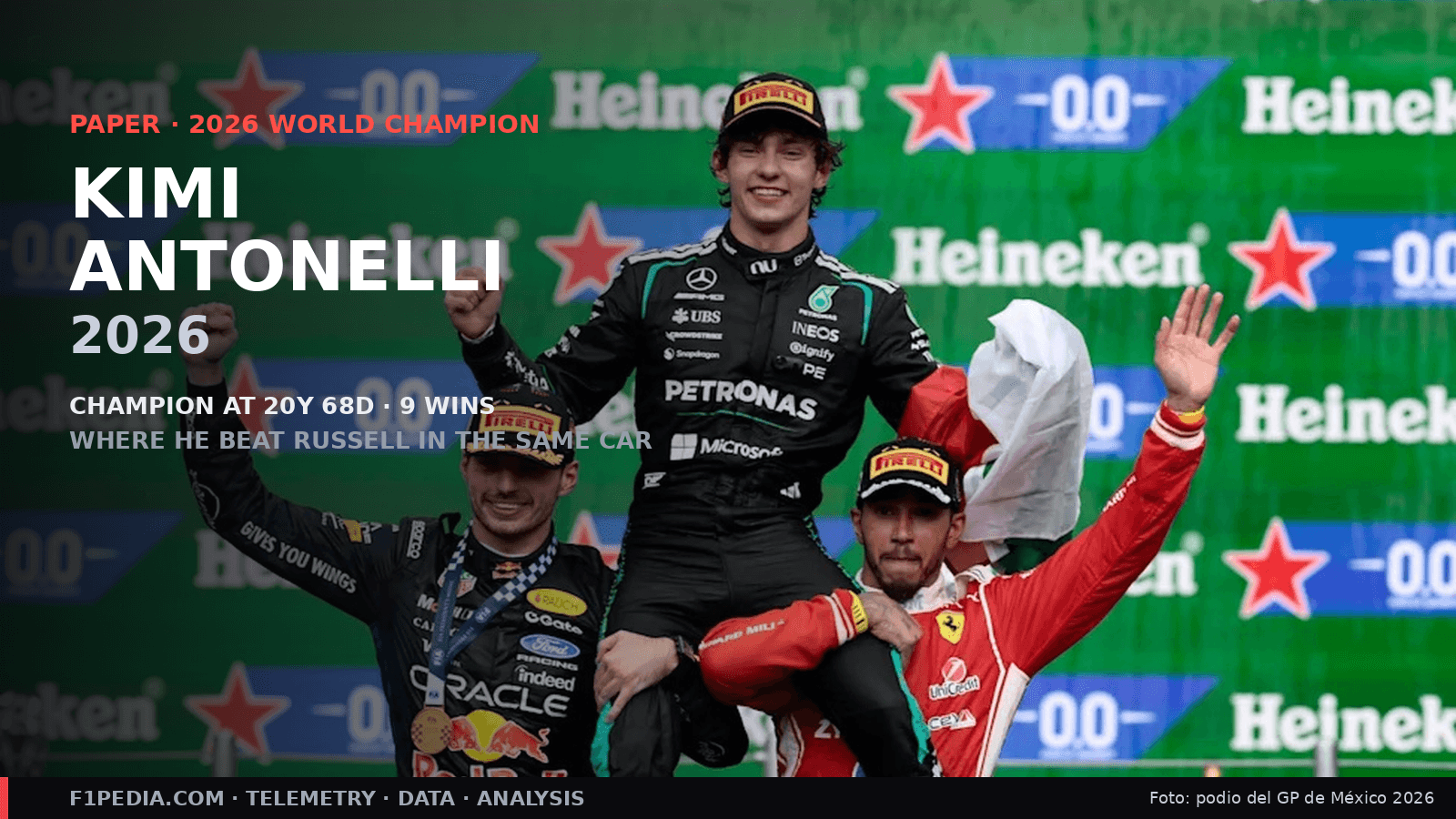
Kimi Antonelli is Formula 1 world champion at 20 years and 68 days, with four races to go: nine wins, a Sprint, 16 podiums, seven poles and 380 points in 19 Grands Prix. Sebastian Vettel was 23 years and 134 days old when he won his first title in 2010; Alberto Ascari was the last Italian champion, in 1953. Yes, Mercedes built the best car of the new rules. But the same car was driven by George Russell, 28, with three wins, 250 points and two poles fewer. This paper tells where Antonelli comes from, how the year went, and then asks the question that matters: with two equal cars, where did he beat his team-mate. The answer, measured corner by corner, is that Antonelli was faster in the slow corners and on the straights, managed his tyres better and started better; Russell was faster in the fast corners and in qualifying at the tracks he likes, and it was not enough.
From Bologna to Brackley
Andrea Kimi Antonelli was born on 25 August 2006 in Bologna. He started karting at five and Mercedes signed him to its young driver programme before he turned 12: "they signed me at 11 or 12", he said in Mexico. In 2019 he won six international titles in the OK-Junior class and in 2020 he became the youngest senior European champion in history, a title he defended in 2021. That same year he made his debut in Italian Formula 4 with Prema; in 2022 he won the championship with 13 wins, a record at the time, plus the German championship and gold for Italy at the FIA Motorsport Games. In 2023 he moved up to Formula Regional and won both championships he entered, the Middle East and the European one, again in his first season. Mercedes and Prema decided to skip Formula 3 and in 2024 put him in Formula 2 alongside Oliver Bearman: two wins, Silverstone and Budapest, and sixth in the championship. It was not the dominant year of the categories before, but the team had already decided.
2025: the year of the tears
When Lewis Hamilton told Toto Wolff he was leaving for Ferrari, the reaction, according to Wolff himself, was immediate: "we have to put Antonelli in the car". He made his debut in Australia 2025 at 18 and finished fourth. Then came the hard part: with the team far from McLaren, there was a run of races without points in mid-season, four retirements between Imola and Silverstone, and at Spa he went out in Q1 and cried in parc fermé. "The many people that said he shouldn't be in a Mercedes; people in other teams that said he shouldn't even be in Formula 1", Wolff recalled in Mexico. He finished seventh in the championship with 150 points and three podiums, third in Canada, second in São Paulo and third in Las Vegas, the youngest fastest lap in history in Japan and a Sprint pole in Miami. Russell, in the same car, scored 319, won two races and was fourth.
2026, race by race
The new rules changed the order. Russell won the first race, in Australia, from pole, with Antonelli second. And then Antonelli won five in a row: China, with the youngest pole in history and his first win; Japan, where he lost five places at the start and won anyway; Miami; Canada, where Russell retired from pole; and Monaco, with a grand chelem, pole, win, fastest lap and all 78 laps in the lead. After six races he had 156 points to 88.
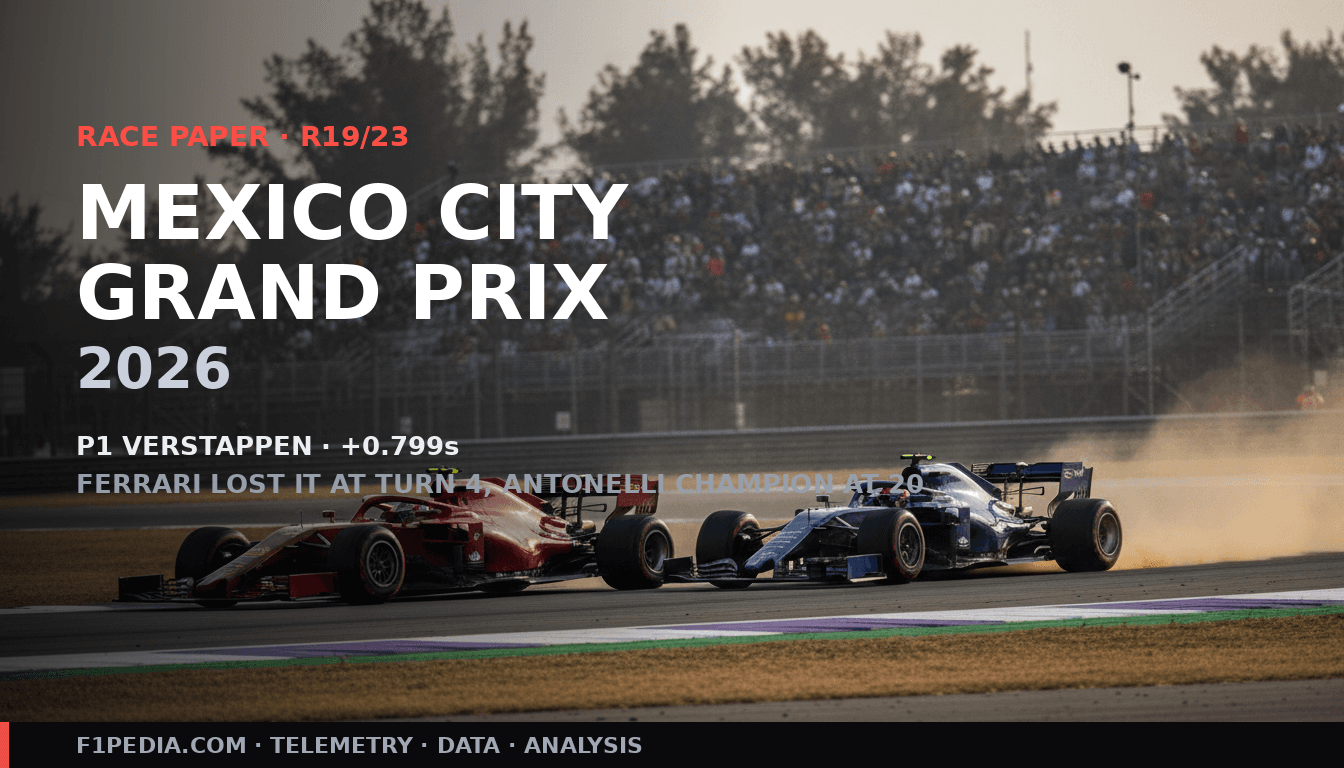
The summer was the only crack. In Barcelona he retired on lap 62 while running second and Hamilton won Ferrari's first; in Austria he was third behind Russell, who won from pole; at Silverstone he took pole, won the Sprint and set the fastest lap, but a broken brake-duct deflector cost him three stops in nine laps and he finished 15th. Three races, 15 Grand Prix points, and Russell 25 behind. The answer was Spa: pole and win with a pass on Leclerc at Kemmel on lap 34, while Russell was out at the first corner with the battery. Third in Hungary from seventh on the grid, second at Zandvoort with the fastest car of the Sunday, and Monza: 19th on the grid with a 30-place engine penalty and the winner by 3.857s over Russell, with two neutralisations that made the comeback cheaper. Madrid was another win, by 4.351 over Verstappen.
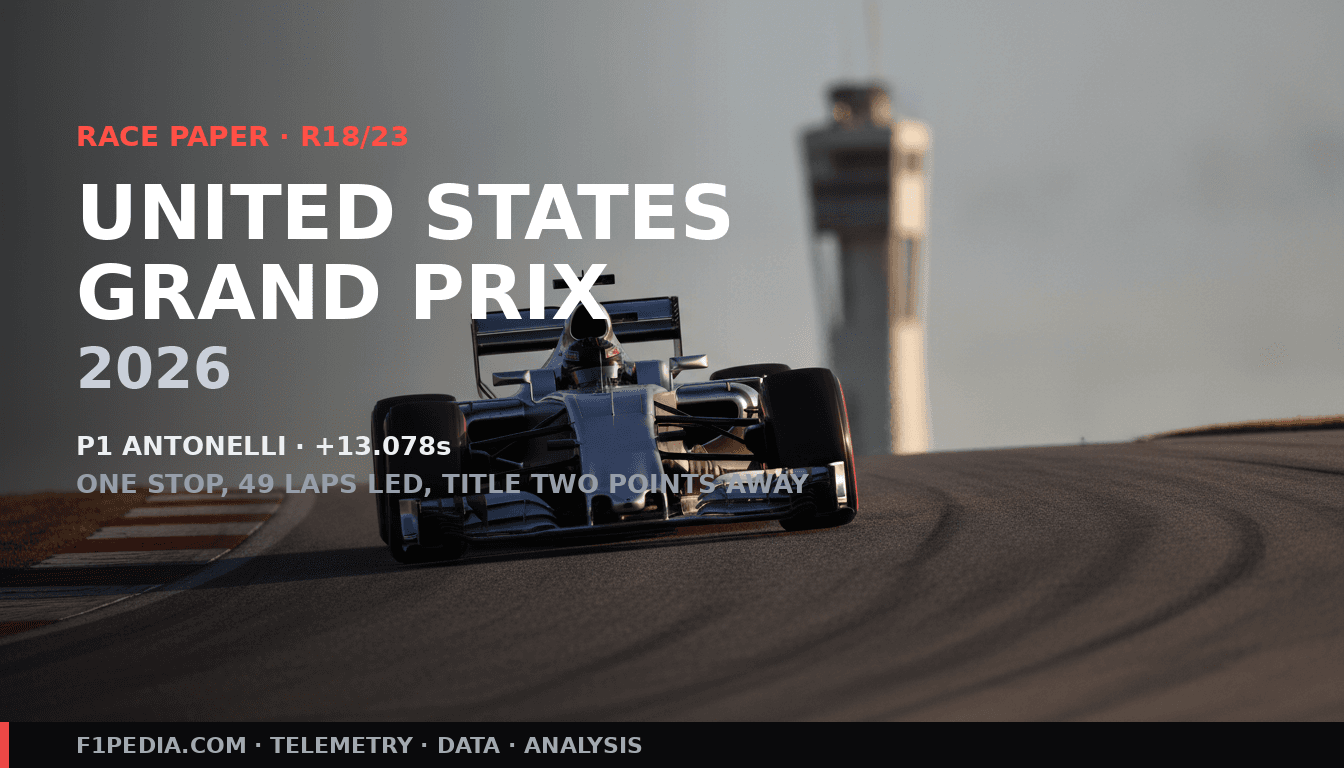
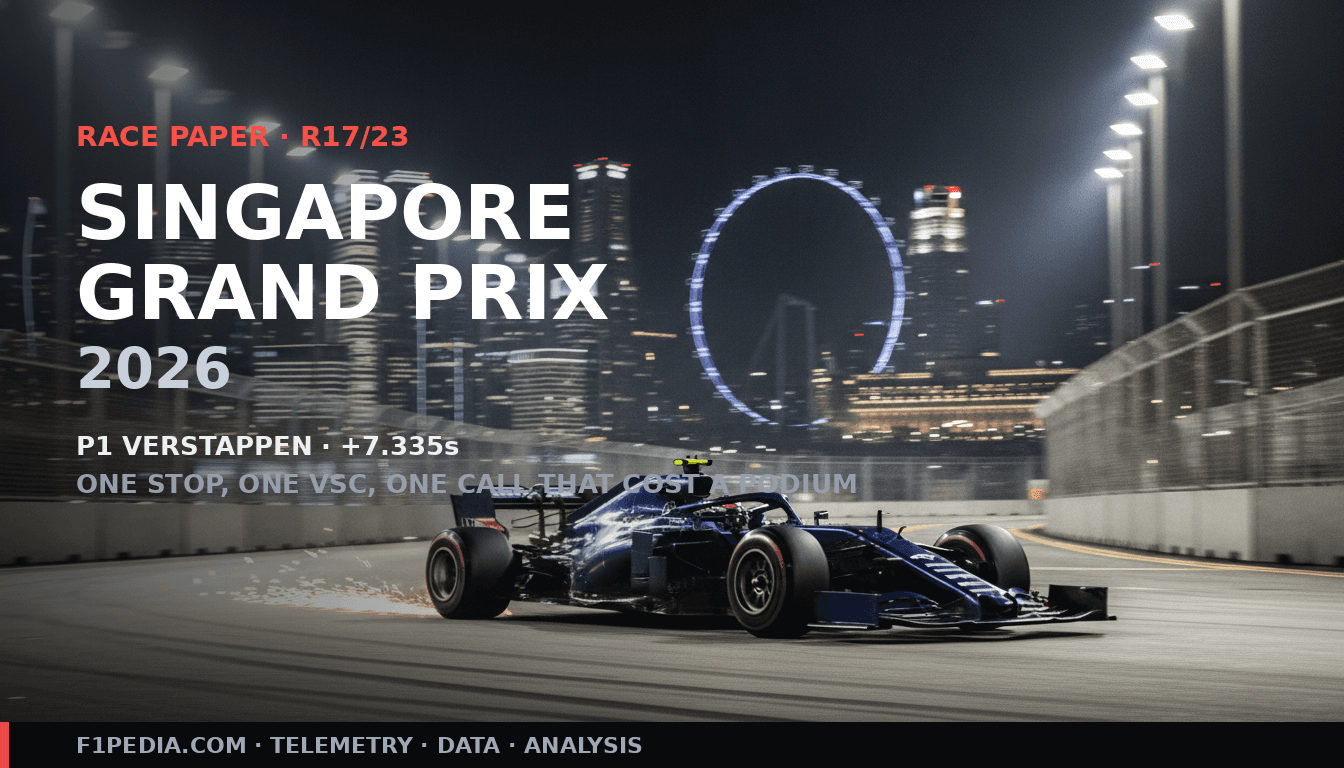
He managed the autumn. He crashed in qualifying in Baku, started 16th and came fifth on the day Russell won; he was second in Malaysia, third in Singapore, won in Austin from pole with a single stop and in Mexico, third, closed out the title. In 19 races he finished 18 and stood on the podium in 16; Russell retired three times and finished out of the points in Monaco. The final gap, 130 points, is bigger than the total of any driver outside the top seven.
View data
| R1 | R2 | R3 | R4 | R5 | R6 | R7 | R8 | R9 | R10 | R11 | R12 | R13 | R14 | R15 | R16 | R17 | R18 | R19 | |
|---|---|---|---|---|---|---|---|---|---|---|---|---|---|---|---|---|---|---|---|
| Antonelli | 18 | 47 | 72 | 100 | 131 | 156 | 156 | 171 | 179 | 204 | 219 | 242 | 267 | 292 | 302 | 320 | 340 | 365 | 380 |
| Russell | 25 | 51 | 63 | 80 | 88 | 88 | 106 | 131 | 154 | 154 | 160 | 183 | 201 | 211 | 236 | 236 | 238 | 242 | 250 |
Antonelli versus Russell, in numbers
| Puntos | 380 | 250 |
| Victorias | 9 | 3 |
| Victorias en Sprint | 1 | 3 |
| Podios | 16 | 8 |
| Poles | 7 | 5 |
| Clasificación, mejor de los dos | 11 | 8 |
| Carrera, mejor de los dos | 15 | 4 |
| Vueltas lideradas | 430 | 235 |
| Abandonos | 1 | 3 |
| Lugares ganados en la vuelta 1 | -4 | -19 |
Nineteen Grands Prix. The qualifying head-to-head counts who started ahead in each session; the race one, who finished ahead, retirements included. Lap-1 places are the sum of grid position minus position at the end of the first lap over every race with data (18 for Antonelli, 17 for Russell).
Sprints are the only column Russell wins, 3 to 1, and qualifying is close: Antonelli was ahead 11 times and was, on average, 0.123s faster across the 18 sessions in which both set a time, with Baku left out because of his crash. Russell's poles came in Australia, Canada, Barcelona, Austria and Baku: circuits of fast corners or long street layouts. Antonelli's, in China, Japan, Miami, Monaco, Silverstone, Spa and Austin. Where the difference gets big is on Sunday: in 15 of the 19 races Antonelli finished ahead.
View data
| R1 | R2 | R3 | R4 | R5 | R6 | R7 | R8 | R9 | R10 | R11 | R12 | R13 | R14 | R16 | R17 | R18 | R19 | |
|---|---|---|---|---|---|---|---|---|---|---|---|---|---|---|---|---|---|---|
| Antonelli − Russell | 0.293 | -0.222 | -0.298 | -0.399 | 0.068 | -0.394 | 0.319 | 0.301 | -0.37 | -0.508 | -0.281 | 0.031 | 0.247 | -0.314 | -0.24 | -0.185 | -0.441 | 0.184 |
Where he beat him: slow corners and straights
To measure where that difference was made we used the method of our race papers. At each Grand Prix we measured how long each of them took through each corner on every clean lap (100 metres before and after the apex, without overlapping the neighbouring corner), classified the corners by the speed at which they were taken (slow under 110 km/h, fast above 215) and estimated the difference between the two with a model that discounts compound, tyre age and fuel. That leaves eleven races in which both ran at least 35 clean laps and the model closes: Australia, China, Japan, Miami, Barcelona, Austria, Silverstone, Zandvoort, Singapore, Austin and Mexico. Left out are Monaco and Hungary, where the telemetry does not allow the corners to be isolated; Madrid and Malaysia, with no corner map; Spa and Canada, where Russell retired early; Monza, where the model does not separate; and Baku, where Antonelli spent the race in traffic.
| Australia | +0.11 | +0.03 | -0.22 | +0.23 | +0.14 |
| China | +0.28 | +0.12 | -0.05 | -0.27 | +0.07 |
| Japón | -0.07 | -0.32 | -0.09 | +0.46 | -0.02 |
| Miami | +0.49 | +0.28 | -0.12 | -0.10 | +0.54 |
| Barcelona | +0.21 | -0.28 | -0.10 | +0.12 | -0.04 |
| Austria | -0.08 | -0.03 | +0.01 | +0.12 | +0.02 |
| Silverstone | +0.12 | +0.01 | -0.03 | +0.20 | +0.30 |
| Zandvoort | -0.13 | +0.07 | -0.04 | +0.12 | +0.02 |
| Singapur | +0.54 | +0.93 | -0.14 | -0.21 | +1.12 |
| Austin | +0.54 | +0.28 | +0.09 | -0.08 | +0.83 |
| México | +0.10 | +0.15 | 0.00 | +0.02 | +0.28 |
| Promedio | +0.19 | +0.11 | -0.06 | +0.06 | +0.30 |
Russell's seconds per lap against Antonelli, corrected for compound, tyre age and fuel; a positive value means Russell was slower. The columns add up to the lap, bar rounding. Mexico has no fast corners by our criterion. The margin of error of each lap is between ±0.06 and ±0.22s.
The average says Russell was three tenths a lap slower in the races, and it says where: two tenths in the slow corners, one in the medium ones, and a small further loss on the straights, which under the 2026 rules are as much a matter of how the battery's energy is managed as of the engine. The only thing Russell did better, in eight of the ten races with fast corners, was precisely that: the fast corners, by between three hundredths and two tenths a lap. It is not enough because there are fewer fast corners than slow ones and because the edge is small. It also says when: in the first half of the year the two were almost always within the margin of error, with Miami the exception, and in Singapore and Austin the gap opened to more than eight tenths a lap, on tracks of slow and medium corners. The corner-by-corner comparison of each race is in each Grand Prix's telemetry; Mexico's, in the race telemetry.
View data
| Australia | China | Japan | Miami | Barcelona | Austria | Silverstone | Zandvoort | Singapore | Austin | Mexico | |
|---|---|---|---|---|---|---|---|---|---|---|---|
| Curvas / Corners | -0.088 | 0.342 | -0.482 | 0.647 | -0.164 | -0.098 | 0.098 | -0.1 | 1.333 | 0.902 | 0.256 |
| Rectas / Straights | 0.231 | -0.27 | 0.458 | -0.104 | 0.121 | 0.116 | 0.198 | 0.117 | -0.212 | -0.076 | 0.024 |
View data
| Curvas lentas / Slow | Curvas medias / Medium | Curvas rápidas / Fast | Rectas / Straights | Vuelta / Lap | |
|---|---|---|---|---|---|
| Russell − Antonelli | 0.191 | 0.113 | -0.064 | 0.055 | 0.295 |
How he managed the tyres
The same model, applied to the lap times of the 17 races with data for both, allows one more question: whose tyre wore faster? We added a term that measures how much more Russell lost than Antonelli for every lap of tyre age. In ten races the difference was nil. In five, Russell's tyre lost between 25 and 58 thousandths a lap more than Antonelli's: Monaco, Austria, Silverstone, Baku and Austin. In two, Zandvoort and Singapore, it was the other way round, 22 and 30 thousandths in Russell's favour. The examples are in the papers: in Austin, Antonelli did 32 laps on hards that got 12 thousandths a lap faster while Norris, on the same compound, lost 33; in Mexico he stretched his softs for 43 laps with no measurable degradation and led 16 of them. Austin's single stop and Mexico's long stint were not strategy alone: they were a tyre that lasted.
The starts
Lap 1 is the other place where they split. We counted the places gained against the grid at the end of the first lap: Antonelli lost 4 places in total over 18 starts, Russell 19 over 17. Antonelli had one bad one, Japan, where he dropped from pole to sixth and recovered the race; and one very good one, Monza, with five places from 19th. Russell had Hungary, 13 places lost from sixth on the grid, and Mexico, three places on the first straight with an energy delivery problem that Mercedes took on itself. "Today was another race where we didn't give him the platform to show what he could do", said Wolff.
The context: the best car and the new rules
Mercedes won 12 of the 19 Grands Prix and 12 of the 19 poles. In our clean-lap medians it was the fastest car on most Sundays of the first half of the year, and Ferrari and Red Bull caught it in the autumn: in Austin and Mexico, corrected for tyres, Hamilton, Verstappen and Antonelli were within a tenth. Wolff thinks the new rules helped Antonelli because everyone had to learn a new car at the same time, and admits he did not expect this level: "I still don't know what has happened over the winter". The other reading is Russell's own, whom Wolff saw "distraught" on the FIA scales after Mexico, and who went to congratulate his team-mate: for Wolff, "a great show of sportsmanship".
The hypotheses, in short
One: in the same car, Antonelli was three tenths a lap faster in the races, and the difference lives in the slow and medium corners and in the energy management on the straights.
Two: Russell is faster in the fast corners and often was on Saturday, but Formula 1 is decided on Sunday and on 15 of 19 Sundays he finished behind.
Three: the title was built in the spring, five wins in a row, and defended in the summer with the one column not measured in hundredths: finishing races, 18 of 19.
What this data does NOT say
Sources
- Sky Sports — Kimi Antonelli becomes F1 world champion: couldn't see through his tears on final lap
- Sky Sports — Toto Wolff explains Kimi Antonelli turnaround after 'tears' in Belgium 2025
- Sky Sports — Toto Wolff says Russell was 'distraught' after Antonelli sealed the title
- Formula1.com — What the teams said – Race day in Mexico City 2026
- Wikipedia — Andrea Kimi Antonelli
- F1pedia — Race Papers 2026 (Barcelona, Silverstone, Spa, Monza, Baku, Austin)
Every figure comes from reproducible queries; press claims are attributed.
Related