

 Dutch
Dutch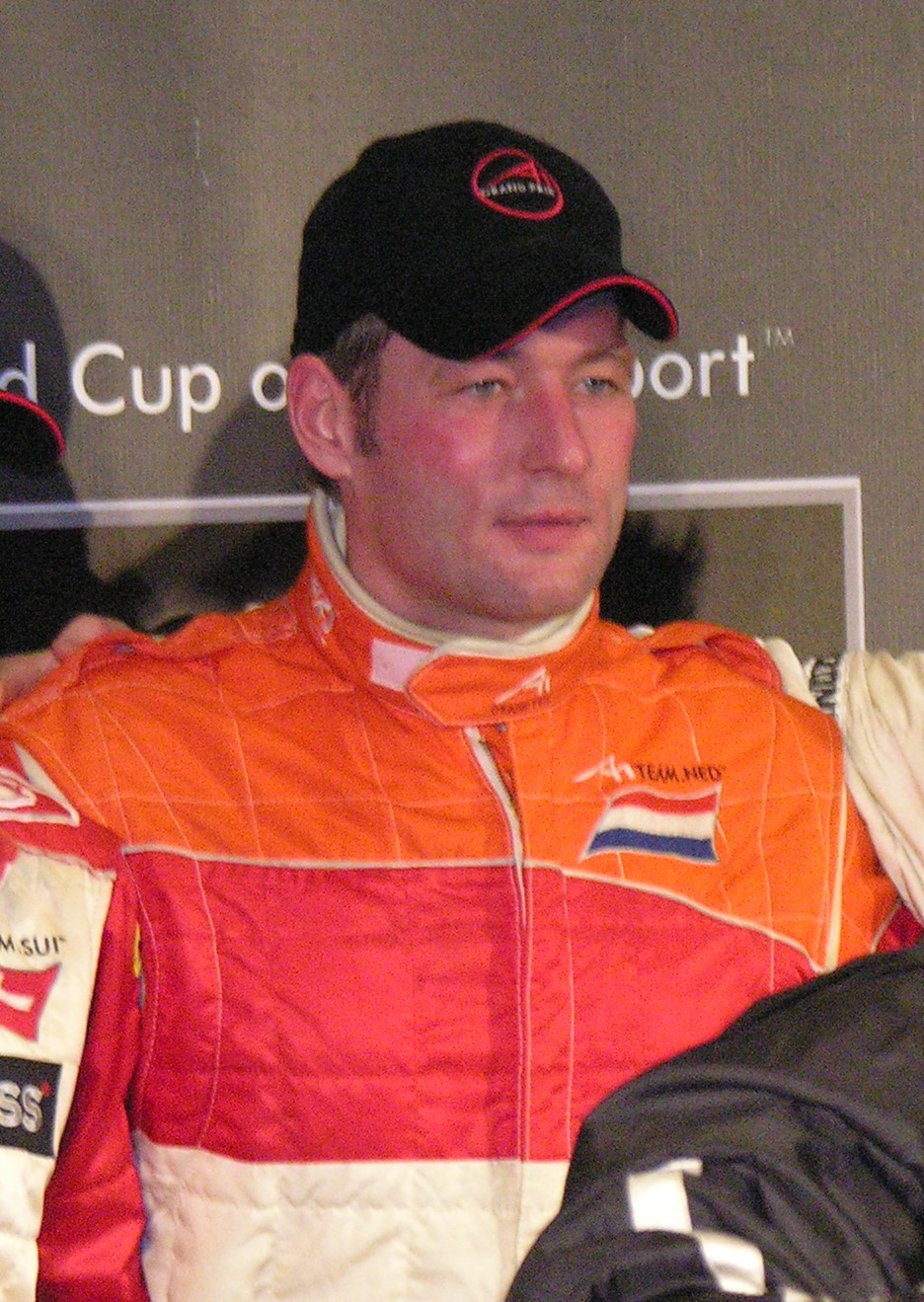
About Jos Verstappen
Johannes Franciscus "Jos" Verstappen, a pivotal figure in Dutch motorsport, forged a diverse racing career spanning Formula One, endurance racing, and rallying. Born on March 4, 1972, in Dutch Limburg, Verstappen's journey from a karting prodigy to a Grand Prix competitor, and later a Le Mans winner, is notable. His career, marked by flashes of speed and challenging team circumstances, also laid the foundation for his son Max Verstappen's ascent in Formula One.
Early Career and Formula One Ascent
Verstappen began competitive karting at age eight, quickly achieving national success as the Dutch junior champion in 1984. His karting career culminated in winning two senior European Championships in 1989, a record unsurpassed until his son Max in 2013. Transitioning to car racing in late 1991, Verstappen excelled in Formula Opel Lotus, winning the Benelux Championship and the EFDA Nations Cup in 1992. In 1993, he dominated German Formula Three, securing the championship title in his rookie season with Opel and winning the prestigious Masters of Formula 3. His talent attracted Formula One attention, leading to a test with Footwork Arrows in September 1993. Despite the significant power increase, Verstappen's lap times were remarkably competitive, with his best effort only 0.07 seconds slower than regular driver Derek Warwick's qualifying time at the same circuit, demonstrating immediate adaptability to F1 machinery.
Formula One Career (1994-2003)
Verstappen joined Benetton as a test driver for 1994, making his unexpected Formula One debut at the Brazilian Grand Prix, substituting for the injured JJ Lehto. His first race involved a multi-car collision, though he was unharmed. A significant incident occurred at the German Grand Prix, where his car was engulfed in flames during a pit stop due to a fuel leak, an event that prompted modifications to fuel delivery safety systems. Despite the challenges, Verstappen achieved two podium finishes in his rookie season: a third place at the Hungarian Grand Prix, making him the first Dutch driver to score a Formula One podium, and another third at the Belgian Grand Prix following Michael Schumacher's disqualification. He also secured a fifth place in Portugal. For the final two races, he was replaced by Johnny Herbert. In 1995, Verstappen was loaned to Simtek by Benetton team principal Flavio Briatore. Technical difficulties hampered his performances, and the team's bankruptcy after five rounds left him without a race seat. He returned to test for Benetton and Ligier but was not retained for 1996. He secured a full-time drive with Footwork in 1996, scoring a sixth-place finish in Buenos Aires. A heavy crash at the Belgian Grand Prix, caused by a suspension failure, resulted in a prolonged neck injury. The team's acquisition by TWR and the subsequent availability of Damon Hill led to Verstappen's departure. For 1997, Verstappen moved to Tyrrell, a team struggling with an underpowered engine and limited funding. He failed to score points, with his best result an eighth place at Monaco. The team's sale to British American Tobacco ultimately led to his replacement by a pay driver for 1998. In 1998, after testing for Benetton, Verstappen returned to F1 mid-season, replacing Jan Magnussen at Stewart. However, the uncompetitive car yielded no points, and he was again without a drive for the following season. The 1999 season saw Verstappen as a test driver for the Honda Formula One project. The promising venture was aborted after the death of technical director Harvey Postlethwaite, with Honda shifting to an engine supplier role. A subsequent test for Jordan proved underwhelming, leaving him without a race seat. Verstappen returned to Arrows for the 2000 and 2001 seasons. The 2000 car, while often unreliable, demonstrated good straight-line speed. He scored points with a fifth-place finish in Canada and a strong fourth at Monza. In 2001, despite a more reliable package, Verstappen occasionally struggled in qualifying. Highlights included a superb start at Sepang, running second from 18th, and scoring the team's only point with a sixth-place finish at the A1-Ring. Incidents included a collision with Juan Pablo Montoya at Interlagos. He was re-signed for 2002 but was dropped at the eleventh hour for Heinz-Harald Frentzen. A potential test with Sauber was also thwarted by his physical size relative to the car. His final Formula One season was in 2003 with Minardi, a team operating with limited funds and underpowered engines at the rear of the grid. His best result was ninth in Canada. Notably, he achieved Minardi's only provisional pole position in the first qualifying session of the French Grand Prix by capitalizing on a rapidly drying track. He left the team at the end of the year, unwilling to continue racing in uncompetitive machinery. Across 107 Grands Prix, Jos Verstappen achieved two podiums and scored 17 championship points (equivalent to 117 under the modern system), making him the second-best performing Dutch driver in Formula One history, behind his son Max. His highest qualifying position was sixth at the 1994 Belgian Grand Prix.
Post-Formula One and Endurance Racing
Following his Formula One career, Verstappen diversified his racing pursuits. He competed in the 2005–06 A1 Grand Prix series for A1 Team Netherlands, securing a feature race victory in Durban, South Africa. He later departed the team due to payment disputes. In 2008, Verstappen transitioned to sportscar racing, competing in the Le Mans Series and the 24 Hours of Le Mans in the LMP2 class with Van Merksteijn Motorsport. Driving a Porsche RS Spyder, he won multiple races, including the 1000km Catalunya, 1000km Spa, and 1000km Nurburgring, ultimately clinching the LMP2 Drivers' title. The highlight was his victory in the LMP2 class at the 2008 24 Hours of Le Mans. He also participated in the 2009 24 Hours of Le Mans. More recently, Verstappen has engaged in rallying, competing in the 2022 Ypres Rally and the European Rally Championship since 2025 as a privateer.
Personal Life and Public Scrutiny
Verstappen's personal life has attracted significant public attention, particularly concerning his family and a series of legal challenges. He has been married three times and has five children, including Formula One World Champion Max Verstappen and racing driver Victoria Verstappen. Since 2002, Verstappen has been deeply involved in coaching and managing his son, Max, from his early karting days. This intense mentorship has been described by some in Formula One as "tough love," while others have characterized it as "child abuse." The source details allegations of physical beatings and specific incidents, such as Verstappen reportedly making Max's kart perform worse or insisting he drive in freezing conditions. Max himself recounted an incident in 2012 where, after a karting crash, his father abandoned him at a fuel station before returning, and subsequently did not speak to him for a week. Jos Verstappen has denied abusing Max, and journalist Erik van Haren reports that Max publicly maintains a good relationship with his father.
Legal Challenges
Verstappen has faced several legal challenges. In 1998, following a karting track incident, he and his father, Frans, were found guilty of assault, receiving a five-year suspended jail sentence after an out-of-court settlement. In December 2008, after separating from Sophie Kumpen, Verstappen was charged with assaulting her. He was found not guilty of assault but guilty of threatening her via text messages and violating a restraining order, resulting in a fine and a suspended prison sentence. In January 2009, he received another suspended sentence and fine for similar offenses. In 2011, allegations surfaced that Verstappen assaulted an unnamed 24-year-old girlfriend. In January 2012, he was arrested on attempted murder charges following accusations he drove a car into his ex-girlfriend, causing heavy injuries. He was released two weeks later after the charge was withdrawn, though he also faced accusations of destroying her property. He later reconciled with Kelly van der Waal, whom he married in 2014. In July 2016, reports alleged Verstappen physically attacked his father, Frans, who filed a police complaint. Frans later withdrew the complaint, stating it was a private matter.