

 British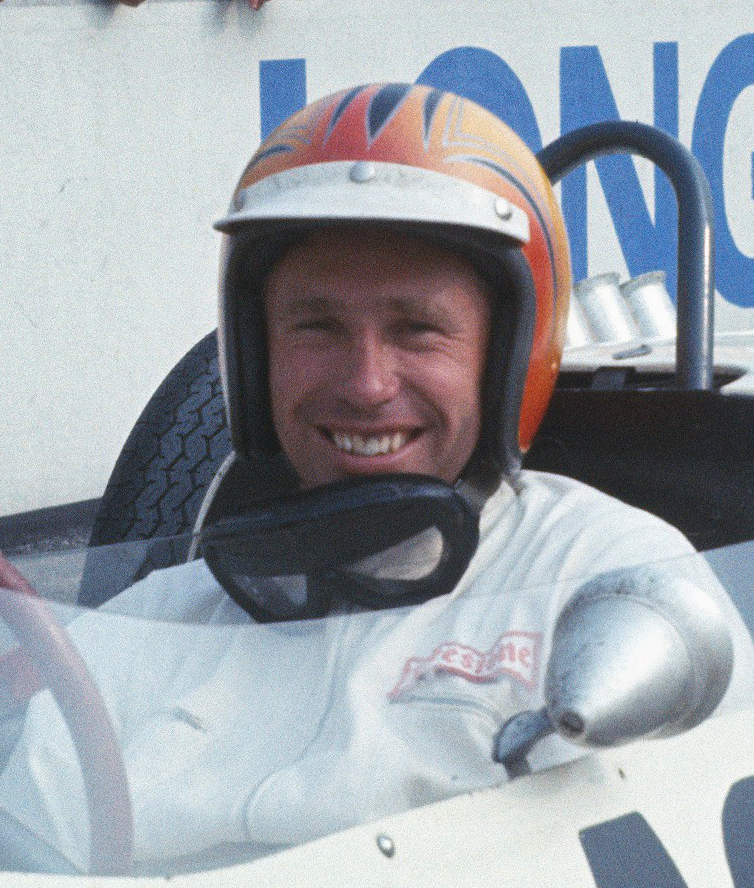
Signature numbers
- Win rate
- 0.0%
- Podium rate
- 2.8%
- Race starts
- 36
- Total points
- 27
Era
About Mike Spence
Introduction
Mike Spence was a British racing driver whose career, though tragically cut short, spanned a significant period of Formula One and sports car racing. Born Michael Henderson Spence in Purley, Surrey, on December 30, 1936, he participated in 37 Formula One World Championship Grands Prix, achieving a single podium finish and accumulating a total of 27 championship points. His racing endeavors extended beyond the Grand Prix circuits, encompassing numerous non-Championship Formula One events and a notable presence in sports car racing.
Early Career Foundations
Spence's journey into motorsport began with an early immersion in racing, initially competing in his father's Turner and an AC Ace sports car. This foundational experience in sports car machinery laid the groundwork for his transition to open-wheel racing. In 1960, he entered the competitive world of Formula Junior, a crucial stepping stone for aspiring Grand Prix drivers. His talent quickly became apparent, leading to opportunities in non-Championship Formula One races. In 1961, Spence piloted an Emeryson in two such events. At the Solitude Grand Prix near Stuttgart, his race was curtailed by a gearbox failure, forcing an early retirement. However, he demonstrated his potential at the Lewis-Evans Trophy at Brands Hatch, where he secured an impressive second place, finishing only behind Tony Marsh, who was driving a BRM. These promising performances opened doors for Spence, leading to a move to the privateer Ian Walker Racing Formula Junior team in 1962, where he competed in a Lotus 22. The following year, 1963, saw him join the prestigious works Lotus Formula Junior squad, a testament to his growing reputation. Despite this significant step, his initial season with the factory team yielded somewhat disappointing results in Formula Junior, with his best finish being a fourth place in the British Grand Prix support race.
Formula One Debut and Formative Years
Towards the end of 1963, an unexpected opportunity arose that would mark Spence's entry into the pinnacle of motorsport. Following an injury to Trevor Taylor, Spence received the call-up to the Lotus Formula One team for the Italian Grand Prix. Making his debut in the iconic Lotus 25, he qualified ninth, a respectable position for a rookie. Although he was classified 13th in the race due to fading oil pressure towards the end, his teammate Jim Clark secured the victory and, with it, the Drivers' Championship. This initial outing provided Spence with invaluable experience at the highest level. The 1964 season saw Lotus sign Peter Arundell as Clark's full-time teammate, meaning Spence spent the early part of the year primarily competing in Formula Two events. However, fate intervened once more when Arundell suffered a severe accident during an F2 race at Reims-Gueux shortly before the British Grand Prix. Spence was again called upon to step into the breach, replacing Arundell in the Lotus F1 team for the remainder of the season. Piloting both the Lotus 25 and the newer Lotus 33, Spence demonstrated his capability by securing points finishes in two World Championship races: a sixth-place finish in Italy and a strong fourth at the season finale in Mexico. These results earned him four points, placing him equal 12th in the Drivers' Championship standings. Spence continued with Lotus for the 1965 season, commencing the year strongly with a fourth-place finish in the South African Grand Prix. He also showcased his prowess in non-Championship events, winning the prestigious Race of Champions at Brands Hatch and finishing third in the International Trophy at Silverstone. Despite these promising performances, the World Championship season proved challenging for Spence in comparison to his teammate. While Jim Clark dominated, easily securing his second Drivers' title, Spence managed only two more points finishes: another fourth place in Britain and a third-place finish at the season finale in Mexico. This podium, achieved behind American drivers Richie Ginther and Dan Gurney, marked his sole podium finish in a World Championship race. With a total of ten points, he concluded the season eighth in the Drivers' Championship. The 1966 season began with another non-Championship victory for Spence in South Africa. However, a significant change in his career trajectory occurred when Lotus boss Colin Chapman reinstated the recovered Peter Arundell, leaving Spence without a factory drive. Undeterred, Spence signed with the privateer Reg Parnell Racing team before the Championship commenced in May at Monaco. He campaigned an elderly and often unreliable BRM-powered Lotus 25, which was notably a rebuilt chassis incorporating elements of a Lotus 33 monocoque. Despite the machinery's limitations, Spence managed to finish in the points on two occasions, securing fifth place in both the Netherlands and Italy. These four points placed him 13th in the Drivers' Championship. A new chapter began for Spence at the end of 1966 when Graham Hill departed the works BRM team to join Lotus. Spence was selected as Hill's replacement, a significant move to a factory team. Throughout the 1967 Championship, driving the BRM P83, Spence consistently delivered points finishes in five races, comprising four fifth-place results and one sixth. This consistent performance earned him nine points, placing him tenth in the Drivers' Championship. He continued with BRM into the early part of the 1968 season, driving the P115 in the South African season opener, from which he retired. He subsequently drove the P126 in the non-Championship Race of Champions and the International Trophy. Although he retired from both these events, his strong performances hinted at a significant potential for the remainder of the season, suggesting a period of promising form was on the horizon.
Sports Car Racing Endeavors
Beyond Formula One, Mike Spence carved out a distinguished reputation in sports car racing, particularly during 1967. That year, he was recruited by Jim Hall to join his innovative Chaparral sports car team. Hall was renowned as one of the most pioneering engineers of the 1960s, responsible for significant advancements in racing technology. For the 1967 season, a key innovation was the integration of aerodynamic wings at the rear of his cars, a design choice that generated additional downforce, thereby enhancing grip levels and cornering speeds. Driving the Chaparral 2F alongside his regular co-driver Phil Hill, Spence made a profound impact on the sports car scene. His speed and skill were evident, as he set fastest laps in both the 12 Hours of Sebring and the 1000km Spa races. These impressive individual performances were a prelude to a dominant victory in the 1967 BOAC 500 race at Brands Hatch. In a remarkable display of speed and endurance, Spence and Hill finished a commanding half a lap ahead of the formidable Ferrari 330P driven by Jackie Stewart and Chris Amon. The significance of this achievement is further underscored by the fact that the Ferrari itself was three laps ahead of the rest of the field, highlighting the Chaparral's and its drivers' superior performance. In 1968, Spence transitioned to the Ford-backed Alan Mann Racing team. Here, he became one of the few drivers to compete in the ill-fated Ford P68. His participation in this advanced, yet ultimately unsuccessful, prototype was brief. An engine mount failure on his own entry, followed by a driveshaft failure on the team's second car during the race, prevented Spence from reaching the chequered flag, denying him the opportunity to demonstrate his full potential with the car.
Tragic End and Enduring Potential
The racing world was still reeling from the death of Jim Clark at Hockenheim in early April 1968 when Colin Chapman extended an invitation to Spence. Chapman asked Spence to rejoin the Lotus fold, this time as part of their Indianapolis 500 team, with the iconic race scheduled for late May. Spence was slated to drive the revolutionary Lotus 56 gas turbine car, a highly advanced and unconventional machine designed to challenge the traditional piston-engined competitors. During practice sessions at the Indianapolis Motor Speedway on Tuesday, May 7, Spence demonstrated his exceptional adaptability and speed. Driving the No. 60 Lotus 56 turbocar, he recorded a blistering lap of 169.555 mph (272.9 km/h). This speed was not only the fastest recorded during the month of May but also ranked as the second-fastest in the track's history at that time, underscoring his immediate mastery of the powerful and unique vehicle. Later that afternoon, Colin Chapman received a request from Andy Granatelli, asking if Spence could test turbocar No. 30. Driver Greg Weld had been struggling to get the car up to speed, and Spence's expertise was sought. Spence quickly brought the car up to a lap speed of 163 mph (262 km/h). However, early on his second lap, he misjudged his entry into Turn One, resulting in a heavy collision with the concrete wall. The impact caused the right-front wheel of the Lotus to swivel backward into the cockpit, striking Spence on the helmet. He was rushed to the hospital but succumbed to massive head injuries later that evening at 9:45 pm. Mike Spence's death at Indianapolis was a profound loss for motorsport. His fastest lap speed set earlier that day remained unsurpassed for the subsequent five practice days, a poignant testament to the raw speed and potential he possessed. His career, marked by versatility across Formula One and sports car disciplines, and his ability to perform strongly in diverse machinery, was tragically cut short, leaving behind a legacy of unfulfilled promise and a reminder of the inherent dangers of the sport during that era.