

 Italian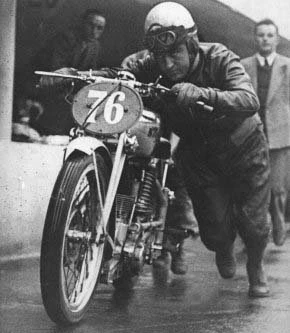
Signature numbers
- Win rate
- 0.0%
- Podium rate
- 100.0%
- Race starts
- 1
- Total points
- 3
Era
About Dorino Serafini
Early Career and Two-Wheeled Dominance
Teodoro "Dorino" Serafini, an Italian racer from Pesaro, established a formidable reputation long before his singular, yet impactful, appearance in the Formula One World Championship. His journey into competitive motorsport commenced in 1928, beginning his career on two wheels, piloting a Benelli 175cc motorcycle. This early immersion laid the foundation for a distinguished period of his career. Serafini's talent on motorcycles quickly became evident, culminating in a significant achievement in 1939. Astride a Gilera machine, he secured the coveted 500cc European Championship. This triumph was underscored by dominant performances, including victories in the German, Swedish, and Ulster Grands Prix. These successes firmly established Serafini as a leading figure in motorcycle road racing, demonstrating a profound command of his machinery and an innate racing instinct.
Transition to Four Wheels
The post-war era saw a pivotal shift in Serafini's racing focus. In 1947, he transitioned from the demanding world of motorcycle racing to the burgeoning discipline of single-seater car racing. This move represented a significant adaptation for a driver accustomed to the unique dynamics of two-wheeled competition. His aptitude for car racing quickly became apparent, as he demonstrated his versatility and skill in this new environment. A notable highlight during this transitional phase was his performance in the 1950 Mille Miglia, a legendary endurance road race. Serafini navigated the challenging Italian roads to secure an impressive second-place finish, a testament to his adaptability and enduring competitive spirit. Concurrently, he also participated in several non-Championship Formula One events, gaining crucial experience in the nascent Grand Prix machinery, serving as a prelude to his eventual, albeit brief, foray into the World Championship.
Formula One World Championship Debut
Serafini's entry into the Formula One World Championship is etched into motorsport history as one of the most unique and statistically remarkable debuts. On September 3, 1950, at the iconic Autodromo Nazionale Monza, Serafini made his solitary World Championship start at the Italian Grand Prix, competing for the esteemed Scuderia Ferrari. In an era where driver changes and shared drives were a strategic element, Serafini's race took a distinctive turn. During the event, he shared his Ferrari entry with the legendary Alberto Ascari. This practice, common in the early years of Formula One, allowed teams to maximize their chances of securing points or victory. Despite this shared effort, Serafini's contribution was undeniable. He was instrumental in guiding the Ferrari to a second-place finish, a remarkable achievement for any driver, let alone one making their World Championship debut. For his part in this shared success, Serafini was awarded half of the six points typically allocated for a second-place finish, earning him three World Championship points. This singular performance bestowed upon him a unique distinction: Dorino Serafini remains the only Formula One driver to have achieved a podium finish in every World Championship Grand Prix they ever entered. While this record is a direct consequence of his career comprising only one such race, it nonetheless underscores the immediate impact and high level of performance he demonstrated on the sport's grandest stage.
Career-Altering Incident and Later Career
The trajectory of Serafini's full-time racing career was profoundly altered following a severe incident during the 1951 Mille Miglia. While competing in this arduous road race, he sustained serious injuries that necessitated a prolonged period of recovery. The gravity of these injuries was such that they required multiple surgical operations over several years, a testament to their debilitating nature and the extensive rehabilitation process he endured. This unfortunate turn of events effectively curtailed his full-time involvement in top-tier motorsport, forcing a premature cessation of what had been a highly promising career across both two and four wheels. Despite the physical and emotional toll of his injuries, Serafini's enduring passion for racing saw him make a remarkable, albeit brief, return to competition. In 1954, he participated in the Brescia-Rome-Brescia race, an event that showcased his resilience and undiminished skill. In this comeback appearance, Serafini demonstrated his continued competitive edge, finishing seventh overall. Furthermore, he secured a victory within his class, taking first place in the GT category. This performance was a poignant reminder of his talent and determination, proving that even after a significant hiatus and severe injuries, his racing acumen remained intact.
Legacy
Dorino Serafini's career, though spanning various disciplines and marked by both triumph and adversity, culminated in a distinctive legacy within Formula One. His singular World Championship Grand Prix appearance, resulting in a podium finish at the 1950 Italian Grand Prix for Ferrari, stands as a testament to his immediate effectiveness at the sport's pinnacle. The statistical anomaly of achieving a podium in every World Championship race entered, while a product of his limited participation, firmly places him in a unique category among Grand Prix drivers. Beyond this unique F1 record, Serafini's broader career as a 500cc European Motorcycle Champion and a strong contender in endurance car racing like the Mille Miglia, paints a picture of a versatile and exceptionally talented racer. His ability to transition successfully from motorcycles to single-seater cars, coupled with his resilience in overcoming severe injuries to return to competition, underscores a profound dedication to motorsport. Serafini's story serves as a reminder of an era when racing careers were often forged across multiple disciplines, and where a single, brilliant performance could secure a permanent place in the sport's rich history.