
 American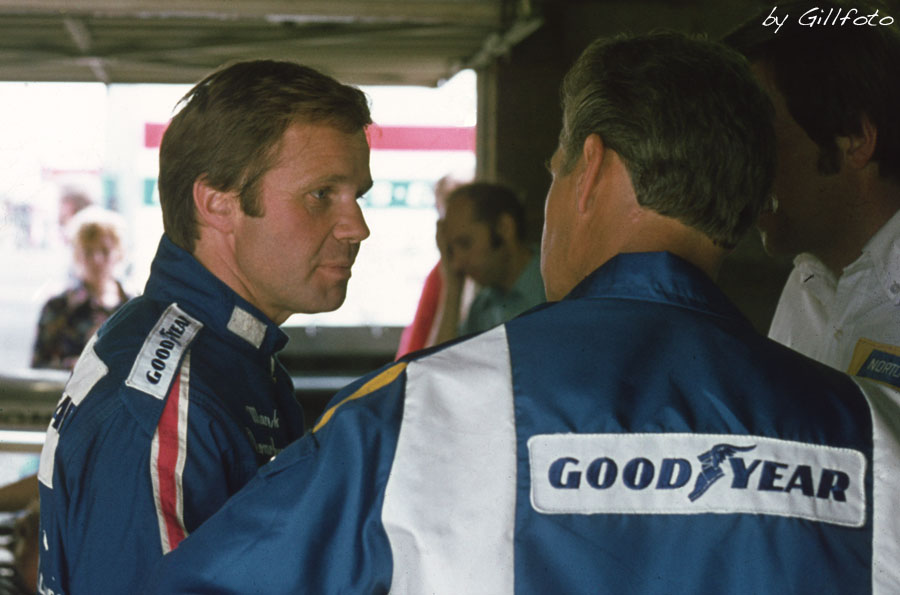
About Mark Donohue
Origins
Mark Neary Donohue Jr. was born on 18 March 1937 in Summit, New Jersey, the son of a successful patent attorney whose income provided unusual financial security for the young Donohue's racing ambitions. He attended Brown University, earning a degree in mechanical engineering in 1959 — an academic background that would set him apart from most contemporary racing drivers and that would inform his entire career as one of the most engineering-literate professional drivers of his era. His amateur racing began with sports cars in SCCA national series in the early 1960s, and his progression to professional racing through the Trans-Am championship and the Penske Racing organisation under Roger Penske defined the rest of his career.
Rise
Donohue's partnership with Roger Penske, which began with Trans-Am sports cars in 1966, became the most consequential American driver-team principal relationship of the late 1960s and 1970s. Together they won the Trans-Am championship in 1967 and 1968 with Chevrolet Camaros and Ford Mustangs, the 24 Hours of Daytona in 1969, the 12 Hours of Sebring in 1969, the Indianapolis 500 in 1972, the Can-Am championship in 1973 with the dominant Porsche 917/30 (a car so fast it was banned for the following season), and the IROC inaugural championship in 1973-1974. The Penske-Donohue combination represented the most professionally-engineered American racing operation of its era, with engineering rigor that contemporary American teams (and most international teams) could not match.
Championship Years
Donohue's F1 career consisted of fourteen starts across 1971, 1974 and 1975. His F1 debut came at the 1971 Canadian Grand Prix with Penske's privateer March 711 entry, where he finished third on debut — one of the most successful F1 debuts of the modern era. The 1974 and 1975 F1 seasons came after Penske's decision to enter F1 with their own American-built chassis (the Penske PC-1), with Donohue as the driver. The 1974 season produced no points but consistent qualifying results in a difficult debut chassis; the 1975 season included a fifth place at the British Grand Prix and a podium-pace performance at the Austrian Grand Prix at the Österreichring that he was leading until tyre failure in practice ended his life.
Style and Legend
Donohue's driving combined American sports car aggression with the analytical engineering literacy of his Brown training. He authored "The Unfair Advantage," a 1975 book about his racing methodology that became one of the most-read motorsport autobiographies of its era and remains influential among engineering-minded drivers and team engineers a half-century later. His preparation methods — extensive private testing, methodical setup work, mathematical approaches to tire pressure and chassis geometry — directly influenced the entire generation of American racing engineers (including Roger Penske's later operation) and crossed over into Formula 1 thinking through Penske's brief F1 programme. His personality was the opposite of A.J. Foyt's hot-tempered Texas dirt-track flamboyance — Donohue was reserved, intellectual, university-educated, professionally cool — and the contrast between the two American open-wheel champions of the early 1970s defined the cultural diversity of the era.
Beyond Racing
Donohue died on 19 August 1975 at the Österreichring during practice for the Austrian Grand Prix — a tyre failure on the straight before the Vöest-Hügel sent his Penske PC-1 off the track and into a debris fence; he was extracted from the car alive but died two days later in hospital from a cerebral haemorrhage. The death at age 38 ended one of the most accomplished American racing careers of its generation. The Indianapolis 500 victory, the dominant Penske Can-Am season, the Trans-Am championships, the IROC title, the 1971 Canadian Grand Prix podium, and the engineering-literate professional culture he established with Roger Penske together secure his place as one of the most consequential figures in 1970s American motorsport — a figure whose F1 record (one third place from fourteen starts) understates his broader international impact, and whose death at the Österreichring contributed to the wider safety reform movement that would dominate F1 in the late 1970s.