

 New Zealander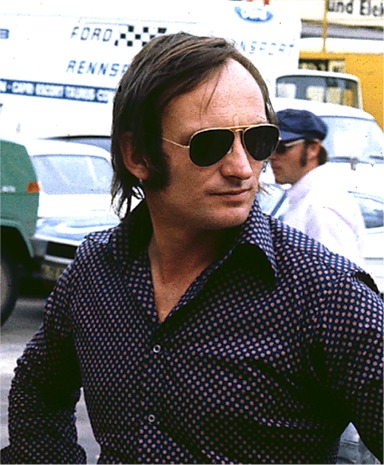
About Chris Amon
Origins
Christopher Arthur Amon was born on 20 July 1943 in Bulls, in New Zealand's Manawatū-Whanganui region, the son of a sheep farmer. His upbringing on the family sheep station was conventional rural New Zealand, and his entry to motorsport came through Kiwi club racing in modified saloons and sports cars from age sixteen. Bruce McLaren's New Zealand racing connections brought Amon to Britain in 1962 at age nineteen, an extraordinarily young debutant for the F1 of the era. His first F1 outings came with Reg Parnell's privateer team in 1963, before his pace and natural talent attracted the attention of Lola, Cooper and eventually Ferrari.
Rise
Amon's pre-Ferrari years included Le Mans victory with Bruce McLaren in 1966 (the famous Ford GT40 Mk II 1-2-3) and Can-Am sports car podiums, establishing him as one of the most versatile young drivers of his generation. Ferrari signed him for 1967, and his three years at Maranello (1967-1969) coincided with one of Ferrari's most difficult competitive periods — strong pole position pace combined with chronic mechanical unreliability that made race wins almost impossible. The pattern was established that would define his career: extraordinary speed in qualifying, multiple race leads, and almost no race wins.
Championship Years
Amon never won a world championship grand prix despite being widely considered one of the fastest drivers of the late 1960s and early 1970s — a record that earned him the perpetual nickname "the best driver never to win a grand prix." His career produced eleven podiums and five pole positions across 96 starts, but the win column remained empty through Ferrari (1967-1969), March (1970), Matra (1971-1972), Tecno (1972), Tyrrell (1973), BRM (1974), Ensign (1975-1976) and Williams (1976). The closest near-misses became part of F1 lore: the 1968 Spanish, French and British Grands Prix all led from pole and lost to mechanical failures; the 1972 French Grand Prix at Clermont-Ferrand was lost to a puncture from on-track debris while leading by half a minute. The Ferrari 312B he drove in 1969 produced multiple performances where he ran away from the field before retiring; the Matra MS120D of 1972 was the most beautiful and the most fragile car of his career.
Style and Legend
Amon's driving combined enormous natural pace with a willingness to take mechanical risks that, in any other era, would have produced a championship. His engineering feedback was rated by Mauro Forghieri (Ferrari) and Robin Herd (March) as among the most acute of his generation; both engineers used the phrase "Amon would tell you exactly what the car needed to do" in their published memoirs. His personality was relentlessly cheerful — Amon was widely regarded as the most popular driver in the paddock among his peers — and his refusal to complain about the mechanical bad luck that defined his career made him a moral exemplar of how to handle persistent injustice in elite sport. His decision to leave Ferrari at the end of 1969 (just before the team's 1970-71 turnaround under Forghieri) is often cited as the ultimate "Amon moment" — a strategic choice that, with different timing, would have made him a multiple champion.
Beyond Racing
Amon retired from F1 in 1976 after a high-speed accident at the Nürburgring left him with serious injuries; he returned to New Zealand to manage the family sheep farm and become a Marlborough sauvignon blanc producer in the developing New Zealand wine industry. His ambassador roles for Toyota New Zealand and his commentary work on New Zealand television kept him publicly visible through the 1980s and 1990s. He was awarded the OBE in 1993 and the Order of New Zealand for services to motorsport. He died on 3 August 2016 at age 73 from cancer, with obituaries across the international motorsport press emphasising his peer reputation as one of the most talented drivers of any era who simply never had the right machinery at the right time. The eleven podiums, the five pole positions, the unwavering peer respect from rivals like Stewart and Lauda, and the wider symbolic role as F1's perpetual "what if" together secure his place as one of the most loved and most-misfortuned figures in the history of grand prix racing.