

CircuitPark Zandvoort
 NetherlandsZandvoortEntry 1952Active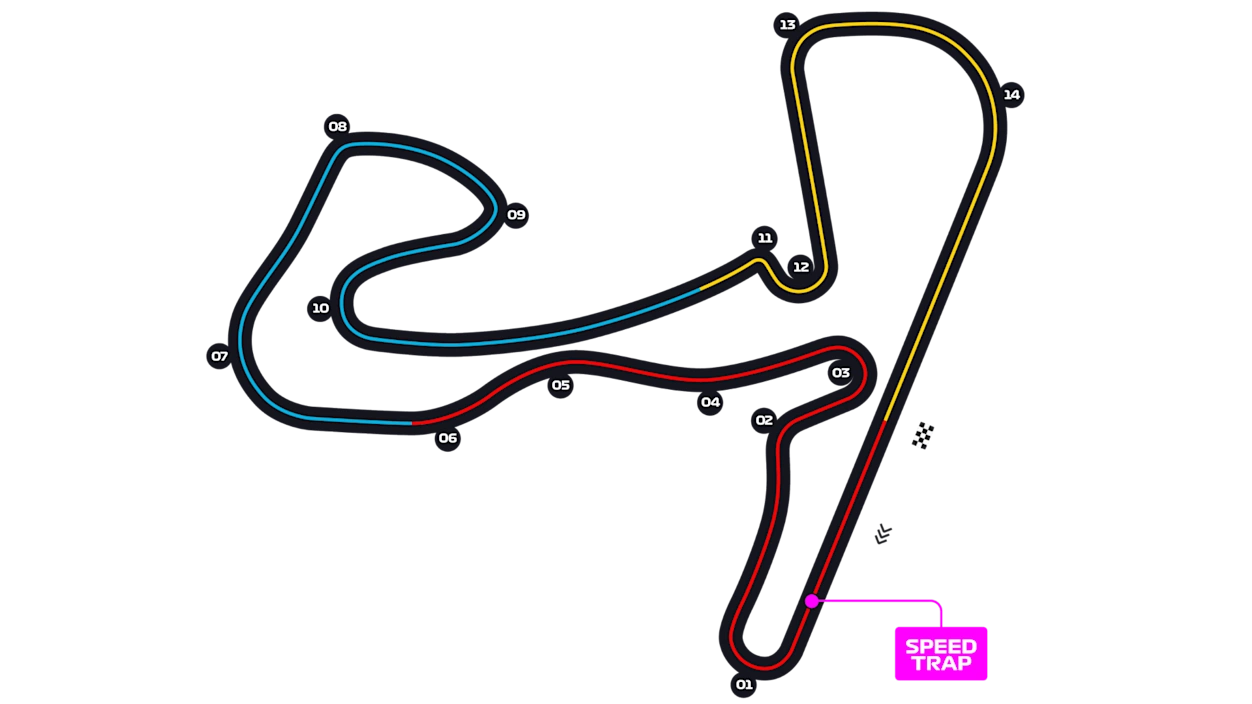
Career timeline
Signature numbers
- Career
- 1952 – 2026
Era
About Circuit Park Zandvoort
Circuit Park Zandvoort sits behind the dunes on the North Sea coast in the Dutch province of North Holland, half an hour from Amsterdam. It is one of F1's most distinctive venues: a flowing seaside layout with the only significantly banked corners on the modern calendar, brought back to F1 in 2021 after a 36-year absence on the back of Max Verstappen's championship charge. The Dutch Grand Prix in the Verstappen era has produced some of the most spectacular crowd atmospheres in F1, the orange Schwalmedammer grandstands resembling football matches more than motor races.
Origins
Zandvoort was built in 1948 from concrete laid over wartime German military roads (Atlantic Wall fortifications) by Dutch engineer Sammy Davis. The first race was held that summer; F1 first visited in 1952 with Alberto Ascari winning the inaugural Dutch Grand Prix in a Ferrari. The original 4.193-km layout, designed by John Hugenholtz (later of Suzuka fame), was sandy, fast, and famously windswept. Zandvoort hosted the Dutch Grand Prix essentially every year from 1952 to 1985. The 1985 race was the last of that era; rising commercial pressures and a fatal accident involving spectator Roger Williamson's death-by-fire in 1973 contributed to F1's withdrawal. The circuit shrank to its modern 4.259-km configuration in the late 1990s and survived as a national motorsport venue. The return of F1 in 2021 was driven entirely by the Verstappen phenomenon. After Max debuted in F1 in 2015 and quickly built a national fan base, a Dutch consortium began lobbying for a Grand Prix slot. The deal was announced for 2020, delayed by COVID, and finally happened in September 2021 with Verstappen winning his home race in front of 70,000 ecstatic Dutch fans.
Layout
The current 4.259-km layout includes two banked corners — Hugenholtzbocht (Turn 3) at 19 degrees and Arie Luyendykbocht (Turn 14, the final corner) at 18 degrees — both reintroduced in 2020 specifically to enable overtaking and to set Zandvoort apart from sterile Tilke-style venues. The banking allows multiple lines through these corners and creates passing opportunities that flat versions of the same corners would not. The lap begins at Tarzanbocht, a long, deceptively cambered right-hander that is one of the most popular F1 overtaking spots. The mid-section flows through the Gerlachbocht, Hugenholtzbocht (banked), Hunzerug (a left-right complex over a crest), and the Slotemakerbocht. The fast Scheivlak (Turn 8) takes drivers blind over a crest into a downhill left-hander where commitment is everything. The back stretch is fast and flowing — Mastersbocht, Vodafone, Audi-S — ending at the banked Arie Luyendykbocht final corner that catapults cars back onto the long start-finish straight. Lap times are around 1:11 in qualifying — short, but absolutely flat-out from start to finish.
Legendary Moments
The 2021 Dutch Grand Prix was Zandvoort's modern signature moment. Max Verstappen won from pole in front of Crown Princess Amalia and an estimated 70,000 orange-clad fans. The atmosphere was so intense that broadcast audio engineers had to attenuate the crowd microphones. Verstappen has won every Dutch Grand Prix since (2021, 2022, 2023, 2024). The 1979 Dutch Grand Prix produced one of F1's iconic comebacks: René Arnoux and Gilles Villeneuve battled for second place over the final laps in a wheel-banging brawl that Villeneuve eventually won. Footage of the two men embracing at the end is regularly cited as one of the great sportsmanship moments in F1. The 1985 Dutch Grand Prix, the last of the original Zandvoort era, was won by Niki Lauda over Alain Prost in his penultimate F1 race. Lauda announced his retirement immediately afterwards. The crowd gave him a standing ovation through three slow-down laps. The 1973 race produced one of F1's darkest moments: Roger Williamson's March-Ford crashed and burst into flames, and despite David Purley heroically stopping his own car and trying to save him single-handedly, no fire marshals reached the scene with effective extinguishers in time. Williamson died of smoke inhalation. The incident accelerated the FIA's fire-safety reforms.
Quirks & Curiosities
The banking returned to Zandvoort in 2020 explicitly to enable F1 overtaking — the only banked corners on the modern calendar (Indianapolis in 2000-2007 had banking but is no longer on the F1 schedule). The banking specifications were calculated using Fanboost-era simulation software to maximise multi-line racing. The circuit's seaside location produces a unique sand-on-track problem: strong North Sea winds blow dune sand onto the racing surface, requiring constant sweeping during the race weekend and producing tricky off-line grip conditions. Drivers describe Zandvoort as the most "pebble-bouncy" circuit on the calendar. The Dutch Grand Prix is the only F1 race that begins with a national- anthem singalong led by professional Dutch DJs (Armin van Buuren has performed multiple times). The Orange Army's coordinated chants and flag displays have inspired comparisons to Liverpool football matches. The pit lane runs uphill — one of the only F1 pit lanes with significant elevation change, complicating pit-stop choreography and producing distinctive engineer-cam shots.
Modern Era
Zandvoort's contract was confirmed through 2025 with discussions ongoing about an extension. The circuit's relevance is tightly tied to Verstappen — Dutch Grand Prix attendance fell perceptibly in 2024 when his championship was already secured early. Liberty Media recognises that the race needs him on the calendar to maintain its cultural momentum. The 2025 race introduced new safety modifications at Tarzanbocht after a 2024 testing-incident review. The banking corners remain unchanged and are considered model examples of how to engineer overtaking into a modern circuit redesign.