

CircuitGilles Villeneuve
 CanadaMontrealEntry 1978Active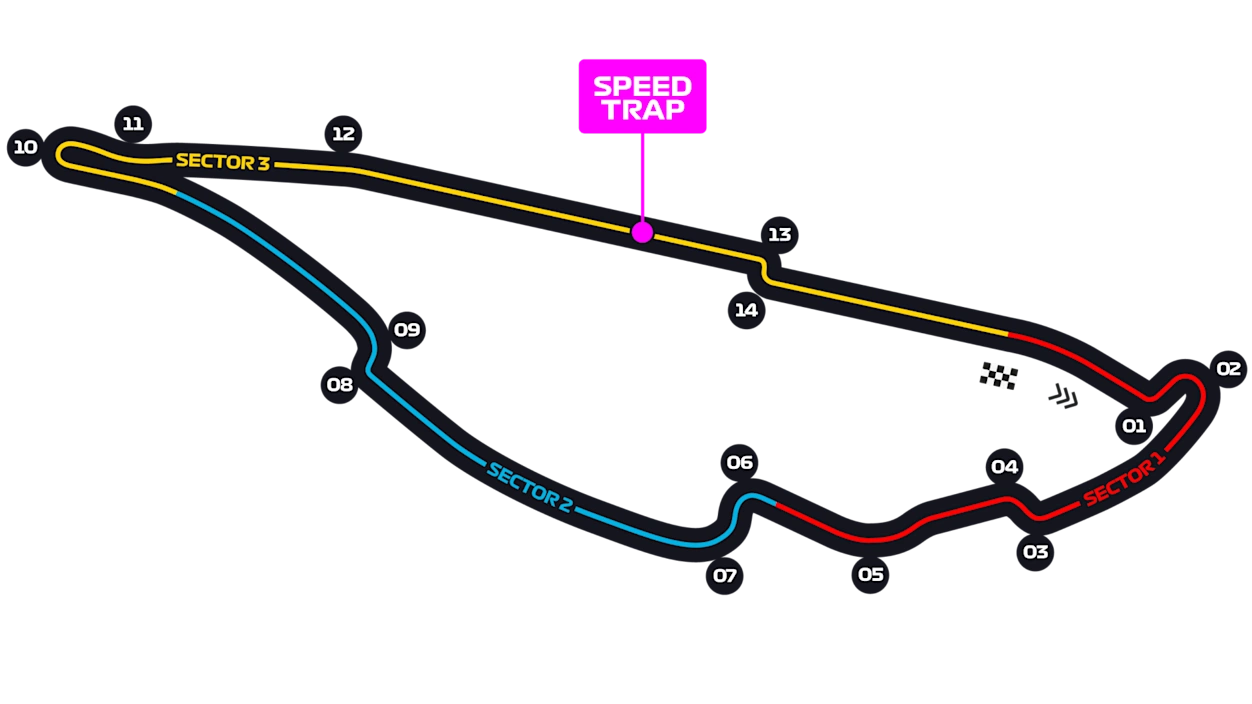
Career timeline
Signature numbers
- Career
- 1978 – 2026
Era
About Circuit Gilles Villeneuve
Origins
The **Circuit Île Notre-Dame** in Montreal, Quebec — renamed **Circuit Gilles Villeneuve** after the Canadian driver's death in 1982 — sits on a **man-made island** in the St. Lawrence River, originally constructed for the 1967 World's Fair (Expo 67) and the 1976 Summer Olympics rowing venue. The circuit opened in **1978** as a purpose-built F1 venue, replacing the dangerous Mont-Tremblant facility. F1 has hosted the **Canadian Grand Prix in Montreal since 1978**, with brief gaps in 1987, 2009, 2020, and 2021. As of 2026, the venue has hosted **45+ Canadian Grands Prix** — making it one of F1's most consistent long-term venues, only behind Monaco, Silverstone, Monza, and Spa.
Layout
The **Circuit Gilles Villeneuve** is **4.361 km, 14 corners** with one defining characteristic: it is **almost completely flat** (less than 2 metres of elevation change across the entire lap). The circuit is built on a narrow island, with the St. Lawrence River visible on both sides of the track at multiple points. Key features: - **Senna S** (Turns 1–2) — fast right-left at the start of the lap, named for Ayrton Senna after his death. - **Hairpin** (Turn 10) — the slowest corner on the lap, located near the Olympic basin. - **Casino Straight** — long flat-out section that ends in the famous **Wall of Champions**. - **Wall of Champions** (Turn 14) — fast right-left chicane at the end of the lap. The exit wall is uniquely close to the racing line, and four World Champions (Damon Hill, Michael Schumacher, Jacques Villeneuve, Sebastian Vettel) have all crashed there in different races. The **flat layout** means the circuit is **brake-dominated** — four heavy braking zones at Turn 1, Turn 8, the Hairpin, and the Wall of Champions chicane. Brake temperatures and wear are critical strategic factors.
Legendary Moments
**1978 — First Canadian GP in Montreal**: Gilles Villeneuve won the inaugural race for Ferrari in front of his home crowd — his **first Formula 1 victory**. The win happened just 2 weeks after Italian GP teammate Niki Lauda had predicted Villeneuve would win. **1982 — Riccardo Paletti's death**: At the start of the Canadian GP, Riccardo Paletti's Osella struck the stalled Ferrari of Didier Pironi at high speed. Paletti died at the scene. The accident occurred 5 weeks after Villeneuve's death at Zolder. The 1982 season was already F1's most tragic in modern memory; Paletti's death deepened the mourning. **1991 — Mansell's stuck wheel rim**: Nigel Mansell led the Canadian GP with a clear advantage. On the final lap his Williams's gearbox stuck in 5th gear at the Hairpin — unable to accelerate, he was passed by Nelson Piquet for the win. **One of F1's most heartbreaking final-lap mechanical failures**. **1995 — Jean Alesi's only F1 win**: French-Sicilian Jean Alesi won the Canadian GP for Ferrari — his **first and only F1 victory** after a decade of strong runs. He raised his arms in triumph after years of misfortune. The win is Ferrari's 100th in F1 history. **1999, 2001, 2014 — Wall of Champions**: Damon Hill (1999), Michael Schumacher (1999), Jacques Villeneuve (1999), and Sebastian Vettel (2014) all crashed at the chicane — earning the corner its eternal nickname. **2011 — Jenson Button's epic comeback**: Button started 7th, collided with Hamilton, made multiple pit stops in heavy rain, finished as low as last, and stormed back through the field to win on the final lap when Vettel overshot the chicane under pressure. **One of the greatest F1 wins ever in changing conditions**.
Quirks & Curiosities
The **island** the circuit sits on is artificial — built from material excavated during the construction of Montreal's metro system in the 1960s. The island contains the **Cosmodrome museum**, **Olympic basin**, and the **Casino de Montréal**. The **Hairpin** at Turn 10 sits next to the Olympic rowing basin. **Beavers** have been spotted along the basin shore during F1 practice sessions — one of F1's more unusual wildlife encounters. The famous **Wall of Champions** sign was added by track officials in 2000 after the 1999 incidents. The wall itself is a tribute to the four Champions who crashed there. The **Senna S** at Turns 1–2 was renamed in Senna's honor after his death in 1994. A small commemorative plaque sits near the corner. Montreal's **francophone culture** gives the venue a unique F1 atmosphere — French is the dominant language in the paddock, French-Canadian fans are among F1's most passionate, and the **post-race nightlife** in Old Montreal is legendary among teams and drivers.
Modern Era
The Canadian GP at Circuit Gilles Villeneuve continues as a flagship F1 race. The contract was renewed through **2031** in 2023. Recent winners include Lewis Hamilton (multiple), Sebastian Vettel, and George Russell. The venue underwent **major upgrades in 2017** including new pit and paddock buildings and improved safety walls. The classic flat layout has been preserved. The race attracts **300,000+ fans** across the race weekend, making it one of F1's best-attended events globally. Hotel rates in Montreal triple during race week. For F1 history, Circuit Gilles Villeneuve represents the **beloved French-Canadian flagship venue** — Villeneuve's inaugural win, Mansell's gearbox heartbreak, Alesi's only win, the 2011 Button comeback, and the legendary Wall of Champions all combine to make it one of F1's most storied modern circuits.