

LasVegas Strip Street Circuit
 USALas VegasEntry 2023Active
Career timeline
Signature numbers
- Career
- 2023 – 2026
Era
About Las Vegas Strip Street Circuit
The Las Vegas Strip Street Circuit: A High-Stakes Engineering Challenge Under Neon Lights
The Las Vegas Strip Street Circuit, a spectacle of speed and glamour, made its highly anticipated debut on the Formula 1 calendar in 2023, marking a bold return for the sport to the iconic city after a four-decade hiatus. Unlike its predecessors, the Caesars Palace Grand Prix, this modern iteration is a purpose-built temporary street circuit designed to showcase both the raw power of Formula 1 cars and the dazzling backdrop of the Las Vegas Strip. Spanning 6.201 kilometers (3.853 miles) and featuring 17 turns, the circuit is a unique blend of ultra-fast straights and technical, low-speed sections, presenting a distinct engineering puzzle for teams and drivers.
Location and History
Located in Paradise, Nevada, just outside Las Vegas, the circuit weaves through some of the city's most famous landmarks. The concept of a street race directly on the Strip was a long-held ambition, finally realized by Formula 1 itself, which took on the role of promoter alongside Liberty Media. The inaugural event in November 2023 was a night race, adding to the spectacle and creating unique environmental conditions. The circuit's construction involved significant infrastructure changes, including resurfacing public roads and building temporary pit and paddock facilities, a testament to the scale of the undertaking.
Layout Philosophy and Challenges
The design philosophy behind the Las Vegas Strip Street Circuit was clear: create a high-speed, high-drama track that maximizes overtaking opportunities while integrating seamlessly with the city's iconic architecture. The layout is characterized by three long straights, including the monumental 1.9-kilometer (1.18-mile) blast down the Las Vegas Boulevard, which is among the longest straights on the F1 calendar. This dictates a low-to-medium downforce aerodynamic setup, prioritizing straight-line speed to exploit the DRS zones. However, this must be carefully balanced with the need for mechanical grip and stability through the circuit's numerous tight, ninety-degree corners and a demanding chicane.
Sector by Sector Breakdown
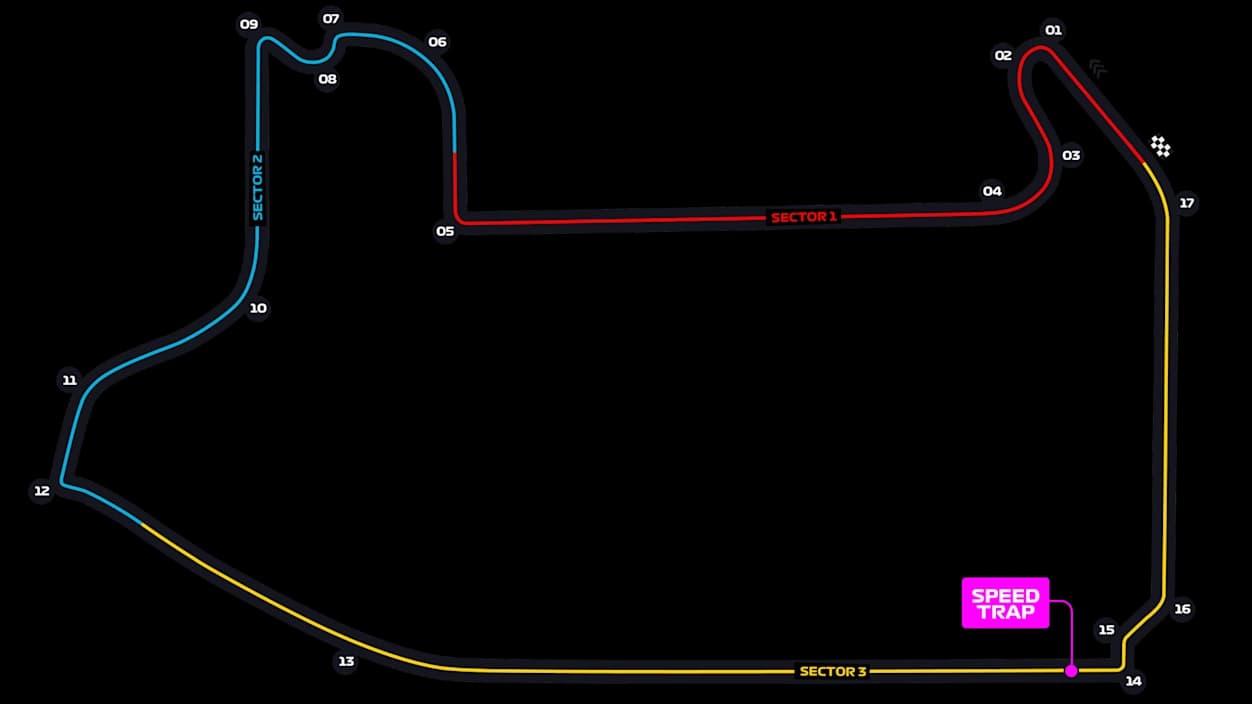
**Sector 1:** The lap begins with a tight, left-hand hairpin (Turn 1) after the start/finish straight, leading into a fast, sweeping left-hander around the MSG Sphere (Turns 2-4). This initial sequence is crucial for gaining track position at the start and requires precise braking and throttle control. The cars then navigate a series of medium-speed corners (Turns 5-9) that demand good change of direction and mechanical grip. This sector is relatively technical and can be challenging for tire warm-up due to the cool night temperatures. **Sector 2:** Following the technical first sector, cars accelerate onto a long, sweeping right-hand bend (Turn 10) that transitions into a short straight. This leads to a tight chicane (Turns 11-12) – a critical overtaking spot under braking. Exiting the chicane, drivers unleash the full power of their engines onto the second significant straight, which culminates in a sharp left-hander (Turn 13) before the main event: the Las Vegas Boulevard. **Sector 3:** This sector is dominated by the colossal 1.9-kilometer straight down the Strip. Here, cars reach their absolute top speeds, often exceeding 340 km/h (210 mph). This long flat-out section is the primary DRS zone and the most obvious overtaking opportunity on the circuit. The challenge lies in managing tire temperatures and avoiding excessive drag. The sector concludes with a final tight chicane (Turns 14-15) and a fast, flowing right-left combination (Turns 16-17) that leads back to the start/finish line. The braking zone into Turn 14 is another prime overtaking spot, demanding significant brake stability and driver confidence.
Elevation Changes and Surface Characteristics
The Las Vegas Strip Street Circuit is largely flat, with minimal significant elevation changes, which is typical for a city-based street circuit. The primary challenge from a surface perspective is the asphalt itself. Being a newly laid surface for a temporary track, it initially offered very low grip and was prone to high track evolution throughout the weekend, especially with the cool night temperatures. This meant teams had to adapt quickly to changing grip levels, and tire warm-up was a persistent issue, particularly after safety car periods. The street circuit nature also means potential for bumps and uneven surfaces, though efforts were made to ensure a smooth racing line.
Aerodynamic Setup and Tyre Demands
The circuit demands a compromise in aerodynamic setup. While the long straights scream for a low-downforce configuration to maximize top speed, the numerous tight corners, particularly in the first and final sectors, require sufficient downforce for stability and mechanical grip. Teams typically opt for a medium-low downforce package, sacrificing some cornering speed for straight-line advantage, hoping to make up time in the DRS zones. Brake cooling is also crucial due to the heavy braking events after the long straights. Tyre demands are high, albeit in a specific way. The cool ambient and track temperatures, combined with the long straights, make it difficult to generate and maintain optimal tire temperature. This can lead to graining, especially on the front tires, as drivers push to get heat into them. Pirelli typically brings softer compounds (C3, C4, C5) to encourage multi-stop strategies and provide grip on the low-grip surface. Degradation, once the tires are up to temperature, can be moderate, but thermal management and warm-up are the primary concerns.
DRS Zones and Overtaking Spots
The circuit features two DRS zones. The first is on the long straight leading into Turn 11, and the second, and by far the most significant, is on the 1.9-kilometer Las Vegas Boulevard straight. These zones are critical for overtaking, providing the necessary speed differential to make moves stick. The heavy braking zones into Turn 11, Turn 14, and Turn 1 are the primary targets for drivers looking to gain positions. The effectiveness of these zones is paramount to the racing spectacle, given the circuit's street nature.
Weather Considerations
As a night race held in late autumn, weather conditions in Las Vegas can be quite cool, with track temperatures often dropping significantly as the evening progresses. This exacerbates the tire warm-up challenges and can make the track feel even slipperier. While rain is generally rare in the Nevada desert, strong winds could also be a factor, affecting aerodynamic balance on the long straights. The cool temperatures, however, can also be beneficial for engine and brake cooling.
Lap Record and Notable Incidents
The official race lap record was set by Oscar Piastri in 2023 with a time of 1:35.774. The inaugural event was marked by several incidents, most notably a loose drain cover in Free Practice 1 that caused significant damage to Carlos Sainz's Ferrari, leading to the session's early abandonment and a grid penalty for Sainz due to power unit component changes. This highlighted the inherent challenges and unforeseen issues that can arise with new street circuits. Despite initial logistical hurdles and track surface issues, the race itself delivered exciting action, showcasing the circuit's potential for dramatic racing.
Recent Layout Changes
Given its recent debut, the Las Vegas Strip Street Circuit has not undergone any significant layout changes. However, lessons learned from the inaugural event regarding track surface preparation, drainage, and logistical flow are likely to inform future iterations of the temporary circuit's construction and operation, aiming to refine the experience for both teams and fans. In conclusion, the Las Vegas Strip Street Circuit is a bold and ambitious addition to the Formula 1 calendar. It presents a unique engineering challenge, demanding a delicate balance between outright straight-line speed and crucial mechanical grip for its numerous tight corners. Under the dazzling lights of the Strip, it offers a high-speed, high-stakes spectacle that pushes the boundaries of street circuit racing, promising thrilling action for years to come.
El Circuito Urbano de Las Vegas Strip: Un Desafío de Ingeniería de Alto Riesgo Bajo las Luces de Neón
El Circuito Urbano de Las Vegas Strip, un espectáculo de velocidad y glamour, hizo su esperado debut en el calendario de la Fórmula 1 en 2023, marcando un audaz regreso del deporte a la icónica ciudad después de un paréntesis de cuatro décadas. A diferencia de sus predecesores, el Gran Premio de Caesars Palace, esta iteración moderna es un circuito urbano temporal construido específicamente para exhibir tanto la potencia bruta de los coches de Fórmula 1 como el deslumbrante telón de fondo de Las Vegas Strip. Con una extensión de 6.201 kilómetros (3.853 millas) y 17 curvas, el circuito es una mezcla única de rectas ultrarrápidas y secciones técnicas de baja velocidad, presentando un rompecabezas de ingeniería distintivo para equipos y pilotos.
Ubicación e Historia
Situado en Paradise, Nevada, a las afueras de Las Vegas, el circuito serpentea a través de algunos de los lugares más famosos de la ciudad. El concepto de una carrera callejera directamente en el Strip era una ambición largamente acariciada, finalmente realizada por la propia Fórmula 1, que asumió el papel de promotor junto con Liberty Media. El evento inaugural en noviembre de 2023 fue una carrera nocturna, lo que añadió al espectáculo y creó condiciones ambientales únicas. La construcción del circuito implicó cambios significativos en la infraestructura, incluyendo el reasfaltado de carreteras públicas y la construcción de instalaciones temporales de boxes y paddock, un testimonio de la magnitud de la empresa.
Filosofía de Diseño y Desafíos del Trazado
La filosofía de diseño detrás del Circuito Urbano de Las Vegas Strip era clara: crear una pista de alta velocidad y alto dramatismo que maximizara las oportunidades de adelantamiento mientras se integraba perfectamente con la arquitectura icónica de la ciudad. El trazado se caracteriza por tres largas rectas, incluyendo el monumental tramo de 1.9 kilómetros (1.18 millas) por Las Vegas Boulevard, que se encuentra entre las rectas más largas del calendario de F1. Esto dicta una configuración aerodinámica de baja a media carga aerodinámica, priorizando la velocidad en línea recta para explotar las zonas DRS. Sin embargo, esto debe equilibrarse cuidadosamente con la necesidad de agarre mecánico y estabilidad a través de las numerosas curvas cerradas de noventa grados y una exigente chicane del circuito.
Análisis Sector por Sector
**Sector 1:** La vuelta comienza con una horquilla cerrada a la izquierda (Curva 1) después de la recta de salida/meta, que lleva a una curva rápida y amplia a la izquierda alrededor de la MSG Sphere (Curvas 2-4). Esta secuencia inicial es crucial para ganar posición en la pista al principio y requiere una frenada y un control del acelerador precisos. Luego, los coches navegan por una serie de curvas de velocidad media (Curvas 5-9) que exigen un buen cambio de dirección y agarre mecánico. Este sector es relativamente técnico y puede ser un desafío para el calentamiento de los neumáticos debido a las bajas temperaturas nocturnas. **Sector 2:** Tras el técnico primer sector, los coches aceleran en una larga curva a la derecha (Curva 10) que transiciona a una recta corta. Esto conduce a una chicane cerrada (Curvas 11-12), un punto crítico de adelantamiento en la frenada. Al salir de la chicane, los pilotos desatan toda la potencia de sus motores en la segunda recta significativa, que culmina en una curva cerrada a la izquierda (Curva 13) antes del evento principal: el Las Vegas Boulevard. **Sector 3:** Este sector está dominado por la colosal recta de 1.9 kilómetros por el Strip. Aquí, los coches alcanzan sus velocidades máximas absolutas, a menudo superando los 340 km/h (210 mph). Esta larga sección a fondo es la zona DRS principal y la oportunidad de adelantamiento más obvia del circuito. El desafío radica en gestionar las temperaturas de los neumáticos y evitar el arrastre excesivo. El sector concluye con una última chicane cerrada (Curvas 14-15) y una combinación rápida y fluida de derecha-izquierda (Curvas 16-17) que lleva de vuelta a la línea de salida/meta. La zona de frenada en la Curva 14 es otro punto de adelantamiento clave, que exige una estabilidad de frenado significativa y confianza del piloto.
Cambios de Elevación y Características de la Superficie
El Circuito Urbano de Las Vegas Strip es en gran parte plano, con cambios de elevación mínimos y poco significativos, lo cual es típico de un circuito urbano. El principal desafío desde la perspectiva de la superficie es el propio asfalto. Al ser una superficie recién colocada para una pista temporal, inicialmente ofrecía muy poco agarre y era propensa a una alta evolución de la pista durante todo el fin de semana, especialmente con las bajas temperaturas nocturnas. Esto significó que los equipos tuvieron que adaptarse rápidamente a los niveles de agarre cambiantes, y el calentamiento de los neumáticos fue un problema persistente, particularmente después de los períodos de coche de seguridad. La naturaleza del circuito urbano también implica la posibilidad de baches y superficies irregulares, aunque se hicieron esfuerzos para asegurar una línea de carrera suave.
Configuración Aerodinámica y Demandas de Neumáticos
El circuito exige un compromiso en la configuración aerodinámica. Si bien las largas rectas claman por una configuración de baja carga aerodinámica para maximizar la velocidad punta, las numerosas curvas cerradas, particularmente en el primer y último sector, requieren suficiente carga aerodinámica para la estabilidad y el agarre mecánico. Los equipos suelen optar por un paquete de carga aerodinámica media-baja, sacrificando algo de velocidad en curva por una ventaja en línea recta, con la esperanza de recuperar tiempo en las zonas DRS. La refrigeración de los frenos también es crucial debido a los fuertes eventos de frenado después de las largas rectas. Las demandas de neumáticos son altas, aunque de una manera específica. Las bajas temperaturas ambiente y de la pista, combinadas con las largas rectas, dificultan la generación y el mantenimiento de la temperatura óptima de los neumáticos. Esto puede provocar el graining, especialmente en los neumáticos delanteros, a medida que los pilotos se esfuerzan por calentarlos. Pirelli suele traer compuestos más blandos (C3, C4, C5) para fomentar estrategias de múltiples paradas y proporcionar agarre en la superficie de bajo agarre. La degradación, una vez que los neumáticos alcanzan la temperatura, puede ser moderada, pero la gestión térmica y el calentamiento son las principales preocupaciones.
Zonas DRS y Puntos de Adelantamiento
El circuito cuenta con dos zonas DRS. La primera está en la larga recta que conduce a la Curva 11, y la segunda, y con mucho la más significativa, está en la recta de 1.9 kilómetros de Las Vegas Boulevard. Estas zonas son críticas para los adelantamientos, proporcionando la diferencia de velocidad necesaria para que las maniobras se mantengan. Las fuertes zonas de frenado en la Curva 11, la Curva 14 y la Curva 1 son los objetivos principales para los pilotos que buscan ganar posiciones. La efectividad de estas zonas es primordial para el espectáculo de la carrera, dada la naturaleza urbana del circuito.
Consideraciones Climáticas
Como carrera nocturna celebrada a finales de otoño, las condiciones climáticas en Las Vegas pueden ser bastante frescas, con temperaturas de la pista a menudo descendiendo significativamente a medida que avanza la noche. Esto exacerba los desafíos de calentamiento de los neumáticos y puede hacer que la pista se sienta aún más resbaladiza. Si bien la lluvia es generalmente rara en el desierto de Nevada, los fuertes vientos también podrían ser un factor, afectando el equilibrio aerodinámico en las largas rectas. Las bajas temperaturas, sin embargo, también pueden ser beneficiosas para la refrigeración del motor y los frenos.
Récord de Vuelta e Incidentes Notables
El récord oficial de vuelta en carrera fue establecido por Oscar Piastri en 2023 con un tiempo de 1:35.774. El evento inaugural estuvo marcado por varios incidentes, el más notable un desagüe suelto en la Práctica Libre 1 que causó daños significativos al Ferrari de Carlos Sainz, lo que llevó al abandono temprano de la sesión y a una penalización en la parrilla para Sainz debido a cambios de componentes de la unidad de potencia. Esto puso de manifiesto los desafíos inherentes y los problemas imprevistos que pueden surgir con los nuevos circuitos urbanos. A pesar de los obstáculos logísticos iniciales y los problemas de la superficie de la pista, la carrera en sí ofreció una acción emocionante, mostrando el potencial del circuito para carreras dramáticas.
Cambios Recientes en el Trazado
Dado su reciente debut, el Circuito Urbano de Las Vegas Strip no ha sufrido cambios significativos en su trazado. Sin embargo, las lecciones aprendidas del evento inaugural con respecto a la preparación de la superficie de la pista, el drenaje y el flujo logístico probablemente informarán futuras iteraciones de la construcción y operación del circuito temporal, con el objetivo de refinar la experiencia tanto para los equipos como para los aficionados. En conclusión, el Circuito Urbano de Las Vegas Strip es una adición audaz y ambiciosa al calendario de la Fórmula 1. Presenta un desafío de ingeniería único, exigiendo un delicado equilibrio entre la velocidad pura en línea recta y el agarre mecánico crucial para sus numerosas curvas cerradas. Bajo las deslumbrantes luces del Strip, ofrece un espectáculo de alta velocidad y alto riesgo que empuja los límites de las carreras en circuitos urbanos, prometiendo acción emocionante en los años venideros.