

CircuitMont-Tremblant
 CanadaQuebecEntry 1968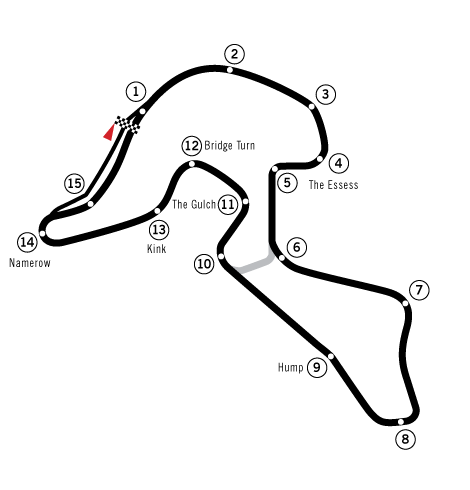
Career timeline
Signature numbers
- Career
- 1968 – 1970
Era
About Circuit Mont-Tremblant
Mont-Tremblant — properly Circuit Mont-Tremblant, also called St. Jovite — is a 4.265 km road course in the Laurentian Mountains of Quebec, north of Montreal, that hosted the Canadian Grand Prix twice in 1968 and 1970. Built into pristine Canadian wilderness on the slopes of a ski mountain, the circuit combined elevation change, blind crests, and a long straight passing the lakeshore in genuinely beautiful surroundings. The Canadian GP alternated between Mont-Tremblant and Mosport in this era, but Tremblant's safety standards (or lack thereof) and remote location meant it lost the alternation; F1 left after 1970 and never returned. The circuit survived as a sports car and historic racing venue and remains active today, beautifully preserved.
Origins
The Mont-Tremblant circuit was opened in 1964, built on land owned by businessman Joe Bonneau on the slopes of the Laurentian Mountains adjacent to the Mont-Tremblant ski resort. The circuit was intended for sports car and Trans-Am racing, with the full road course being a 4.265 km layout featuring substantial elevation change. The Canadian Grand Prix had been founded at Mosport in 1967 and arrived at Tremblant in 1968 as the alternating venue, with the two circuits trading hosting duties.
Layout
The lap began with a fast descent from the start through Turn 1, then a long left-hander down to the Namerow corner — a fast right that demanded commitment. The middle section ran along the lake shore with the longest straight ending at a tight right-hander. The final climb back up to the start passed through a blind crest at Turn 9, where cars momentarily became airborne before the track turned. Elevation change was approximately 30 meters per lap. Average speeds touched 195 km/h, with top speeds around 280 km/h on the lakeshore straight.
Legendary Moments
The 1968 Canadian Grand Prix at Mont-Tremblant was won by Denny Hulme in the McLaren M7A — a chaotic race in changeable Quebec autumn weather. Bruce McLaren himself finished second in the second McLaren, giving the constructor a 1-2 result. The 1970 race went to Jacky Ickx in the Ferrari 312B, after a battle with Jackie Stewart in the March 701. The race was significant as one of Ferrari's strong moments in a year dominated by the Lotus 72 — Ickx and Clay Regazzoni finished 1-2 for the Italian team. After the 1970 race, the Canadian GP moved permanently to Mosport, with safety concerns about Mont-Tremblant's blind crests and the circuit's relative remoteness from major Canadian population centers cited as factors. F1 never returned.
Quirks & Curiosities
The circuit's location adjacent to a ski resort meant winter operations existed alongside summer racing — drivers and teams visiting in race week could see the chairlifts and ski runs visible from the paddock. The circuit was bought by Lawrence Stroll in 2000 (yes, that Lawrence Stroll, father of Lance and owner of Aston Martin F1) and extensively restored, becoming a private members' club facility while still hosting public racing events. The Stroll connection means that F1 figures occasionally visit Tremblant — Lance Stroll has tested there, and Sebastian Vettel visited during his Aston Martin days. The blind crest at Turn 9 was reduced in severity during 2000s renovations but remains one of the most spectacular features in North American road racing.
Modern Era
Mont-Tremblant has not hosted Formula 1 since 1970, but it remains an active racing facility hosting the Trans-Am Series, Sports Car Club of America events, club races, motorcycle racing, and trackdays. The Stroll renovation modernized the facilities significantly while preserving the original layout. The Canadian Grand Prix's permanent settling at Mosport (1971-1977) and then at Île Notre-Dame in Montreal (1978 onward) meant Tremblant's F1 history closed early, but the circuit's intrinsic quality has kept it relevant in regional racing. For F1 historians, the 1968 and 1970 races represent a Canadian moment when Quebec's wilderness briefly hosted Grand Prix racing — an unusual combination of pristine environment and global motorsport that has not been replicated.