

SuzukaCircuit
 JapanSuzukaEntry 1987Active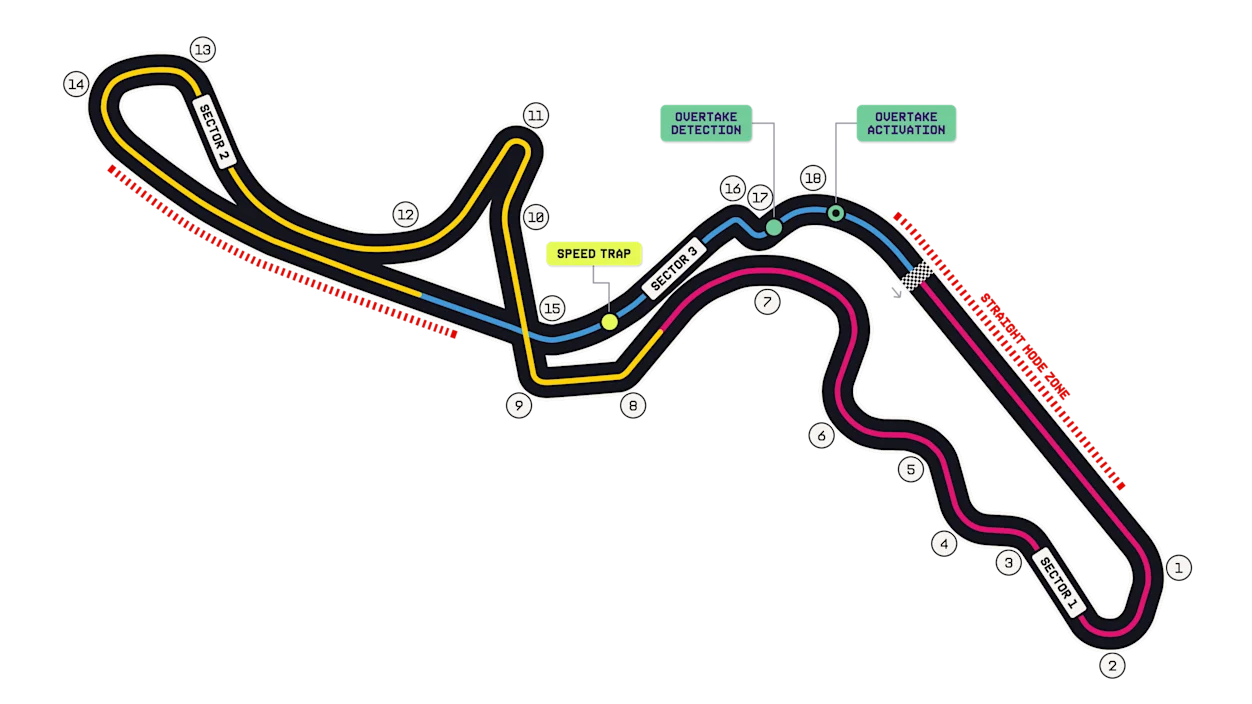
Career timeline
Signature numbers
- Career
- 1987 – 2026
Era
About Suzuka Circuit
Suzuka is the only figure-eight circuit on the Formula 1 calendar — the only one in international motorsport, in fact. Designed by Dutch engineer John Hugenholtz on commission from Honda in 1962, it was conceived as Honda's private testing ground for its automobile programme, only to grow into one of the most respected and beloved drivers' circuits in the world. Drivers universally rate it among their top three, alongside Spa and Silverstone. The Japanese Grand Prix has produced more title-deciding races than any other venue, and in the cherry-blossom-soaked atmosphere of Mie Prefecture the circuit has a cultural and emotional weight in F1 that punches far above its 5.807-kilometre length.
Origins
Honda commissioned Suzuka as a test track for its motorcycle and car divisions in 1961. Hugenholtz, fresh from designing Zandvoort, was given a mandate to create something challenging enough to develop racing cars, with infrastructure for spectators if Honda's competition ambitions ever materialised. He responded with the figure-eight — a layout where the back section crosses over the front via a flyover bridge — to maximise track length on a relatively modest plot of land in the Suzuka mountains. The circuit opened in September 1962 with a Honda Sports 360 demonstration. For its first 25 years it hosted Japanese national racing and the Japanese Grand Prix in Formula 2 and Formula 3000 categories. The first F1 Japanese Grand Prix was held at Fuji in 1976 and 1977, then disappeared from the calendar until Suzuka took over in 1987 — an arrangement that has survived with only one interruption (Fuji 2007-08, then back to Suzuka permanently) through 2024. Honda's ownership of the circuit is part of why it has remained essentially unchanged: Honda regards Suzuka as a sacred test of its engineering, and modifications have been resisted unless safety-critical. The 1991 chicane revision, the 2002 Degner reprofile and various 2009 run-off extensions are the only significant updates in 60 years.
Layout
The lap begins with a long downhill run to Turn 1 — a fast right-hander taken in fifth gear at around 290 km/h. Turn 2 is the heaviest braking zone of the lap, leading into the famous "esses" — a sequence of medium-high- speed S-curves that flow uphill from Turns 3 to 7 and demand absolute commitment. Get one corner wrong and the rest of the sequence is compromised. The esses are widely considered one of the great challenges of any racing circuit in the world; Lewis Hamilton has called them "the most rewarding section of corners in F1". Dunlop Curve, named after the original sponsor, is a fast left-hander taken at sustained high speed. Then come Degner 1 and Degner 2 — a deceptively complex right-right combination named after Ernst Degner, the East German motorcyclist who crashed there in 1963 and was severely burned. Degner 1 is a fast committed right; Degner 2 is the trap, requiring a late, slow turn-in. Get Degner 1 right and Degner 2 wrong, you crash. Get both right and you build crucial lap time. The crossover bridge takes the cars over the front straight to the back section: the slow Hairpin, the fast Spoon Curve (a long double-apex left) and the long climbing back straight to 130R — a flat-out left-hander taken at over 320 km/h that until 2003 was a corner where bravery alone distinguished the best drivers. Modern aero has tamed it, but the run-up through 130R is still pure adrenaline. The lap ends with the Casio Triangle chicane — slow and technical — and a short blast back to the line. Lap times under current regulations are around 1:28-1:29 in qualifying.
Legendary Moments
Suzuka has hosted more title-deciding races than any other circuit. The 1989 and 1990 collisions between Senna and Prost are the most-discussed in the sport's history. In 1989, going for the title at the Suzuka chicane, Prost (in a McLaren-Honda team-mate Senna desperately needed to overtake) turned in on Senna; both cars locked up. Prost retired; Senna restarted via the chicane escape road, won, then was disqualified for cutting the chicane. The title went to Prost. Twelve months later, with Prost now in a Ferrari and Senna again needing to beat him, Senna started from pole on the dirty side of the grid (he had publicly stated his disgust with the FIA after the 1989 verdict), got beaten into Turn 1 by Prost, and crashed both cars off at over 250 km/h on the run to the corner. Senna admitted years later that the move was deliberate revenge for 1989. He took the title. The 1996 race produced the most poignant title scene in F1: Damon Hill won both race and championship in the final round, fulfilling the legacy of his late father Graham Hill, who had won the championship 34 years earlier. Hill's celebration on the slow-down lap, weeping in his Williams cockpit, remains one of F1's most emotional images. In 2005, Kimi Räikkönen drove from 17th on the grid to victory in the most spectacular drive of the modern era, overtaking Giancarlo Fisichella on the last lap at the chicane after charging through the field for two hours. The McLaren MP4-20 was a sublime car; Räikkönen drove it sublimely. The 2014 race was the darkest in Suzuka's history. In monsoon rain, Jules Bianchi crashed his Marussia into a recovery tractor at high speed at Turn 7, sustaining a brain injury from which he would die nine months later — the first F1 driver fatality at a race since Senna in 1994. The incident triggered the Virtual Safety Car system and Halo cockpit protection development.
Quirks & Curiosities
Suzuka is the only F1 circuit with a permanent on-site amusement park, "Motopia", complete with a Ferris wheel visible from the back straight. The park predates F1's arrival and has its own following with Japanese families who attend the race weekend specifically for the rides. The circuit's elevation change is among the largest on the calendar — over 40 metres of vertical between high and low points. The flowing nature of the esses comes partly from working with the natural slope of the land. Suzuka's location in Mie Prefecture, far from Tokyo, means race-weekend attendance skews dramatically Japanese (95%+) compared to Suzuka's international reputation. Spectators turn up in extraordinary number with hand-painted banners, costumes (many in Honda or McLaren-Honda colours), and elaborate flag arrangements. The atmosphere is universally praised as one of F1's best. The Honda corporate culture pervades Suzuka. The press conference room is adorned with Honda heritage; the medical centre is staffed with Honda doctors; race control even uses Honda-branded radios. The track lies adjacent to the Suzuka factory. 130R is named after its 130-metre radius (the original; modifications since have made it slightly tighter and faster). It was the corner that nearly killed Allan McNish in qualifying for the 2002 race when he crashed his Toyota and walked away unscathed in one of the era's most violent off-track excursions.
Modern Era
Suzuka's contract was extended through 2029 in a 2024 deal that confirmed its anchor status as F1's Asian flagship. Honda's withdrawal from F1 in 2021 (succeeded by Honda Racing Corporation, then Aston Martin Aramco Honda from 2026) has not affected the circuit's standing — Honda still owns it and remains committed to its operation. The 2025 race introduced Suzuka's first major repaving in over a decade, addressing concerns about surface degradation in the esses sequence. Drivers universally praised the result. The cherry blossoms, which traditionally bloom around the Japanese Grand Prix in early April, have become as much a part of the broadcast as the racing itself — Liberty Media's social-media team works the cherry-blossom angle every spring.