

Circuitde Spa-Francorchamps
 BelgiumSpaEntry 1950Active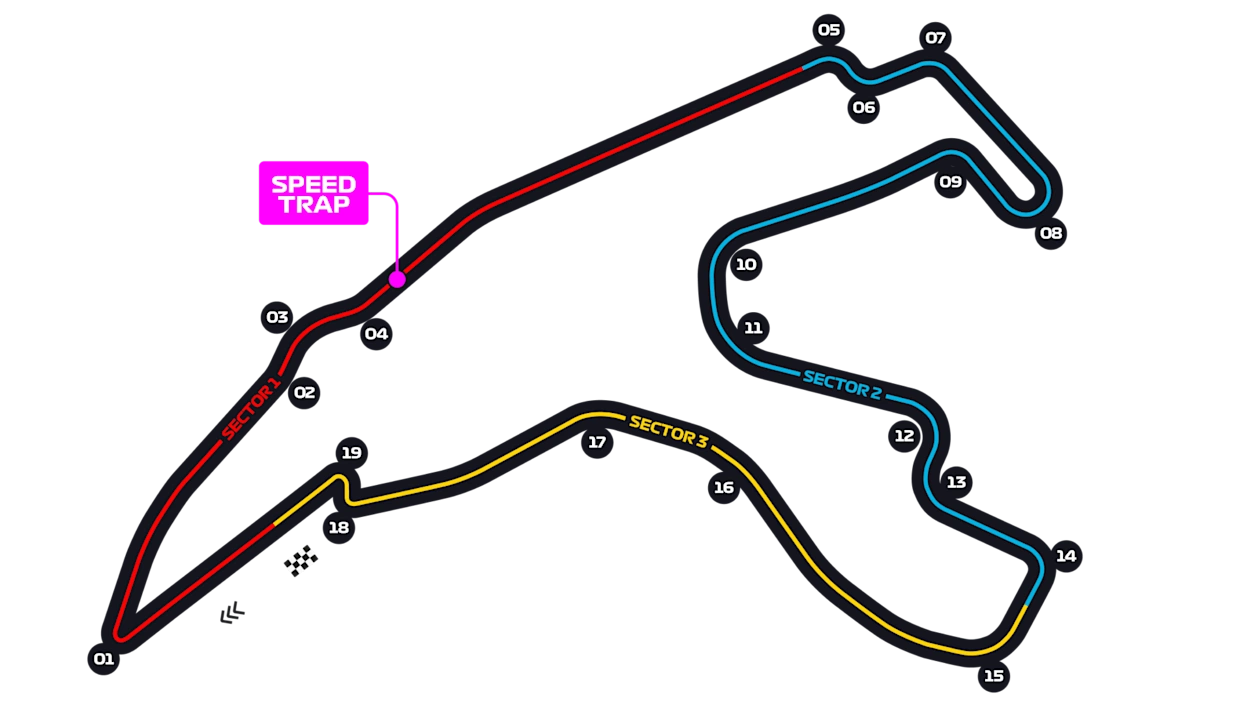
Career timeline
Signature numbers
- Career
- 1950 – 2026
Era
About Circuit de Spa-Francorchamps
Spa-Francorchamps is the longest, fastest and most beloved circuit on the Formula 1 calendar. Sprawling across 7.004 kilometres of Belgian Ardennes woodland, it crams elevation changes that would shame a ski resort, three of the most famous corners in motorsport, and the unique microclimate that allows it to rain on one half of the lap while the other stays dry. Drivers universally name it their favourite. Engineers consider it one of the most revealing setup tests of the year. To win at Spa is to have proven yourself capable of bravery, precision and patience in equal measure.
Origins
The original Spa circuit was traced in 1921 along the public roads connecting the towns of Francorchamps, Malmedy and Stavelot in eastern Belgium. The first race was held in 1922 and the first Grand Prix in 1925. The original layout was a 14.1-kilometre triangular blast through villages and farmland, flat-out for almost the entire lap, that would survive in essentially that form until 1979. The "old Spa" claimed lives at a horrifying rate. Stirling Moss, after escaping unscathed from his sole victory there in 1958, said simply: "Spa will kill you eventually." Drivers Chris Bristow and Alan Stacey both died on the same day in 1960; in 1966 Jackie Stewart suffered the crash in the rain at Burnenville that began his lifelong campaign for circuit safety reform. By 1970 the F1 community had voted Spa unsafe and the race moved to Nivelles and Zolder. The shortened modern circuit, the one we know today, opened in 1983. The designers preserved Eau Rouge, La Source, Stavelot and Blanchimont from the original layout but added a new in-field section through the woods that brought total length down to 6.949 km (later 7.004 km after a kink modification). The result has been almost universally hailed as the rare modern circuit that retained the soul of its predecessor.
Layout
The lap begins at La Source, a sharp right-hand hairpin where contact at the start is almost guaranteed in any race with grid mixing. From La Source the circuit plunges downhill for 800 metres to the Eau Rouge / Raidillon complex — a left-right-left flick taken through a 41-metre vertical compression that is the most photographed corner in motorsport. Modern F1 cars take Eau Rouge flat out; in the 1990s and early 2000s with skinnier tyres and less downforce it was a genuine commitment test, with Jacques Villeneuve, Ricardo Zonta and others crashing spectacularly there in qualifying. After Eau Rouge the cars rocket up the Kemmel Straight, the longest in F1 when DRS is unavailable, where speeds touch 340 km/h and slipstream-and-pass sequences define many races. Les Combes is a tight right-left-right chicane at the top of the hill that is also one of the most popular overtaking points on the calendar. Then comes the descent through Bruxelles, Speakers Corner and Pouhon, a long uphill double-apex left taken in fifth gear at sustained high speed. The middle sector winds through Fagnes, Stavelot and Curve Paul Frère before the circuit drops back down through the woods to Blanchimont — a flat-out fifth-gear left that punishes any imprecision — and the Bus Stop Chicane, the slowest corner of the lap and the final braking zone before the line. Lap times under current regulations are around 1:42, with qualifying speeds approaching 1:40 in optimal dry conditions.
Legendary Moments
The 1992 Belgian Grand Prix saw Michael Schumacher take his first F1 victory, on a circuit he would dominate like no other (six career Spa wins, the record). What made the win extraordinary was that Schumacher pitted from second place specifically to switch to dry tyres while Senna stayed out — a gamble vindicated within two laps as the track dried. The 1998 Belgian Grand Prix produced two of the most spectacular incidents in F1 history within minutes of each other. The race start, in heavy rain, triggered a 13-car pile-up at La Source, the largest opening-lap accident in modern F1. After a one-hour cleanup and restart, Schumacher led easily until he ploughed into the back of David Coulthard's lapped McLaren on the Kemmel Straight in the spray, tearing off Schumacher's right front wheel. Schumacher returned to the pits on three wheels and famously stormed into the McLaren garage to confront Coulthard, accusing him of trying to kill him. The 1995 race featured one of the great drives of Schumacher's career — he overtook Damon Hill for the lead at Bruxelles using two wheels on the grass, a manoeuvre Hill called "completely over the top". Schumacher won by 19 seconds. In 2008, the closing-lap battle between Lewis Hamilton and Kimi Räikkönen in worsening rain produced the most controversial race finish of the era. Hamilton overtook at the Bus Stop chicane, gave the place back, then re-overtook at La Source. Stewards stripped him of the win for the original chicane cut; Hamilton fans never accepted the verdict. The 2014 race produced the Mercedes turbo-hybrid era's defining team-mate collision: Nico Rosberg's clumsy attempt at Les Combes ripped Hamilton's left rear tyre and forced his retirement, igniting a championship feud that would dominate the sport for three years.
Quirks & Curiosities
Spa's microclimate is genuinely unique in F1. The circuit's elevation changes (over 100 metres of vertical between high and low points) and its position in the Ardennes mean the back half can be in a downpour while the front straight is dry. The 2021 Belgian Grand Prix was famously declared "complete" after just two laps behind the safety car in unraceable rain, with half-points awarded — the shortest "race" in F1 history. Eau Rouge takes its name from the Eau Rouge stream that runs under the circuit at the bottom of the compression. The water has a reddish tinge from iron in the surrounding rocks. Raidillon is technically the uphill section after Eau Rouge proper; many drivers and fans use the names interchangeably. The Kemmel Straight is named after the village of Kemmelberg, visible from the top of the climb. Spectators on the hillside between Eau Rouge and Kemmel form one of F1's most atmospheric standing-room sections. Despite being in Belgium, the Belgian Grand Prix is almost as much a Dutch event by attendance — Max Verstappen's home race in everything but geography. The Orange Army takes over entire grandstands, particularly since Verstappen's first Belgian win in 2021.
Modern Era
Spa underwent a major safety redesign in 2022, with new run-off areas at Raidillon, Blanchimont and Pouhon following the death of Anthoine Hubert in the 2019 F2 race. The work was controversial — purists argued the new gravel traps and concrete walls compromised the corners' character — but universally accepted as necessary. The circuit's contract was renewed through 2031 in a deal that includes rotational scheduling: Spa hosts every year, Imola alternates. Liberty Media consistently rates Spa among its top three "must-keep" circuits in the event of calendar contractions. As Niki Lauda once said: "If you don't like Spa, you don't like motor racing."