

SochiAutodrom
Career timeline
Signature numbers
- Career
- 2014 – 2021
Era
About Sochi Autodrom
The Sochi Autodrom, a 5.848-kilometre layout that wove around the 2014 Winter Olympic Park on Russia's Black Sea coast, was the calendar's most politically loaded venue from its 2014 debut until its 2022 cancellation following Russia's invasion of Ukraine. Though universally criticized by drivers as one of the most boring layouts ever designed by Hermann Tilke, the Sochi venue produced several memorable championship moments — including Lewis Hamilton's historic 100th career victory in 2021 — before its abrupt disappearance from F1.
Origins
The Russian Grand Prix was a personal initiative of President Vladimir Putin, who in 2010 announced a $250 million project to build a permanent F1 circuit at the Sochi Olympic Park, three years ahead of the 2014 Sochi Winter Olympics. The project was driven by Putin's desire to use the post-Olympics venue as a year-round sports- tourism destination and to position Russia as a major motorsport host. Hermann Tilke designed the layout to incorporate the existing Olympic Park infrastructure, with the start-finish straight running alongside the Bolshoi Ice Dome and the back straight passing the Fisht Olympic Stadium. The result was a 5.848-kilometre layout that prioritised visual integration with the Olympic Park architecture over racing quality — a compromise that was widely criticized by drivers and engineers from the inaugural race onward. The first race was held on October 12, 2014, won by Lewis Hamilton's Mercedes by a comfortable margin. The race was held just months after Russia's annexation of Crimea, and the political tension surrounding Putin's presence at the race weekend was a topic of F1 broadcasting commentary throughout the event. The Russian Grand Prix was held annually from 2014-2021. Following Russia's full-scale invasion of Ukraine in February 2022, the FIA and Liberty Media immediately cancelled the planned September 2022 Russian Grand Prix and have not returned to Sochi since.
Layout
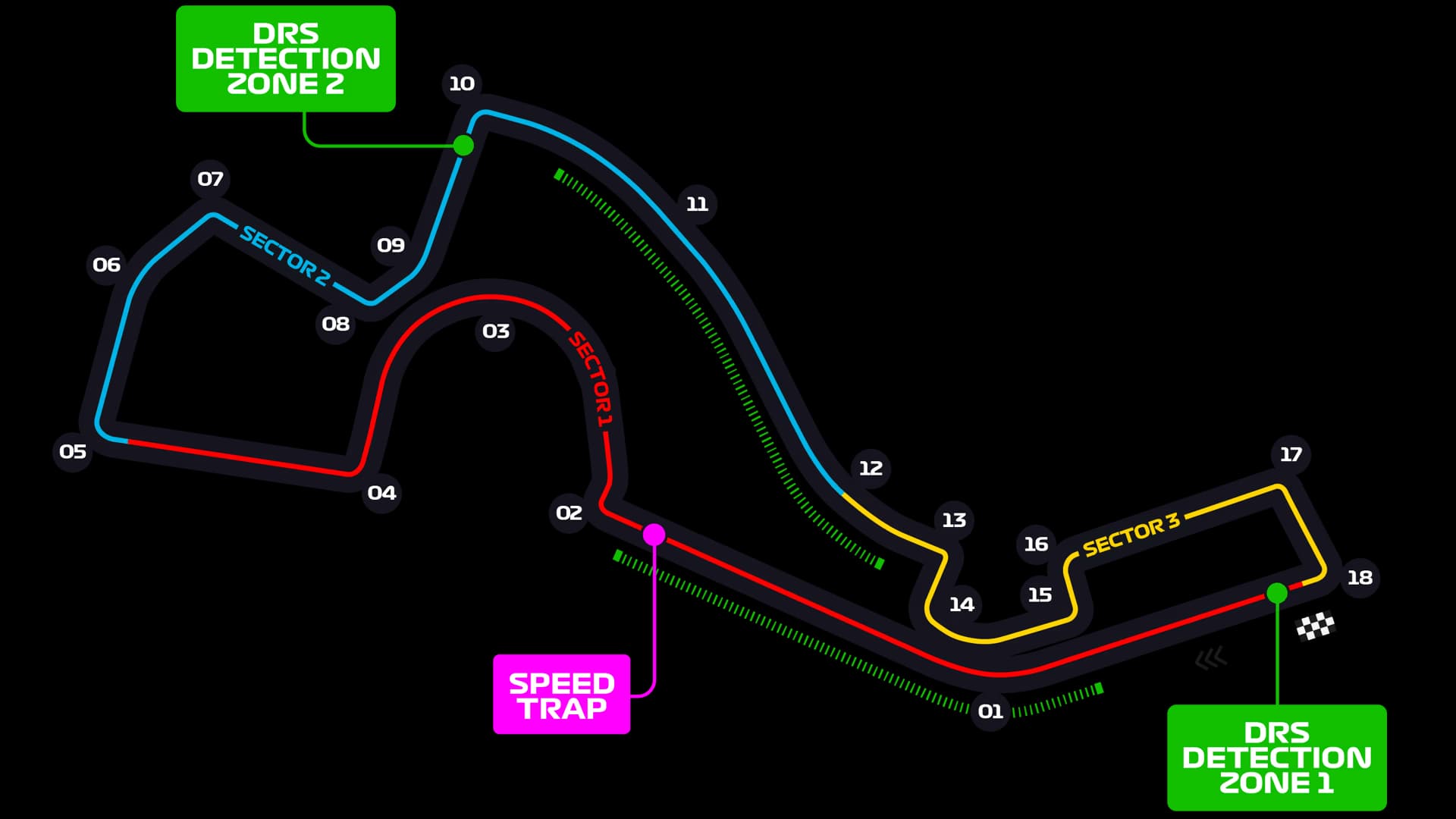
The 5.848-kilometre lap has 18 corners arranged in a flowing configuration that wraps around the Olympic Park. The opening sector includes the long Turn 1 right-hander and the slow Turn 2 hairpin where DRS-aided overtaking is common. The middle sector includes the famous Turn 3 — a constantly-tightening 180-degree right-hander that has been the site of multiple race-deciding incidents — and the long Turn 4-7 sequence that flows through the Olympic Park. The 1,070-metre back straight from Turn 12 to Turn 13 is one of F1's longest, with cars exceeding 320 km/h before the heavy braking into the slow Turn 13 hairpin. The final sector includes the slow Turn 14-15 chicane and the medium-speed Turn 16-18 sequence that returns to the start-finish straight.
Legendary Moments
The 2014 inaugural race was Lewis Hamilton's emphatic statement of intent for the season — the British driver winning by over 13 seconds in conditions where his Mercedes was clearly the class of the field. The race was the first F1 event held in Russia and was attended by President Putin in his private box. The 2018 race produced one of F1's most controversial team-orders moments — Mercedes ordered Valtteri Bottas (then leading) to let Lewis Hamilton pass for the win, with the result swinging the championship momentum decisively in Hamilton's favor. The ethical debate about team orders that followed dominated F1 broadcasting commentary for weeks. The 2021 race produced Lewis Hamilton's historic 100th career victory — the first F1 driver ever to reach that milestone. The win came in damp-to-dry conditions where Hamilton's masterclass in tyre management gave him a 27-second margin over Max Verstappen. The 2021 race was also the last F1 event held at Sochi before the February 2022 cancellation of all Russian motorsport events following the invasion of Ukraine.
Quirks & Curiosities
The Sochi Autodrom is the only F1 circuit ever built around an Olympic Park venue — the layout deliberately incorporates the Bolshoi Ice Dome, Fisht Olympic Stadium, and other Olympic infrastructure into the racing line. The integration was designed to position the Olympic Park as a year-round sports-tourism destination, but the combination of cold-climate venues and warm-climate F1 racing was never fully successful. The Russian Grand Prix was the political most loaded event on the F1 calendar from its 2014 debut onward. President Putin attended every race, and his presence in the paddock and on the podium was a constant source of F1 broadcasting commentary. The 2014 race was also held just months after Russia's annexation of Crimea, generating significant international political controversy. The circuit's flat layout — with no significant elevation changes — was widely criticized by drivers as one of the most boring layouts ever designed by Hermann Tilke. The criticism was a frequent topic of F1 broadcasting commentary throughout the seven-year run of the Russian Grand Prix. The 2020 race was the first F1 event held at Sochi after the COVID pandemic, and was held with limited spectator attendance. The race was won by Valtteri Bottas in a tactical battle with Mercedes teammate Lewis Hamilton.
Modern Era
The Russian Grand Prix has been off the F1 calendar since 2022, with the FIA and Liberty Media maintaining their position that no F1 events will be held in Russia until the Ukraine war is resolved. The Sochi Autodrom continues to host Russian national motorsport championships, but its long-term future is uncertain. A planned new Russian F1 venue at the Igora Drive complex near St. Petersburg — which was awarded the 2023 Russian Grand Prix that was later cancelled — has been put on indefinite hold. As of April 2026, there is no expectation of a Russian F1 return in the foreseeable future, and the Sochi venue remains one of F1's most politically loaded chapters.