

SilverstoneCircuit
Career timeline
Signature numbers
- Career
- 1950 – 2026
Era
About Silverstone Circuit
Silverstone is where Formula 1 began. On 13 May 1950 the first round of the inaugural Formula One World Championship was contested on this disused Northamptonshire airfield, won by Giuseppe Farina in an Alfa Romeo 158, in the presence of King George VI and Queen Elizabeth — the only time a reigning British monarch has attended a Grand Prix. From that founding moment Silverstone has remained the home of the British Grand Prix (with brief sharing arrangements with Aintree and Brands Hatch in earlier decades) and the symbolic capital of motorsport. It is to F1 what Wimbledon is to tennis or the Old Course at St Andrews to golf.
Origins
The airfield was built in 1942 as RAF Silverstone, a bomber training base for Wellington crews. After the war it sat derelict until the Royal Automobile Club leased it from the Air Ministry in 1948 for motor racing. The first layout was a quick chalk-and-string job using the perimeter roads and runways themselves, marked by hay bales. The famous Becketts and Stowe corners were already there in essentially their current geometry, though the rest of the layout has changed substantially across multiple reconfigurations. The 1948 RAC International Grand Prix, won by Italian Luigi Villoresi, was the first international race on British soil since the war and confirmed Silverstone's viability. By the time the World Championship arrived in 1950, the chalk had been replaced by oil-drum markers and the haybales by earthen banks. The British Racing Drivers' Club purchased the freehold in 1971 and has owned it ever since — making Silverstone one of the very few major F1 circuits that is owned and run by drivers.
Layout
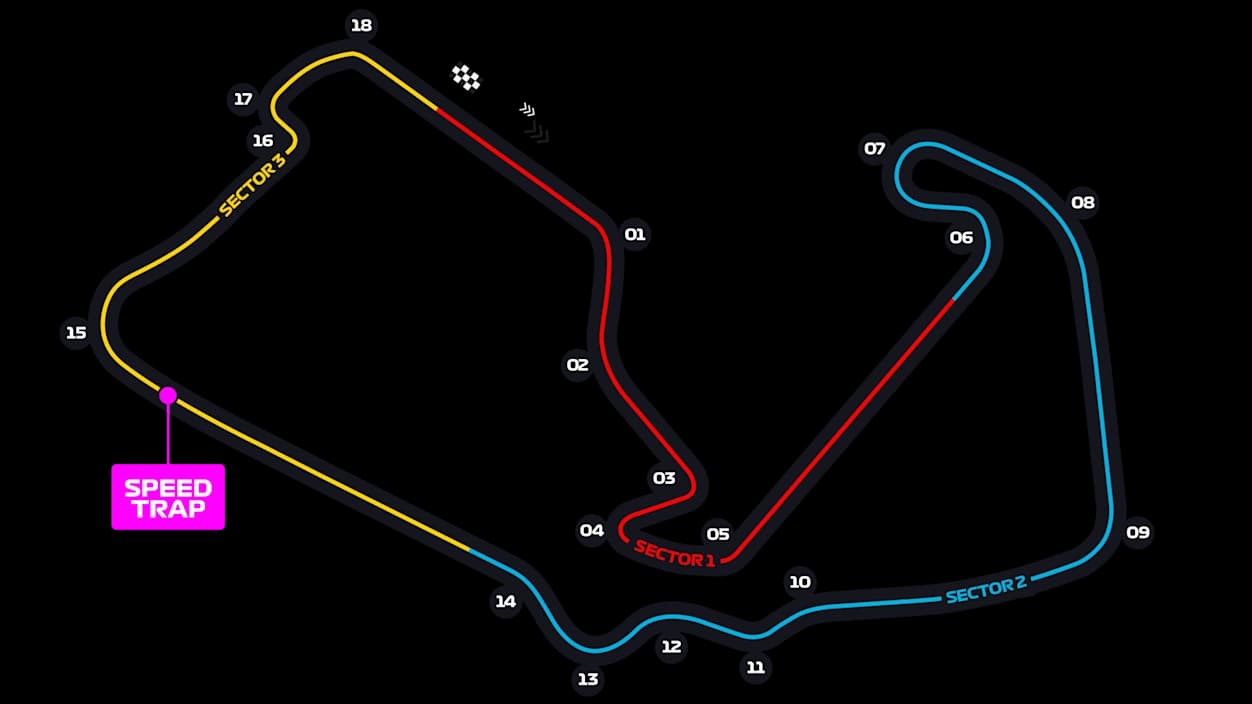
The current 5.891-kilometre layout dates from the 2010 reconfiguration that added the new "Arena" complex to address the previous version's lack of overtaking opportunities and to accommodate the new Wing pit complex. The lap is fast, sweeping and absolutely brutal on tyres — the right-front in particular is loaded heavily through the Maggotts-Becketts-Chapel sequence, which generates more sustained lateral G than any other corner complex in F1 outside of the high-speed sweepers at Suzuka. A flying lap begins on the Hamilton Straight (renamed in 2020 from the National Pits Straight in honour of the seven-time World Champion's record British GP victories). The first corner is Abbey, taken flat in modern cars with DRS, leading into Farm Curve and Village. Then The Loop — a slow left- hand hairpin — and the Aintree right onto Wellington Straight. Brooklands and Luffield are tight, technical, hard on brakes; Woodcote leads onto the National Pits Straight and the historic stretch. The famous Maggotts-Becketts-Chapel complex is a high-speed left-right-left- right-left sequence taken at sustained 250+ km/h that defines the lap. Get it right and you carry massive speed onto the Hangar Straight; get it wrong and you bleed time everywhere. Then comes Stowe — historically the fastest corner in F1, where Michael Schumacher broke his leg in 1999 and where countless qualifying laps have been won and lost — followed by the Vale chicane and the long Club corner that loops back to the start-finish.
Legendary Moments
The 1969 British Grand Prix is the canonical example of why F1 is sometimes described as a wheel-to-wheel art form. Jackie Stewart and Jochen Rindt swapped the lead 35 times in 84 laps, often by half a wheel-width, in two of the era's defining cars (the Matra MS80 and the Lotus 49). Rindt's car ultimately developed an exhaust crack and he dropped to fourth; Stewart won. Cinéma vérité-style footage of the duel is still played as proof of what F1 can be. In 1973, Jody Scheckter caused the largest accident in F1 history (until Spa 1998) by spinning his McLaren on the run to Woodcote and triggering a multi-car pile-up that destroyed nine cars and put Andrea de Adamich into the barriers with leg injuries that ended his career. The incident prompted the introduction of the Woodcote chicane in 1975. The 1987 British Grand Prix produced the most-replayed wheel-to-wheel moment in British motorsport history. Nigel Mansell, having lost a wheel weight and dropped 30 seconds behind team-mate Nelson Piquet, drove a shocking comeback. The decisive overtake, with Mansell selling Piquet a classic dummy on the entry to Stowe and stealing the inside, was watched by an estimated 200,000 spectators. The crowd invasion that followed was so dense that Mansell's Williams was carried back to the paddock by hand. The 2008 race in monsoon conditions, with Hamilton lapping the entire field except second-place Nick Heidfeld, was the most dominant rain drive of the modern era — a 68-second margin of victory that announced Hamilton's first title-contending season in serious style. In 2020, Hamilton's blown-tyre victory on the final lap, dragging his three-wheeled Mercedes across the line ahead of Verstappen, was the most viewed British motorsport moment in two decades.
Quirks & Curiosities
Silverstone's location on a former airfield gives it the most exposed, weather-vulnerable layout on the calendar. There is essentially no windbreak; the wind direction can change tyre wear, brake cooling, and overtaking dynamics dramatically between sessions. Drivers routinely complain about Silverstone winds. Many of the support buildings on-site are former military structures, visible on the in-field. The control tower from RAF days still stands and is used for race-control purposes during smaller events. Silverstone hosts more racing days per year than any other F1 venue — typically over 300, including everything from karting to historic races to trackdays. The circuit has multiple loop configurations (National, Stowe, International) used by lower formulae. The first lap of every British Grand Prix is traditionally one of the most chaotic of the year because the high-speed downhill run from Abbey to Village concentrates the field into a fast, narrow funnel. Verstappen- Hamilton in 2021 (Verstappen pitched into the Copse barriers at over 250 km/h, in the fastest crash in F1 history at 51G) is the most famous recent example.
Modern Era
The £40m Wing pit complex opened in 2011 and gave Silverstone the most modern facilities in F1, ending a long period of grandstand and paddock underdevelopment that had embarrassed the BRDC. The contract was secured through 2034 in 2024, locking in the British Grand Prix for another decade. Silverstone now routinely hosts attendance of over 480,000 across the race weekend — the largest in F1 history — driven by the Hamilton-era boom and a deeply rooted British motorsport culture. The combination of Hamilton and Norris-Russell has kept the British contingent at the front of the grid in nearly every season since 2007. The home crowd does not let them forget it.