

ShanghaiInternational Circuit
 ChinaShanghaiEntry 2004Active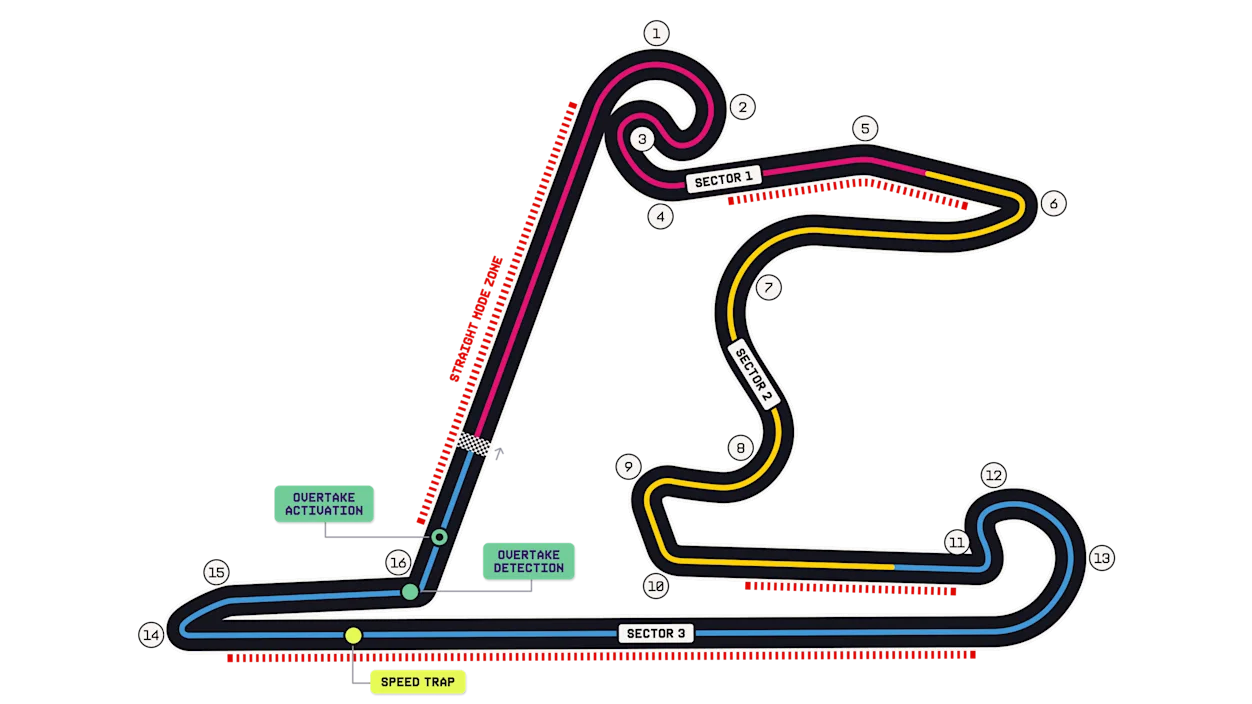
Career timeline
Signature numbers
- Career
- 2004 – 2026
Era
About Shanghai International Circuit
The Shanghai International Circuit, opened in 2004 in the Anting district of Jiading, is the most architecturally ambitious circuit ever built — a 5.451-kilometre layout designed to spell out the Chinese character "shang" (上, meaning "above" or "ascend"), with a $450 million pit-paddock complex modeled on the Shanghai Lujiazui financial district. After a tumultuous decade of attendance struggles in the 2010s and a five-year COVID-related absence (2020-2023), the Chinese Grand Prix returned in 2024 to an enthusiastic local following.
Origins
The Shanghai International Circuit was the most ambitious motorsport project in history when announced in 2002. The Shanghai municipal government, led by Mayor Han Zheng (later Vice Premier of China), committed approximately $450 million to the project as part of a broader strategy to position Shanghai as Asia's premier sporting capital. Hermann Tilke designed the layout to spell out the Chinese character "shang" (上) when viewed from above — the unique configuration was a cultural homage that became one of F1's most photographed signatures. The pit-paddock complex was built as a giant mirror-image of Shanghai's Lujiazui financial district, with two 60-storey hospitality buildings flanking a glass-and-steel media centre. Construction took 18 months and was completed in early 2004. The inaugural race on September 26, 2004 was won by Rubens Barrichello's Ferrari, with the race attracting over 200,000 spectators across the weekend. The Chinese Grand Prix was on the F1 calendar from 2004-2019 before being cancelled in 2020 due to the COVID outbreak. Subsequent cancellations in 2021, 2022, and 2023 were due to a combination of ongoing COVID restrictions, local political concerns, and Liberty Media's strategic uncertainty about the Chinese market. The race returned in 2024 with a renewed five-year hosting contract through 2030.
Layout
The 5.451-kilometre lap has 16 corners arranged in the unique "shang" character configuration. The opening sector includes the famous Turn 1 — a constantly-tightening right-hander that spirals into Turn 2 and the slow Turn 3 hairpin — that has been the site of multiple race-deciding incidents. The middle sector flows through the technical Turn 4-9 sequence, including the long Turn 7 right-hander where understeer is common. Turn 10 is a slow chicane that has been criticized for limiting overtaking opportunities. The 1,170-metre back straight from Turn 13 to Turn 14 is one of F1's longest, with cars exceeding 320 km/h before the heavy braking into the slow Turn 14 hairpin. DRS-aided overtaking is common. The final sector includes the medium-speed Turn 15 sequence and the short final straight that returns to the start-finish.
Legendary Moments
The 2007 race was Lewis Hamilton's first F1 disaster — leading the championship by 12 points entering the race, he ran wide at the pit-lane entry on his second-to-last lap and beached his McLaren in the gravel, ending his race in 0 points and turning the championship fight into a three-way battle that ultimately went to Kimi Räikkönen. The 2010 race produced one of F1's great wet-dry battles, with Jenson Button winning his second race in a row for McLaren after a tactical masterclass against the Red Bulls of Sebastian Vettel and Mark Webber. The 2017 race was Lewis Hamilton's emphatic statement of intent for the season — the British driver winning by over 6 seconds in conditions where his Mercedes was clearly the class of the field. The result effectively decided the 2017 championship before May. The 2024 return race was Max Verstappen's victory after a five-year F1 absence from China — the result was Verstappen's seventh straight race win to start the 2024 season and confirmed the dominance that would define the year.
Quirks & Curiosities
The Shanghai pit-paddock complex is one of F1's most architecturally distinctive — two 60-storey hospitality buildings (the "twin towers") flank a glass-and-steel media centre that resembles a Chinese fan. The complex cost approximately $250 million and is one of the most expensive pit facilities in motorsport. The track's "shang" character configuration is best appreciated from satellite imagery — the unique shape was a cultural homage by Hermann Tilke to the host city's name (Shanghai literally means "above the sea"). The character is most clearly visible when viewing the Turn 1-3 sequence and the back straight. The 2010 race had to be moved from its traditional April date due to extreme rain forecasts, with the race ultimately held in conditions that varied between brief sunshine and intense thunderstorms across the 90-minute race window. The unstable weather produced one of the most strategically complex races of the modern era. The Chinese Grand Prix has long been one of F1's quietest races in terms of crowd noise, with the local audience showing more reserved support compared to the wild celebrations at Singapore or Mexico. This cultural difference has been a topic of F1 broadcasting commentary for years.
Modern Era
Shanghai's hosting contract was renewed in 2023 and runs through 2030, returning the Chinese Grand Prix to the F1 calendar after a five-year absence. The 2024 race was a critical test of whether the Chinese market could re-engage with F1 after the long break, and the results were positive — over 200,000 spectators attended across the weekend, and TV viewership exceeded pre-pandemic levels. The race weekend has become important for F1's commercial strategy in Asia, with Liberty Media using Shanghai as a base for partnership discussions with Chinese sponsors and broadcasters. The race is contracted through 2030 and is one of F1's most strategically important venues for the Asian market expansion.