
AutódromoHermanos Rodríguez
 MexicoMexico CityEntry 1963Active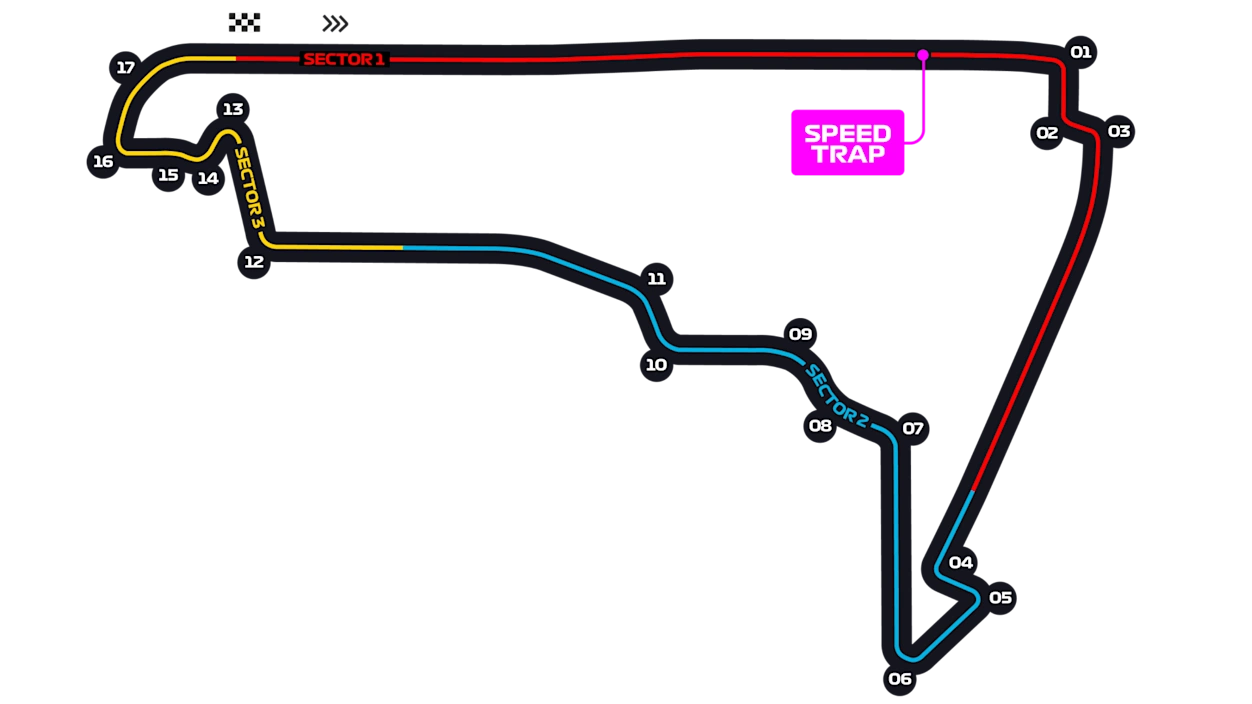
Career timeline
Signature numbers
- Career
- 1963 – 2026
Era
About Autódromo Hermanos Rodríguez
Origins
The Autódromo Hermanos Rodríguez in the eastern fringe of Mexico City is one of Formula 1's most distinctive venues, a circuit forever associated with high altitude, wild atmosphere and the two Mexican brothers whose name it bears. Originally opened in 1959 as the Magdalena Mixhuca circuit on the grounds of a former dry lakebed, it was renamed in 1962 to honour Ricardo Rodríguez after his death at age 20 during practice for the non-championship Mexican Grand Prix at the same venue — a posthumous honour later extended to include his elder brother Pedro after Pedro's own death at the Norisring in 1971.
Three F1 Eras
Mexico City's F1 history splits into three distinct chapters. The first ran 1963-1970 — the years when the venue debuted on the championship calendar and provided some of the era's most evocative racing. The 1964 race was the championship decider between Graham Hill, John Surtees and Jim Clark; Surtees clinched the title for Ferrari after a chaotic final round in which Clark's Lotus failed and Hill suffered a clash. The 1970 race was marred by appalling crowd control — spectators sat on the trackside grass with no barriers — and after that edition F1 abandoned Mexico for sixteen years. The second era ran 1986-1992, returning to a partially-revised circuit. This period gave the world the legendary Peraltada — the immense banked final corner taken flat in the cars of the era. Nigel Mansell's 1990 victory after a famous outside-pass on Gerhard Berger at Peraltada is iconic. Ayrton Senna's 1991 race weekend was overshadowed by his huge Friday accident at the same corner, when his McLaren bottomed out at high speed and barrel-rolled — Senna walked away unhurt but Mexico's safety profile was already troubling F1's growing professionalisation, and the race left the calendar after 1992. The third era began in 2015 after a major Hermann Tilke redesign that converted Peraltada into a slower, safer infield section using the baseball stadium's foul-line area as the new "Foro Sol" stadium section. This contemporary version trades the Peraltada's terrifying speed for a stadium spectacle of packed fans roaring as cars cross the slow tight stadium curves. Lewis Hamilton clinched the 2017, 2018 and 2019 world titles at this venue, often through dominant Mercedes weekends in the thin Highveld-style air; Max Verstappen has dominated the more recent era with multiple Mexico City wins for Red Bull.
Altitude and Engine Demands
Mexico City sits at 2,240 metres above sea level — the highest race on the F1 calendar. The thin air robs naturally aspirated engines of around 25% of their power and reduces aerodynamic downforce proportionally, producing an unusual handling balance and demanding cooling solutions. In the turbo era this produces extreme demands on intercoolers and exhaust systems; lap times are deceptively fast on the long straights despite the reduced grip. Brake cooling is also marginal — the long full-throttle sections give brakes little airflow recovery time, and several races have seen brake failures decide outcomes.
The Foro Sol Spectacle
The modern Foro Sol section, where the cars wind through what is otherwise a baseball stadium, is one of contemporary F1's signature settings. Tens of thousands of fans pack the curved seating and create a noise wall reminiscent of football stadia, with podium ceremonies held inside the stadium itself, providing a unique atmosphere that feels closer to a football final than a grand prix podium. Sergio Pérez's home crowd became a defining element of the modern Mexico City weekend during his Red Bull years.
Legacy
The Autódromo Hermanos Rodríguez is more than a circuit — it is a memorial to two of Mexican motorsport's greatest losses, a reminder of the danger that defined 1960s grand prix racing, and a stage for some of contemporary F1's most evocative atmospheres. The transition from the daring open-throttle Peraltada to the corporate-stadium Foro Sol embodies the broader story of grand prix racing's evolution from raw spectacle to managed entertainment, while the altitude and the brothers' name preserve the venue's irreducibly Mexican character.