

CircuitPaul Ricard
 FranceLe CastelletEntry 1971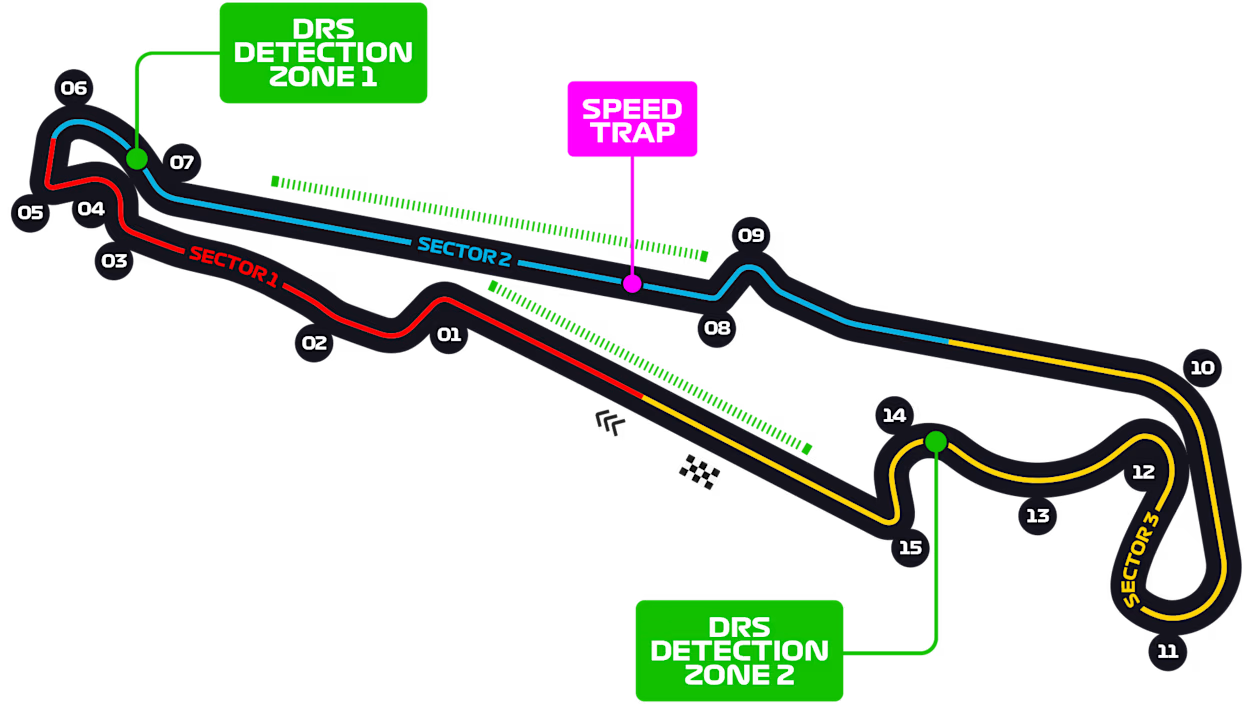
Career timeline
Signature numbers
- Career
- 1971 – 2022
Era
About Circuit Paul Ricard
Origins
The **Circuit Paul Ricard** opened in 1970 in the Provençal hills above the village of Le Castellet, 40 km east of Marseille, France. It was funded entirely by **Paul Ricard**, the billionaire pastis magnate, who built it as both a racing facility and a personal monument. Ricard wanted a circuit that embodied modern thinking — wide, well-paved, with an unusually long main straight and ample run-off that was ahead of its time. The track hosted the **French Grand Prix on and off from 1971 to 1990** (alternating with Dijon-Prenois) and then disappeared from F1 for **27 years**, until it returned in 2018 under heavy renovation. In 1999, Bernie Ecclestone bought the circuit and turned it into a high-tech testing facility — at the time the most-used private test track in F1.
Layout
The original Paul Ricard layout was **5.810 km** with the infamous **Mistral Straight** — 1.8 km of pure flat-out running ending in the daunting Signes corner (a near-flat right at ~290 km/h). The original lap had **15 corners** including the School Esses (Turns 9–11) and the long Beausset right-hander that flowed into the start straight. For the **2018 F1 return**, the circuit was modernised with the **Painted Run-off Areas** that became its visual signature — blue and red striped tarmac instead of gravel, providing abrasive friction to slow off-line cars without the costs and recovery delays of gravel traps. The Mistral was split with a chicane to reduce speeds. The full F1 layout is now **5.842 km with 15 corners**, very similar to the original but safer. The **painted run-off** is unique: blue stripes are normal asphalt, red stripes are abrasive. The "Tecpro red" sections provide enough grip to control a slide but enough abrasion to shred tyres if abused. Drivers who go off the painted strip hit conventional gravel.
Legendary Moments
**1971 — Stewart's first F1 win at Le Castellet**: Jackie Stewart won the inaugural French GP at Paul Ricard for Tyrrell, beginning his 1971 championship campaign. **1989 — Prost's home win**: Alain Prost won his home Grand Prix in front of his home crowd, lapping every car except runner-up Nigel Mansell. The win was symbolic — Prost vs Senna at McLaren was at its bitter peak. **2018 — F1 returns after 28 years**: Lewis Hamilton won the first French GP at Paul Ricard since 1990, beating Max Verstappen and Kimi Räikkönen. The race was strategically interesting but the painted run-off and crash structures generated controversy — drivers complained the track had no "penalty" for off-track moments, allowing them to push wider than would be possible elsewhere. **2019–2022 — Hamilton/Verstappen battles**: The 2019 race saw Hamilton ease to victory as the field lacked competitive opposition. The 2022 race ended with **Charles Leclerc crashing out of the lead** at the high-speed Beausset corner on lap 18 — a single error that arguably cost him the title when momentum shifted to Verstappen.
Quirks & Curiosities
The painted run-off is **deliberately asymmetric**: more abrasive in some sectors than others. Engineers studied which corners produced the most off-track incidents and designed the painted patterns to match. The **Mistral Straight** is named after the dry, cold wind that blows through Provence — strong enough to genuinely affect car straight-line speed and direction. The **paddock** sits next to a small private airstrip — F1's only circuit where you can land your private jet next to the paddock entrance. This was central to Ecclestone's vision of a "VIP-only" facility, before the 2018 commercial F1 return. The pre-2018 era featured **extensive testing**: McLaren, Ferrari, and Williams ran weeks of testing here every winter, producing more lap data than any other circuit. Engineers have decades of correlation data from Paul Ricard, making its lap times unusually predictive of broader season form.
Modern Era
Paul Ricard **hosted F1 from 2018 to 2022** then was dropped from the calendar after the 2022 race. The official reason was financial: the circuit no longer wanted to pay sanctioning fees and wanted a long-term commitment that the French market couldn't justify. The 2022 race attracted ~100,000 spectators across the weekend — well below the break-even. France lost its F1 race entirely after 2022. Discussions about returns to Magny-Cours, a Marseille street circuit, or returning to Paul Ricard surface periodically but no firm plans exist as of 2026. The circuit remains active for international and national testing, the FIA WEC's Le Castellet round, and continues to operate as a high-end private test facility. It maintains FIA Grade 1 certification. For F1 history, Paul Ricard represents both the **flat-out turbo era** of the 1970s–80s and the **painted-run-off modern era** — two very different identities sharing the same Mistral straight.