

Reims-Gueux
 FranceReimsEntry 1950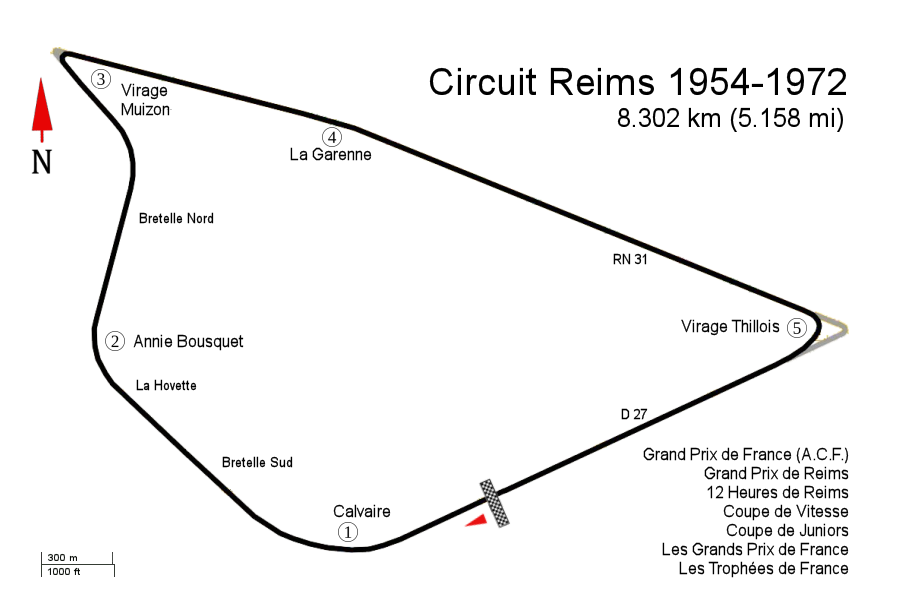
Career timeline
Signature numbers
- Career
- 1950 – 1966
Era
About Reims-Gueux
Origins
The **Reims-Gueux** circuit ran on closed public roads through the Champagne countryside, 8 km west of the cathedral city of Reims, France. First used for the **French Grand Prix in 1925**, it became one of F1's defining venues from the championship's first season — hosting the **French GP 11 times between 1950 and 1966**, alternating with Rouen-Les Essarts and Clermont- Ferrand. The circuit was a triangular layout of public roads — the RD27, RD26, and RD380 — closed once a year for racing. The character was pure flat-out **slipstream racing**: long straights, very fast curves, and tactical drafting battles that produced some of F1's most spectacular finishes.
Layout
The classic Reims layout was **8.302 km, 6 corners** — extraordinarily long and fast for an F1 circuit. The lap consisted essentially of **three long straights** connecting three high-speed corners: - **Virage de la Garenne** — fast right at the end of the start straight. - **Muizon Straight** — 2 km flat-out section through farmland. - **Thillois Hairpin** — the only slow corner, sharp left before the long final straight back to the pits. - **Final straight** — 2.4 km of pure slipstream territory. Average lap speeds exceeded **200 km/h** as early as 1956 — making Reims the fastest road circuit in F1 until Spa overtook it in the late 1950s.
Legendary Moments
**1953 — Mike Hawthorn's first F1 win**: Hawthorn won the French GP at Reims for Ferrari, beating Juan Manuel Fangio in a slipstream battle that decided the lead a dozen times over the final 10 laps. Hawthorn became the **first British driver to win an F1 World Championship Grand Prix**, a landmark moment for British motorsport. **1954 — Mercedes Silver Arrows return**: Juan Manuel Fangio won the French GP for Mercedes — the German manufacturer's **triumphant return** to Grand Prix racing after WWII. The streamlined Mercedes W196 averaged 185 km/h on the Reims straights, a stunning display. **1958 — Mike Hawthorn's championship season**: Hawthorn won again at Reims, becoming **Britain's first F1 World Champion** that year for Ferrari. He retired immediately after the season and was killed in a road accident three months later. **1961 — Giancarlo Baghetti's debut win**: In one of F1's most extraordinary debuts, Baghetti won the French GP at Reims **in his very first championship Grand Prix**, driving a Ferrari for the FISA team. He remains the **only F1 driver in history to win his championship debut race**. **1966 — Last F1 race at Reims**: Jack Brabham won the French GP at Reims, the venue's final F1 visit. The race was overshadowed by mounting safety concerns about racing on public roads at modern F1 speeds.
Quirks & Curiosities
The circuit ran through **Champagne vineyards** — the same region that produces Veuve Clicquot, Pol Roger, and Moët & Chandon. The post-race champagne tradition for podium celebrations is partially attributed to Reims race winners spraying local champagne in the early 1950s. The **pit straight** had famous **art-deco Pernod and Esso billboards** mounted on the pit complex. Black-and-white photos of these billboards are among the most iconic images of 1950s F1. The circuit is **abandoned** as a racing facility but the public roads still exist and can be driven today. The pit buildings, control tower, and grandstand framework are preserved as a **historic monument** — visitors can walk through the structures and imagine the racing era. The **Thillois Hairpin** was named after a small village where the apex sat. The pre-corner braking zone was on a slight downhill — drivers could see grandstands at the village edge during the braking sequence.
Modern Era
Reims-Gueux has not hosted F1 since 1966. The circuit was formally closed as a racing venue in **1972** after public road safety concerns made hosting any motorsport on the layout impractical. The pit and grandstand structures were saved from demolition by local heritage groups in the 1990s. The site today is a **historic monument** — preserved pit buildings, original signage (faded but visible), and information panels explaining the racing history. **Vintage F1 demonstrations** and historic touring car parades occur annually at Reims, drawing French and international enthusiast crowds. For F1 history, Reims represents the **slipstream era**: flat-out racing on public roads, slipshod safety, and the tactical drafting battles that defined 1950s F1. Mike Hawthorn's 1953 first British win, Fangio's 1954 Mercedes comeback, and Baghetti's 1961 debut victory are among the sport's most-cited moments. The circuit's loss to safety concerns in the late 1960s mirrors the broader transition from road circuits to purpose-built venues.