

RedBull Ring
 AustriaSpielbergEntry 1970Active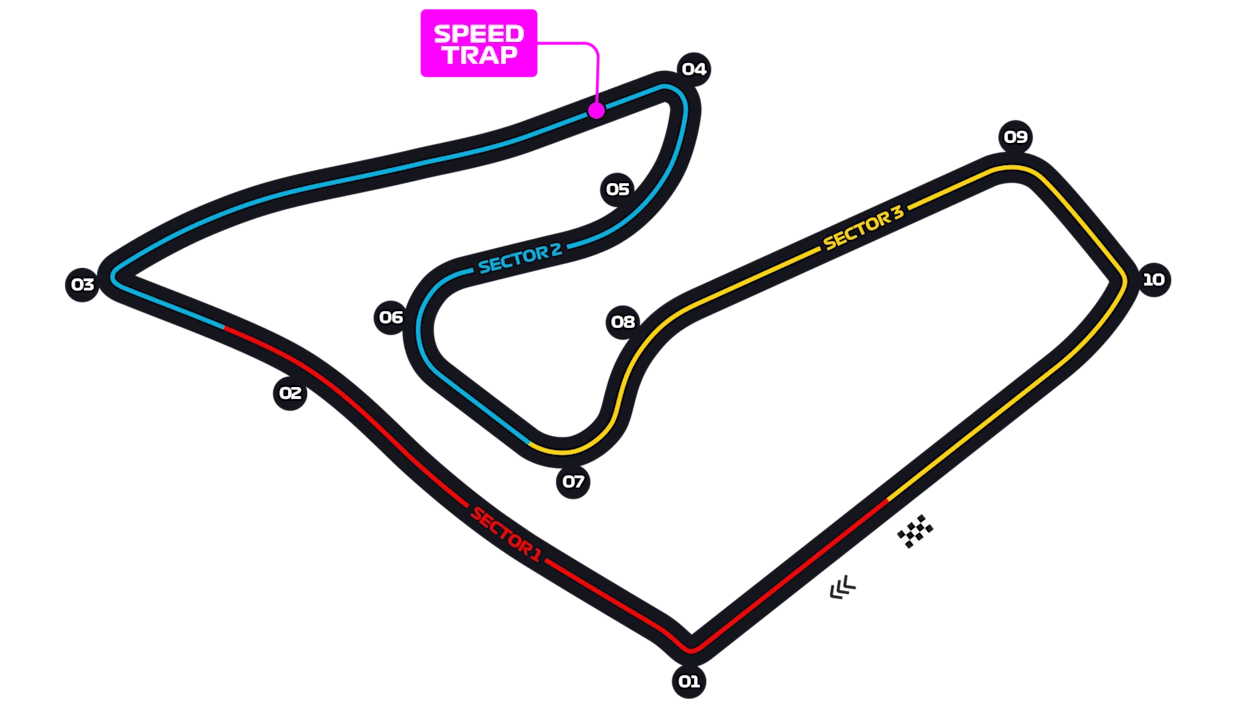
Career timeline
Signature numbers
- Career
- 1970 – 2026
Era
About Red Bull Ring
The Red Bull Ring sits among the rolling green hills of Styria in central Austria, the third incarnation of a circuit that has hosted F1 across three distinct eras: as the Österreichring (1970-1987), the A1-Ring (1997-2003), and finally as the Red Bull Ring since 2014, after Dietrich Mateschitz purchased and resurrected it. At 4.318 kilometres it is among the shortest circuits on the calendar — a punchy 10-corner lap that fits in just over a minute of qualifying — but the elevation changes (60+ metres of vertical), the wide-open run-offs, and the home-team factor make it an annual showcase for what the modern F1 calendar can be.
Origins
The Österreichring was built in 1969 to replace the dangerous Zeltweg Airfield circuit, which had hosted Austria's first F1 race in 1964 and been deemed unraceable by GPDA standards. Designed by Hermann Tilke's predecessor as the FIA's go-to architect — Hans Pichelsdorfer — the original 5.942-km Österreichring was extraordinarily fast, with sweeping turns through the Styrian countryside and an average speed for qualifying laps that exceeded 240 km/h. The Österreichring hosted F1 from 1970 to 1987, producing classic races won by Jacky Ickx, Niki Lauda (twice on home soil), and Alain Prost. By the late 1980s the circuit had become controversial: high-speed corners with no run-off, several fatalities and serious accidents, and the famous 1987 race that started, was red-flagged twice for first-corner pile-ups, and finally completed only after extreme delays. The Österreichring was deemed unsafe and dropped from the calendar. The circuit was rebuilt as the A1-Ring in 1996 — significantly shortened to 4.326 km, with most of the original sweepers replaced by tighter, slower corners and proper run-off. F1 returned in 1997 with a Mika Häkkinen win and remained until 2003, when financial difficulties forced closure. The grandstands were demolished, and the venue sat derelict for nearly a decade. Dietrich Mateschitz, owner of Red Bull and a passionate motorsport enthusiast, purchased the site in 2010 with the explicit intent of restoring it. The reconstruction took four years and €70 million; F1 returned in 2014 with Nico Rosberg's Mercedes win.
Layout
The current Red Bull Ring is essentially the A1-Ring layout with modernised facilities. The 4.318-km lap features 10 corners, of which the first three (Niki Lauda Kurve, Remus, and Schlossgold) are heavy braking zones that produce most of the circuit's overtaking. The middle section through Rauch and the Würth-Kurve flows uphill before the cars descend to Rindt Kurve and the long Power Horse straight. Two of the corners are named after Austrian F1 legends — the first is Niki Lauda Kurve (renamed in 2020 after Lauda's death) and the third was Jochen Rindt Kurve (Austria's only F1 World Champion, who died in 1970). The third sector winds through the Rote Bull Kurve and the Red Bull Tribune complex before returning to the start-finish straight. Lap times are around 1:04-1:05 in qualifying — among the shortest on the calendar. The combination of altitude (the circuit sits at 700 metres above sea level) and short lap length means engine and brake stresses are manageable; Red Bull Ring is widely considered an "easy" weekend for mechanical components.
Legendary Moments
The 2002 Austrian Grand Prix is the defining political moment in modern F1 history. Rubens Barrichello, leading his team-mate Michael Schumacher, was ordered by Ferrari to slow on the final lap and let Schumacher win, under the guise of "team orders". Schumacher took the checkered flag and immediately attempted to put Barrichello on the top step of the podium, to widespread booing from the Austrian crowd. The FIA banned team orders that affected race outcomes immediately afterwards (a rule that lasted until 2010). The 2018 race produced one of the modern era's classic last-lap sequences: with Hamilton retiring from the lead with hydraulic failure, Verstappen inherited and held off Räikkönen by 1.5 seconds for Red Bull's first win at its home circuit. The roar from the orange-clad Dutch contingent (which dominates Austrian Grand Prix attendance) shook the grandstands. The 2020 Austrian Grand Prix was historic for being F1's COVID-era season opener — the first race after the global lockdown, run behind closed doors with strict bubble protocols. Valtteri Bottas won; the absence of crowd noise made the race feel surreal but spotlighted the circuit's natural beauty in a way regular weekends never do. The 2024 race produced one of the era's most-discussed driver moments: Max Verstappen and Lando Norris collided while battling for the lead in the closing laps, with Norris's tyre punctured and Verstappen's car damaged but able to continue. George Russell inherited and won; the incident triggered weeks of debate about wheel-to-wheel etiquette between teammates-in-arms.
Quirks & Curiosities
The Red Bull Ring is the only circuit on the calendar owned and operated by an active F1 team — Red Bull Racing's parent company — which gives Christian Horner and his crew effectively home-race privileges including pit-lane signage advantages, paddock allocation choices, and catering. Other teams have grumbled but the FIA has not intervened. The track surface is unusual in F1: large grass run-offs alongside many corners (rather than asphalt), giving the circuit a more "natural" feel that some compare to Mugello or Brno. The grass tends to ignite when hit by friction-heated tyres, producing the small smoking-grass moments that become weekend memes. Spectator standings on the Red Bull-branded hill above the back straight are among the F1 calendar's most distinctive — a giant stylised bull sculpture overlooks the venue, visible from broadcast helicopter shots, and has become a marketing-iconography fixture. The circuit has hosted the dual Austrian Grand Prix and Styrian Grand Prix (2020-2021) — back-to-back races on the same weekend at the same venue, an arrangement created during COVID and not repeated since.
Modern Era
The Red Bull Ring is contracted through 2030 and has become a calendar fixture that combines Liberty Media's modern-event polish with old-school European Grand Prix character. The Verstappen era has elevated it culturally — Dutch fans treat the Austrian Grand Prix as an extension of Zandvoort, with orange-clad pilgrimages overshadowing the smaller home Austrian crowd. The 2025 race featured a refurbished Tribune Red Bull complex and expanded VIP hospitality. The circuit remains one of the better-attended venues despite Austria's small population, helped by its proximity to Slovenia, Italy, Germany and Hungary.