

Nürburgring
 GermanyNürburgEntry 1951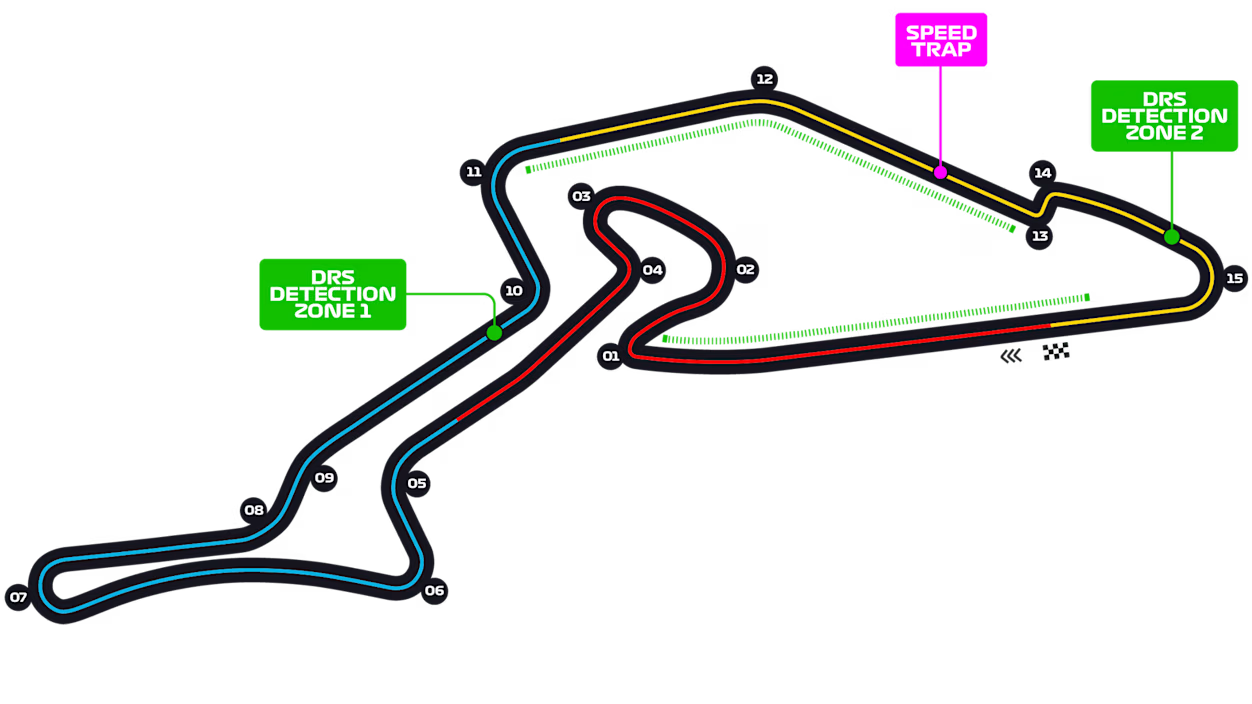
Career timeline
Signature numbers
- Career
- 1951 – 2020
Era
About Nürburgring
The Nürburgring is two circuits in one. The 22.835-kilometre Nordschleife — "Northern Loop" — is the most fearsome racetrack ever built and the venue that Niki Lauda nicknamed "the Green Hell" the morning of his 1976 crash. Adjacent to it sits the modern 5.148-kilometre Grand Prix circuit (sometimes called the GP-Strecke or Nürburgring-Sprintstrecke), built in 1984 to host F1 after the Nordschleife was deemed unraceable. F1 has used the GP circuit intermittently since 1985, hosting variously the German, European, and Luxembourg Grand Prix. The Nordschleife itself last hosted F1 in 1976 — and will not again — but it remains the standard against which all other "challenging" circuits are measured.
Origins
Construction of the Nordschleife began in September 1925 as part of a job- creation programme during the Weimar Republic's economic crisis. It was sited in the Eifel mountains around the village of Nürburg, with its 12th- century castle ruins as the namesake. Built in barely 18 months by 25,000 workers, the circuit opened in June 1927 and immediately became a German showpiece. Rudolf Caracciola won the inaugural Eifelrennen. The original layout combined the 22.8-km Nordschleife with a 7.7-km Südschleife (Southern Loop) for a total of 28.3 km — the longest permanent racing circuit ever built. The Südschleife was abandoned in 1973. The Nordschleife hosted Grand Prix racing through 1976. After Niki Lauda's near-fatal accident at Bergwerk that year, the F1 community demanded withdrawal, and Hockenheim took over. The 1984 Grand Prix circuit was the compromise: a modern, safe, sanitised Tilke-style layout adjacent to the old monster.
Layout (GP-Strecke)
The current 5.148-km GP layout is a clockwise lap of medium-fast corners with two long straights and several decent overtaking opportunities. Castrol S, Mercedes Arena, Schumacher S — the corners are named for sponsors and locals. The lap is technical, surface-grip-sensitive, and historically reveals chassis weakness on bumpy curbs. Lap times under modern regulations are around 1:28-1:30. The Nordschleife loops north from the GP circuit and is no longer connected to it for racing — there is a private gate but for competition use the two operate as separate venues. The Nordschleife hosts the Nürburgring 24 Hours each May and is open to the public on weekends as a "toll road" — anyone with a road-legal vehicle can pay €30 and lap the Green Hell.
Legendary Moments
The 1976 German Grand Prix is the canonical Nürburgring story. World Champion Niki Lauda, having publicly campaigned to boycott the race citing unsafe conditions in the rain, was outvoted by his fellow drivers. On lap two, his Ferrari snapped right at Bergwerk, hit the embankment, burst into flames, and bounced back into the path of oncoming cars. Lauda spent nearly a minute trapped inside the burning cockpit before Arturo Merzario, Brett Lunger and Guy Edwards pulled him out. He was given last rites in hospital. He was back in the cockpit at Monza six weeks later, scarred for life, and would lose the championship to James Hunt by a single point at Fuji's rain-shortened finale. The story formed the spine of the 2013 film Rush. The 1957 race produced perhaps the greatest individual drive in Grand Prix history. Juan Manuel Fangio, needing to win to clinch his fifth title, dropped 50 seconds behind the Ferraris of Mike Hawthorn and Peter Collins after a slow pit stop. He proceeded to break the lap record nine times in ten laps, catching and passing both Ferraris in the closing laps to win by 3.6 seconds. Fangio later said it was the only race that frightened him. The 1973 race produced one of F1's classic photo finishes: Jackie Stewart and Francois Cevert crossed the line side by side at the end of a Tyrrell 1-2, having staged a 14-lap mock battle in honour of Cevert, whom Stewart considered the future of the team. Three months later, Cevert died at Watkins Glen. In 1995, Michael Schumacher won the European Grand Prix at the Nürburgring in front of his home crowd in a controlled wet-race masterpiece, putting his Benetton on intermediate tyres while rivals struggled with full Wets. The victory cemented his second world title and the home-crowd ovation was the loudest of his career.
Quirks & Curiosities
The Nürburgring 24 Hours, held each May on a combined 25.4-km circuit using both Nordschleife and parts of the GP layout, draws around 200,000 spectators and over 200 entries. It is widely considered motorsport's most demanding endurance race. The Nordschleife is the de facto benchmark for production-car lap times. Manufacturers from Porsche and Ferrari to Tesla and Lotus pay for time at the "Industry Pool" days to set bragging-rights times. The current production-car record (sub-6:30 by the Mercedes-AMG ONE) is one of the most contested figures in the automotive press. The track sits at altitude in the Eifel — approximately 600 metres above sea level — which subtly affects engine output and tyre warm-up. Weather conditions can change wildly between the two halves of the long lap; fog rolling off the surrounding hills routinely shuts the public lapping sessions. The GP circuit's pit complex was modernised in 2009 and is now considered among F1's better facilities, though attendance has been a problem in recent years — the German Grand Prix has been off the calendar since 2020, victim of a financial dispute between the venue, the German government and Liberty Media.
Modern Era
The Nürburgring has not hosted F1 since the 2020 Eifel Grand Prix, a COVID-rescheduled race that produced a wet, cold weekend and Lewis Hamilton's record-equalling 91st career victory. Talks of a return have surfaced periodically since then, but the financial economics — Hockenheim and Spa share the regional market — have prevented a definitive deal. The Nordschleife, meanwhile, continues unchanged. Tens of thousands of amateurs lap it each year. Hundreds crash, dozens are seriously injured, and a handful die. F1's relationship with the Green Hell is over; the Nordschleife's relationship with anyone brave enough is forever.