

AutodromoNazionale di Monza
 ItalyMonzaEntry 1950Active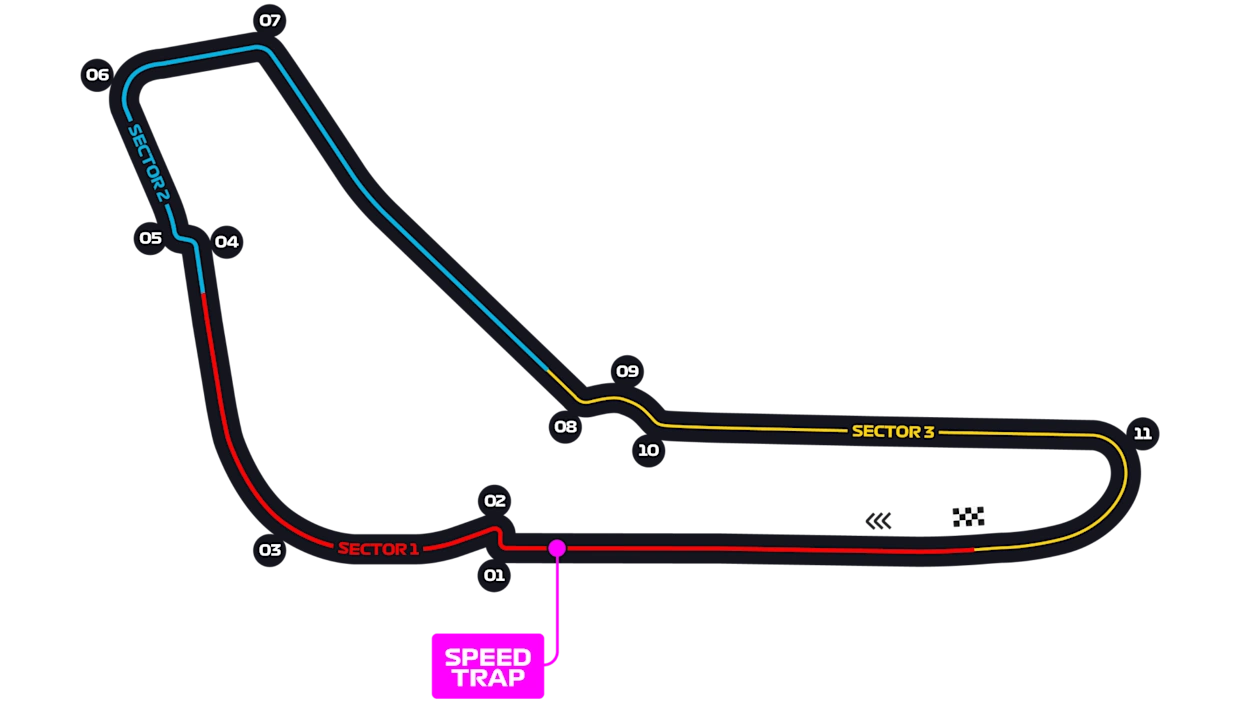
Career timeline
Signature numbers
- Career
- 1950 – 2026
Era
About Autodromo Nazionale di Monza
Monza is the cathedral of Formula 1. Built in 1922 inside the royal hunting grounds north of Milan, it is the third-oldest purpose-built racing circuit in the world (after Brooklands and Indianapolis), the only one to have hosted F1 every single year except 1980, and the spiritual home of Ferrari. To win at Monza in red is to enter a folklore that no other circuit can offer. The Italian Grand Prix routinely produces the loudest grandstands of the season, the deepest tifosi pilgrimages, and — under modern aerodynamic regulations — the highest top speeds anywhere on the calendar.
Origins
Monza was conceived in 1922 by the Automobile Club di Milano in just 110 days of construction, an extraordinary feat that required almost 4,000 workers, 80 trucks and 30 trolley wagons. The original layout combined a 5.5 km road course with a high-speed banked oval, intended to rival Brooklands and Indianapolis. The first Italian Grand Prix was held in September of that year and won by Pietro Bordino in a Fiat 804. The full combined oval-plus-road circuit, totalling 10 km, was used in periodic spells through 1969, including the famous "Monzanapolis" Race of Two Worlds in 1957 and 1958, where the cream of European Grand Prix racing went head-to-head with American Indianapolis 500 specialists on the bankings. The Indy cars dominated, but the spectacle was extraordinary. By the late 1960s the bankings had decayed beyond economic repair and were retired permanently from racing — the crumbling oval still stands today as a melancholy concrete monument visible from the in-field.
Layout
The modern Monza layout, settled essentially since 2000, is 5.793 kilometres of high-speed bravado with three chicanes interrupting otherwise vast straights. The lap begins on the long start-finish straight, where cars hit 350 km/h in eighth gear before the heaviest braking zone in F1 — the Variante del Rettifilo. Drivers bleed off more than 250 km/h in barely 80 metres, loading the car with over 5G of deceleration force. The Curva Grande is a long flat-out right-hander leading to the Variante della Roggia, then the medium-speed Lesmos pair sweep right and then right again. The flat-out Curva del Serraglio (now bypassed by the Curva del Serraglio chicane in chicane configuration) leads under the bridge to the Ascari chicane, a complex left-right-left taken at sustained high speed where exits are critical for the run to Parabolica. Parabolica itself is the signature corner: a long, late-apex right-hander taken in fifth gear at around 240 km/h, where exit speed determines lap time more than any other single point on the circuit. The run from Parabolica back to the line is 1.1 km long. Total full-throttle time approaches 80% of the lap. With low-downforce "Monza-spec" wings, top speed in qualifying trim with DRS open exceeds 360 km/h. Lap times under current regulations hover around 1:18.
Legendary Moments
The 1971 Italian Grand Prix remains the closest finish in F1 history. With the chicanes not yet built, Peter Gethin won by 0.01 seconds over Ronnie Peterson, with the top five separated by 0.61 seconds after 55 laps and over two hours of slipstreaming combat. Five drivers crossed the line within a single second, an unrepeatable spectacle that the chicanes were specifically introduced to tame after Jochen Rindt's death in 1970. In 1988, McLaren-Honda was about to complete a perfect 16-from-16 season. Senna and Prost qualified one-two and ran one-two until Senna lapped Jean- Louis Schlesser at the first chicane — and Schlesser, deputising for an ill Nigel Mansell at Williams, didn't get out of the way cleanly. They collided. Senna retired. Gerhard Berger took the chequered flag in a Ferrari, with Michele Alboreto second. It was Ferrari's first 1-2 at Monza since 1972, and it came one month after Enzo Ferrari's death. The tifosi flooded the track in a scene Italian sports broadcasters still play every September. In 2008, the rookie Sebastian Vettel, in a Toro Rosso, took pole and won the race in monsoon conditions — at 21 years and 73 days he became the youngest-ever F1 race winner and gave Toro Rosso its only victory. The following year he replaced Mark Webber-era Vettel at Red Bull and the juggernaut began. The 2020 Italian Grand Prix delivered Pierre Gasly's miracle: starting tenth, the AlphaTauri driver inherited the lead during a chaotic safety-car-to-red- flag sequence and held off Carlos Sainz by 0.4 seconds for AlphaTauri's only victory. Gasly wept openly on the podium. Charles Leclerc's 2019 victory in red, the first Italian for Ferrari at Monza in nine years, was the loudest podium ovation many in the paddock could remember. The local boy in the local car, after a heartbreak season, gave the tifosi exactly what they had waited for.
Quirks & Curiosities
The crumbling old banking is preserved as a national monument and is open for guided walks during race week. Drivers and engineers regularly visit it out of romanticism — climbing the steep concrete and standing where Stirling Moss raced in 1957. Monza sits inside an active royal park (Parco di Monza). Trees obscure sightlines from many vantage points; trackside cameras have to be carefully positioned to capture the cars. The park's deer occasionally find their way into the circuit infield, and crossing-the-track signage warns that the area remains a wildlife reserve. The high-speed nature of the circuit produces engine and powertrain stresses unmatched anywhere else on the calendar. Teams traditionally bring upgraded or freshly mileage-zeroed engines to Monza — and traditionally pray. DNFs from mechanical failure spike at Monza relative to any other modern venue. The chicanes were added in 1972, after Jochen Rindt's fatal crash at Parabolica in 1970 prompted a safety overhaul. The modifications were deeply unpopular at the time and are still the subject of "what if" debate among purists who believe Monza without chicanes would still produce great racing.
Modern Era
Monza's contract was renewed in 2024 through 2031 after a major resurfacing campaign that finally addressed the notoriously bumpy track surface. The 2024 Italian Grand Prix was held on a freshly laid asphalt that lap-record holder Lewis Hamilton called "transformative". The aging facilities are under continuous staged renovation funded jointly by the Italian government, the FIA and Liberty Media. Discussion of replacing Monza with Imola or rotating the two has surfaced periodically in the Liberty Media era but is consistently rejected: there is no future for F1 in Italy that does not include Monza. The cathedral stays.