

MonsantoPark Circuit
 PortugalLisbonEntry 1959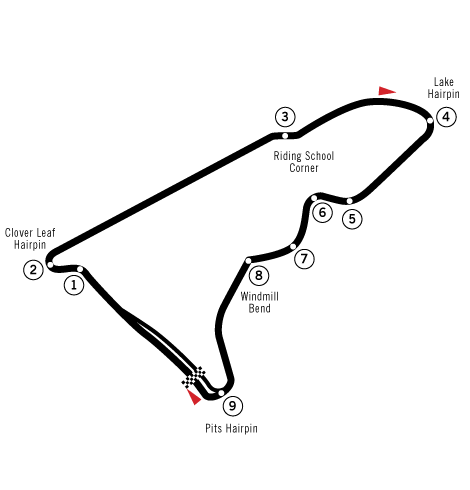
Career timeline
Signature numbers
- Career
- 1959
Era
About Monsanto Park Circuit
Monsanto Park was a temporary street circuit through Lisbon's western suburbs, hosting the Portuguese Grand Prix exactly once in 1959 — a curious one-off in the championship history of a country that would later embrace Estoril for sustained F1 hosting. The 5.44 km circuit wound through the wooded hills of the Monsanto forest park, using public roads with cobblestone sections, dramatic elevation changes, and a 90-degree corner overlooking the Tagus River. Stirling Moss won that 1959 race in a Cooper-Climax. Monsanto returned to its life as a public park immediately afterward, and Portugal would not host another championship Grand Prix for 25 years until Estoril opened in 1984.
Origins
Lisbon's western Monsanto Forest Park is a 1,000-hectare green space on the city's western edge, designed in the 1930s and 1940s as a public recreational area. Roads through the park were used for sports car racing in the late 1950s, and the Portuguese Grand Prix — alternating with Boavista in Porto — arrived at Monsanto in 1959 as part of its first run on the World Championship. The 5.44 km circuit closed public roads through the forest, with rudimentary pits in the parking area near the park entrance.
Layout
The lap began at the park entrance, ran downhill through fast curves to a hairpin overlooking the Tagus River, then climbed back up through twisting forest roads. The most striking visual feature was the river-view section, where the road dropped sharply with the Tagus below; cars hit 220 km/h on the approach. The lap returned through medium-speed curves under tree canopy back to the start. Surface conditions were inconsistent — sections of asphalt mixed with cobblestones, particularly in the older areas of the park, made grip unpredictable.
Legendary Moments
The 1959 Portuguese Grand Prix was Stirling Moss's afternoon. Driving the Cooper-Climax T51, he took pole, led every lap, and lapped the entire field except second-placed Masten Gregory. The race was significant because it confirmed the rear-engine revolution: Moss's Cooper outclassed the front-engined Ferraris and BRMs, foreshadowing the design shift that would dominate the 1960s. Phil Hill in a Ferrari made a competitive showing but couldn't match Moss's pace. The race lasted just over two hours; only nine of fifteen starters were classified at the finish. Beyond Moss's victory, the most memorable image of the weekend was the river backdrop — period photographs of cars cresting the rise above the Tagus remain among the most beautiful in 1950s F1 photography.
Quirks & Curiosities
The cobblestone sections in older parts of the park were a unique challenge — drivers complained that grip changed corner-to-corner, and tyre wear was unpredictable. Spectators stood among trees with no fencing, and crowd photos show people meters from the racing line. The pit complex was a series of tents in the parking area; refueling involved jerry cans. The Portuguese GP alternated between Boavista (Porto) and Monsanto (Lisbon) in the late 1950s — neither circuit hosted the race for long, both being temporary closures of public roads. After 1960's Boavista race, the Portuguese GP fell off the championship calendar entirely.
Modern Era
Monsanto Park has not hosted championship motor racing since 1959. The park remains one of Lisbon's largest green spaces, with the original road network still in use — visitors can walk or drive the layout, and several sections remain instantly recognizable from period photos. Portugal's championship Grand Prix history paused entirely from 1960 to 1984, when Estoril opened to host the modern Portuguese GP through 1996. A revival came in 2020 and 2021 at the Algarve International Circuit during pandemic-era calendar disruption. Monsanto's single Grand Prix is preserved through the photography of Moss's dominant performance and remains a footnote of one-off charm in F1's championship record book.