

Circuitde Monaco
 MonacoMonte CarloEntry 1950Active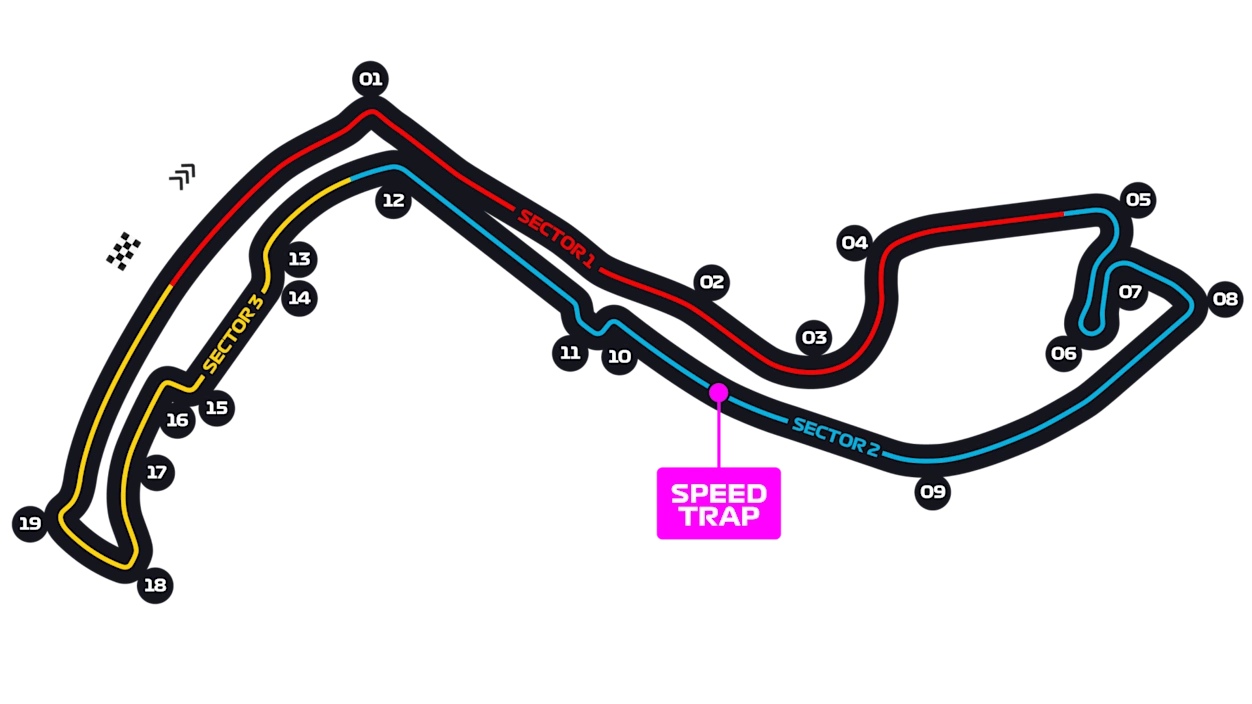
Career timeline
Signature numbers
- Career
- 1950 – 2026
Era
About Circuit de Monaco
Monaco is the only circuit on the Formula 1 calendar that would be illegal to build today. A 3.337-kilometre serpentine of public streets through the Principality of Monte Carlo, it has hosted Grand Prix racing since 1929 and been a permanent fixture of the World Championship since 1955. It is the race every driver wants on their CV, the venue that turns television producers into sommeliers of yacht angles, and — paradoxically — one of the slowest, narrowest, most processional circuits in modern F1. None of that matters. Monaco is the crown jewel because it is impossible.
Origins
The first Monaco Grand Prix was organised in April 1929 by Antony Noghès, son of the founder of the Automobile Club de Monaco, partly to upgrade Monaco's status from a local sporting club to a full-blooded Automobile Club de France affiliate. The race needed a course that proved Monaco could host international motorsport. Noghès found one in his backyard: he simply mapped out the streets between the harbour, the Casino, and the Mirabeau hairpin and sealed them off. The first winner was William Grover-Williams in a green Bugatti Type 35B — "Williams" was the pseudonym he raced under, and he would later die a Special Operations Executive agent at the hands of the Gestapo. Monaco entered the Formula 1 World Championship in 1950, sat out from 1951 to 1954 for political and financial reasons, and returned for good in 1955. The fundamental layout — Sainte-Devote, the climb to Massenet, Casino Square, Mirabeau, the hairpin (variously named Loews, Grand, Fairmont), Portier, the Tunnel, the Nouvelle Chicane, Tabac, the swimming-pool complex, La Rascasse and Anthony Noghès — has barely changed in seventy years. Almost every modification has been a safety concession: barriers moved, kerbs added, chicanes tightened, the tunnel exit reprofiled.
Layout
A flying lap of Monaco is essentially nineteen corners strung together with no room for error and almost no straight worthy of the name. The lap begins with Sainte-Devote, a tight right-hander where the run from the grid is so short that pole position is decisive. From there the road climbs aggressively to Massenet and Casino Square, the surface camber working against the car as drivers brush the barrier on the way out. Mirabeau and the Grand Hotel Hairpin (taken at around 50 km/h, the slowest corner in F1) lead into the plunge to Portier, where Ayrton Senna famously crashed out of the lead in 1988 while leading by nearly a minute. Then comes the Tunnel — the only one of its kind on the calendar — taken flat-out at over 290 km/h with the car emerging into bright Mediterranean sunlight and immediately into the heaviest braking zone of the lap, the Nouvelle Chicane. Tabac follows, then the swimming-pool complex (a fast left- right-right-left flick that rewards commitment and punishes hesitation), La Rascasse hairpin, and Anthony Noghès, the final right-hander onto the straight. Lap times hover around 1:11 in qualifying with a full Monaco-spec downforce setup; race pace is six to eight seconds slower with full fuel.
Legendary Moments
The 1982 Monaco Grand Prix is the canonical "anything can happen" race: Alain Prost crashed from the lead in the rain, Riccardo Patrese spun and restarted to win, then Didier Pironi and Andrea de Cesaris both ran out of fuel in the closing laps, and Derek Daly crashed his Williams into the barriers — all in the final five laps. Patrese, push-starting his car after the spin, became the first Italian to win a Grand Prix in a decade. In 1984, a torrential downpour turned the streets into a river. A 25-year-old Ayrton Senna, in his sixth F1 race, drove an unfancied Toleman from 13th to within sight of leader Alain Prost when officials red-flagged the race. Prost won; Senna was second by a hair, and a legend was born. Many believe Senna would have caught and passed Prost within another lap. Senna's relationship with Monaco is unmatched: six victories, the most of any driver, including five in a row from 1989 to 1993. His 1988 crash at Portier, while leading Prost by 55 seconds, remains one of the most discussed driver errors in F1 history — Senna later admitted he had simply lost concentration in a state of near-trance. The walk back to his apartment, rather than to the pits, became part of the mythology. More recently, Daniel Ricciardo's botched 2016 pit stop (no tyres ready when he arrived in the lead) handed victory to Lewis Hamilton, only for Ricciardo to win in 2018 with a damaged MGU-K and 25% power deficit for two-thirds of the race. Charles Leclerc, the local boy, finally broke the "home-track curse" with victory in 2024, his first Monaco win after years of bizarre DNFs in his own back yard.
Quirks & Curiosities
Monaco hosts the only F1 race that runs on a Sunday with practice on Thursday instead of Friday — a tradition designed so the Principality's restaurants can capture the lucrative Friday-Saturday tourist trade unencumbered by track activity. The free Friday is locally called "Le Jeudi des Pilotes" — the drivers' Thursday — and is when most teams host sponsor events. The pit lane was rebuilt on the Boulevard Albert Ier in 2004 because the old harbour-side pits could no longer accommodate modern team trucks; before that, mechanics worked elbow-to-elbow on a quay barely wide enough for two people. The famous swimming pool that gives the eponymous complex its name is the Stade Nautique Rainier III, in the harbour, which is filled with spectators and yachts during race week. Monaco's status as the slowest circuit on the calendar produces some of the sport's most extreme engineering compromises: maximum downforce wings, rear wings that resemble dinner trays, mechanical setups so soft they are almost useless on any other circuit, and braking systems run at the edge of thermal collapse despite the low average speed, simply because there are 19 braking events per 1:11 lap.
Modern Era
Monaco's place on the calendar has been periodically questioned in the era of ground-effect cars and ever-larger machines that cannot meaningfully overtake on its barriers-everywhere layout. The 2024 race produced just two on-track overtakes; the 2025 edition introduced a mandatory two-stop strategy in an attempt to artificially inject variability. Talk of dropping the race resurfaces every few years and is dismissed every few years. The contract extends through 2031. The principality has invested heavily in upgrades around the periphery — extended run-off at Sainte-Devote, a remodelled tunnel exit, new pit buildings in 2023 — but the essential character of the lap is sacred. Drivers continue to describe Monaco as the most physically and mentally demanding qualifying lap of the year. Win it once and you join Senna, Schumacher, Hamilton, Verstappen and a club of fewer than thirty.