

MarinaBay Street Circuit
 SingaporeMarina BayEntry 2008Active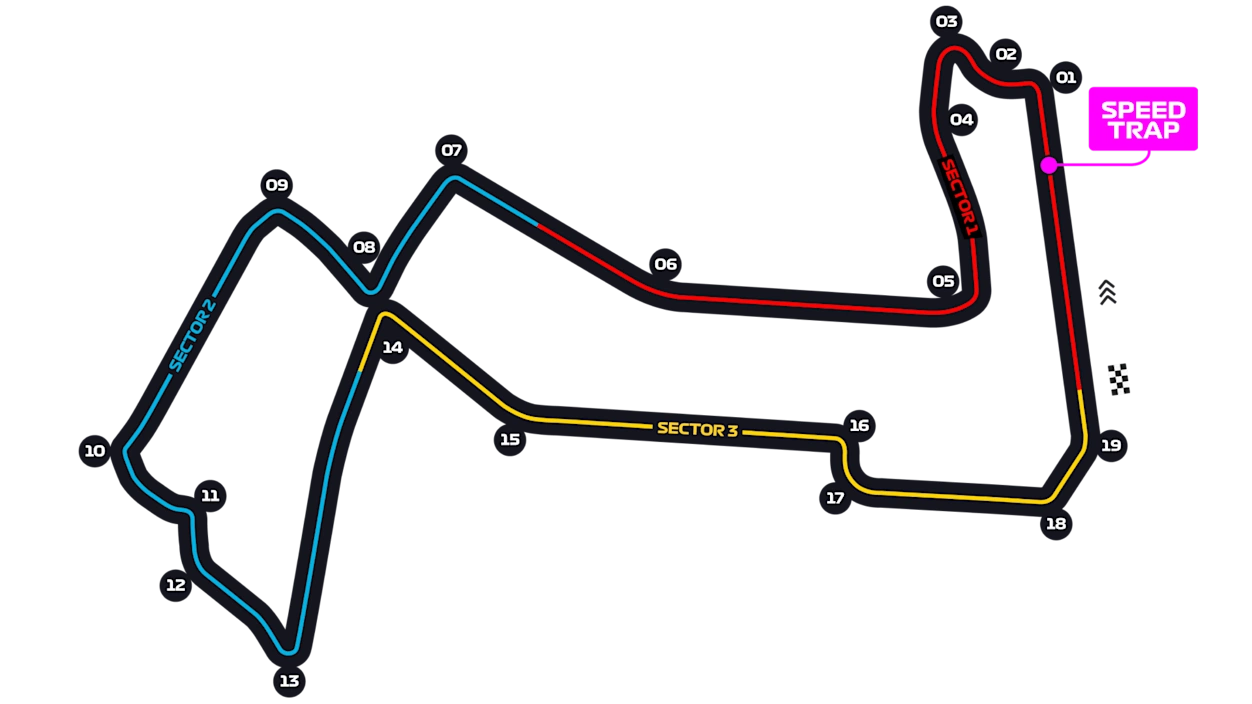
Career timeline
Signature numbers
- Career
- 2008 – 2026
Era
About Marina Bay Street Circuit
The Marina Bay Street Circuit, host of the Singapore Grand Prix since 2008, is Formula 1's first ever night race and arguably the most physically demanding event on the calendar. Run under the searing floodlights of a tropical city after sunset, the 4.940-kilometre layout weaves through downtown Singapore past the Esplanade theatres, the Padang cricket ground, the historic Anderson Bridge, and finally onto the seven-storey-high Marina Bay Sands hotel skyline. The combination of suffocating humidity, two-hour-plus race times, walls inches from the racing line, and a layout that gives drivers no rest has made it the race that separates the truly fit from the merely talented.
Origins
The Singapore Grand Prix is the brainchild of Bernie Ecclestone and local businessman Ong Beng Seng, the property tycoon who sold Ecclestone on the idea of running F1 in Asia at night to suit European TV audiences. The Singapore government — keen to use the race as a tourism showcase and signal of Asian financial-capital status — backed the project heavily, contributing 60% of the original hosting fees. KBR, the engineering firm, was contracted to design the floodlighting system, which uses approximately 1,600 specially-designed projectors mounted on aluminium trusses around the circuit perimeter. The lighting delivers approximately four times the illumination of a typical sports stadium and produces a near-shadowless track surface — drivers report that the light is so even that there is no visual difference between day and night driving once the eyes adjust. The first race was held on September 28, 2008, won by Fernando Alonso in a Renault — a victory that became infamous when, eleven months later, Nelson Piquet Jr. revealed that he had been ordered by Renault team principal Flavio Briatore to deliberately crash on lap 14 to trigger a safety car favorable to Alonso's strategy. The "Crashgate" scandal that followed led to lifetime bans for Briatore and engineering director Pat Symonds and remains one of F1's darkest moments.
Layout
The lap begins on a wide drag down to Turn 1, a 90-degree left where the cars dive under the Sheares Bridge. The circuit winds through the narrow Anderson Bridge section — the tightest squeeze on the calendar at one point — before opening into the high-speed Turn 7 at the end of the long Raffles Boulevard back straight. The middle sector is a relentless sequence of 90-degree corners that gives drivers no breathing room: Turns 8-13 are a cornering rhythm of left-right-left-right that punishes any setup compromise. The Turn 18 section under the Marina Bay grandstand is the most photographed view on the circuit — cars flash past the illuminated theaters with the hotel skyline in the background. The final sector includes the slow Turn 22-23 chicane and the tight final hairpin at Turn 23 (formerly known as the "Sling Shot"), now a fast left-handed sweep following the 2023 layout revision that removed the chicane to speed up lap times.
Legendary Moments
The 2008 race remains infamous for Crashgate, but the on-track action delivered an unexpected first F1 win for Sebastian Vettel's then-Toro Rosso teammate Sébastien Bourdais finishing 4th — a result that surprised the entire paddock. The 2012 race was the most attritional in modern F1 history, with only 14 cars finishing and three safety cars over the 2-hour duration. Sebastian Vettel won from pole. The 2017 race produced one of the most famous Turn 1 crashes in F1 history when Sebastian Vettel, Kimi Räikkönen, and Max Verstappen collided seconds after the start, taking out both Ferraris and the RB13 — a result that effectively handed the championship to Lewis Hamilton. The 2023 race was Carlos Sainz's masterclass — a tactical drive where he deliberately backed Lando Norris into Hamilton and Russell to defend his lead, ultimately winning by 0.812 seconds and ending Red Bull's streak of consecutive victories at 15.
Quirks & Curiosities
The race traditionally lasts the full two-hour limit due to safety cars and the technical complexity of the layout — drivers complete only ~62 laps in the time many other races complete 70+. Driver weight loss during the race regularly exceeds 4 kilograms. The track surface includes 13 different pavement types, including cobblestones over the Anderson Bridge that produce significantly higher tyre wear than the smoother tarmac sections. The bridge surface was modified for 2014 to include a thin asphalt overlay that reduces but does not eliminate the cobblestone effect. The circuit runs over the Anderson Bridge, a 1910 colonial-era steel bridge that pre-dates Singapore's independence by over 50 years. It is the only F1 circuit that incorporates a heritage-listed structure into its racing line. A 2.5-tonne wooden Merlion — Singapore's national symbol — sits in clear view of Turn 16. The track lighting illuminates it at night, creating one of F1's most distinctive racing tableaux.
Modern Era
Singapore extended its hosting contract through 2028 in 2022, with the Singapore Tourism Board citing the race as a $400+ million annual economic driver. The 2023 layout change — eliminating the original Turns 16-19 chicane sequence to add a fast Stadium Section — was the first significant modification in 15 years. The race has consistently featured among the highest-rated TV broadcasts on the F1 calendar, with the night-race format giving European audiences a prime-time Sunday evening event that competes favorably with major football matches. The arrival of Las Vegas as a competing night-race venue has not dimmed Singapore's appeal — the urban setting, two-hour duration, and physical brutality remain unique.