

LeMans
 FranceLe MansEntry 1967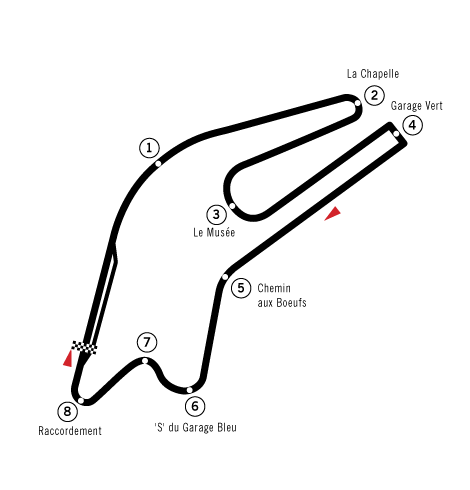
Career timeline
Signature numbers
- Career
- 1967
Era
About Le Mans
Origins
The **Circuit Bugatti** at Le Mans, built in 1965, occupies the permanent infield section of the legendary Circuit de la Sarthe — the 13.6 km circuit that hosts the 24 Hours of Le Mans every June. The Bugatti circuit shares the famous **Dunlop Curve and Bridge** and the start-finish straight with the 24-hour layout, but otherwise twists through a tighter, purpose-built infield section. F1 visited Le Mans only **once**, in **1967**, for the French Grand Prix. The race was won by Jack Brabham in his own Brabham- Repco. It was an experiment that didn't repeat — F1 found the Bugatti layout cramped and lacking character compared to the 24-hour course or contemporary alternatives like Reims and Clermont-Ferrand.
Layout
The 1967 Bugatti F1 layout was **4.430 km, 9 corners**, sharing the Dunlop Bridge area with the 24h course but cutting back through a tight infield instead of heading out to the Mulsanne Straight. The lap was effectively a stadium track — drivers were always within the main spectator area, never disappearing into the forests like the 24h course. Modern Bugatti is **4.185 km, 14 corners** after multiple revisions. It hosts the French motorcycle Grand Prix every May, testing for prototypes, and many trackday events.
Legendary Moments
**1967 — Brabham's only F1 visit win**: Jack Brabham, then 40 years old, won the only F1 race held at Le Mans in his self-built Brabham-Repco. Teammate Denny Hulme finished second. The race attracted modest crowds and was widely considered uninspiring — F1 returned to other circuits the next year. The race was overshadowed by the **24 Hours of Le Mans** held two months earlier — Ford's iconic GT40 1-2-3 finish. F1's brief Bugatti visit felt redundant against that backdrop.
Quirks & Curiosities
The 24 Hours of Le Mans uses the **Circuit de la Sarthe** — 13.6 km incorporating public roads (the Mulsanne Straight is the D338 route nationale, closed for race week). F1 has never visited the full Sarthe layout — too long, too dangerous by modern standards, and operationally incompatible with the 24-hour event's commercial use of the venue. The **Dunlop Bridge** that arches over the start of the Bugatti and 24h layouts is the **oldest active racing landmark in the world** still standing in original form, erected for the 1932 24 Hours. The Bugatti circuit is named after **Ettore Bugatti**, whose factory was based at Molsheim in Alsace — geographically nowhere near Le Mans. The naming was a marketing exercise when the infield circuit opened in 1965. The **paddock** at Le Mans serves as both the F1 1967 venue paddock and the modern WEC/24h paddock — there's only one, shared between disciplines. This is unique among F1 venues.
Modern Era
Le Mans never returned to F1 after 1967. The circuit is maintained for the Le Mans 24 Hours (sports cars, WEC), the French motorcycle GP, and various national series. It maintains FIA Grade 2 certification — too small for modern F1 but adequate for prototypes and motorcycles. The 24 Hours of Le Mans remains one of the **Triple Crown of Motorsport** alongside Monaco and the Indy 500 — the only three races whose individual victories sit at the apex of international racing prestige. Many F1 drivers have raced at Le Mans (notably Fernando Alonso, who won in 2018 and 2019) but F1 itself has not returned. For F1 history, Le Mans 1967 represents the **brief experimental era** when F1 was willing to try unfamiliar venues. The race produced no lasting innovations or controversies but Brabham's win there was his second-to-last F1 victory — a fitting capstone for one of the era's greatest driver-engineers.