

LasVegas Street Circuit
 USANevadaEntry 1981
Career timeline
Signature numbers
- Career
- 1981 – 1982
Era
About Las Vegas Street Circuit
The Las Vegas Strip Circuit, inaugurated in November 2023 along the heart of Las Vegas Boulevard, is Formula 1's largest commercial gamble of the modern era and the most visually spectacular race on the calendar. A 6.201-kilometre layout that runs past the Bellagio fountains, the Sphere, the Caesars Palace forum, and the Wynn casino under floodlights at midnight Pacific time (3 AM Eastern), the Las Vegas Grand Prix is Liberty Media's flagship venue — a $500 million project that the company itself owns and operates rather than licensing to a local promoter, the only race on the calendar where Liberty has direct skin in the game.
Origins
The Las Vegas Grand Prix had been considered for decades — the infamous Caesars Palace Grand Prix of 1981-82 and the equally infamous Las Vegas Grand Prix of 2007 (a Champ Car race held in the casino parking lots) had both ended in financial failure — but the modern Vegas race was a Liberty Media initiative announced in 2022 as part of the company's American expansion strategy. Liberty invested approximately $500 million in the project, including the construction of a permanent pit-paddock complex (one of the few permanent F1 facilities in the United States), a custom lighting system, and a 12-month-per-year operating arm called Las Vegas Grand Prix LLC. The race contract is unusual in that Liberty owns the venue outright and will not pay external hosting fees to a local promoter — the company keeps all hospitality, sponsorship, and broadcast revenue. The first race on November 18, 2023 was a chaotic affair that began with a cracked manhole cover on the Las Vegas Strip causing severe damage to Carlos Sainz's Ferrari during practice (Sainz received a post-incident grid penalty for the unscheduled engine change required, adding insult to injury); the FIA's handling of the incident — refusing to give Sainz any compensation — became a controversy that undermined the inaugural weekend.
Layout
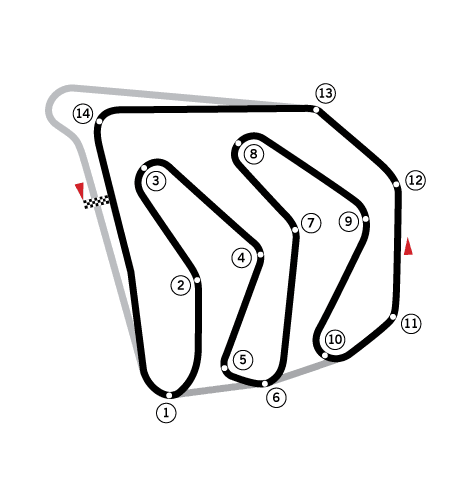
The 6.201-kilometre lap has 17 corners arranged in a configuration that prioritises the Las Vegas Strip experience over racing quality. The opening sector is the famous Strip section — drivers blast past the Bellagio, Caesars Palace, and the Wynn at over 350 km/h on a 1,900-metre straight that ends at the slow Turn 14 hairpin. The middle sector winds through a custom-built infield section behind the casinos, including the Sphere — the 20,000-seat sphere-shaped performance venue — that becomes a visible landmark as drivers approach Turn 11. The Sphere's massive LED exterior lights up the racing surface during the race, creating one of the most distinctive visual moments in F1. The final sector includes the slow Turn 17 hairpin and the long Turn 1-3 sequence that returns to the Las Vegas Strip. The final braking zone at the Turn 14 hairpin has been the most reliable overtaking opportunity in the race. The track surface includes asphalt overlays applied to the Las Vegas Strip itself — a temporary modification that requires repaving the boulevard each November. The total annual track-construction cost is approximately $25-30 million.
Legendary Moments
The 2023 inaugural race was shadowed by the manhole-cover incident in Friday practice, but the on-track action delivered Max Verstappen's victory by 2.0 seconds over Charles Leclerc in a tactical race that saw multiple safety cars and a brief red flag. The race produced better racing than anyone had predicted from a circuit designed primarily for visual spectacle. The 2024 race was George Russell's emphatic victory after Lewis Hamilton's last-lap retirement from second place — a result that swung the Mercedes momentum decisively for the 2025 season and led to Russell's elevation as the Silver Arrows' team leader. The race also saw the formal end of the Hamilton-Mercedes era, with the seven-time champion's 2024 contract expiring.
Quirks & Curiosities
The Las Vegas race start time is a midnight Pacific (3 AM Eastern) schedule, the latest start time of any F1 race. The midnight start was chosen to suit European prime-time TV audiences — the race begins at 9 AM Sunday morning in Western Europe, when audiences are at peak weekend viewing. The Sphere — the 20,000-seat sphere-shaped performance venue inaugurated in 2023 — sits adjacent to Turn 11 and uses its 580,000- square-foot LED exterior to display advertising and animation during the race. The Sphere's lighting is synchronised with the race broadcast and produces one of F1's most distinctive visual moments when cars approach Turn 11. The race weekend coincides with the Las Vegas Convention Center events calendar, and is one of the highest-revenue weekends of the year for the city. Hotel rates double or triple during race weekend, and corporate hospitality is one of the highest-priced in motorsport. The track surface includes asphalt overlays applied to Las Vegas Boulevard itself — a temporary modification that requires repaving the entire Strip each November. The repaving is one of the largest annual road-construction projects in Las Vegas, requiring closure of the boulevard for approximately three weeks each year.
Modern Era
Las Vegas's hosting structure is unique in F1 — Liberty Media owns the venue outright through Las Vegas Grand Prix LLC, rather than licensing to a local promoter. This means Liberty keeps all hospitality, sponsorship, and broadcast revenue, and bears all operating costs. The model is profitable for Liberty but represents significant financial exposure if the race underperforms. The race has consistently drawn 100,000+ spectators across the weekend since 2023, with general-admission tickets starting at approximately $500 and paddock-club passes exceeding $20,000. The race weekend has become one of the highest-revenue events on the F1 calendar despite the operational complexity. The 2025 race produced significantly improved racing quality compared to 2023, with multiple lead changes and a tactical battle that silenced some early critics of the layout. As of April 2026, the race is contracted through 2032 and is one of the most strategically important venues in F1's American expansion strategy.