

AutódromoInternacional Nelson Piquet
 BrazilRio de JaneiroEntry 1978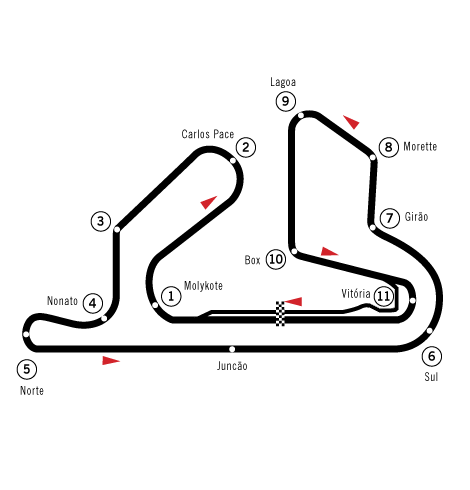
Career timeline
Signature numbers
- Career
- 1978 – 1989
Era
About Autódromo Internacional Nelson Piquet
Autódromo Internacional Nelson Piquet — known to most as Jacarepaguá after the Rio de Janeiro neighborhood that surrounded it — hosted the Brazilian Grand Prix ten times between 1978 and 1989, alternating periods with Interlagos. Built on flat reclaimed swampland on Rio's western edge, Jacarepaguá was windswept, slippery, and produced some of the most painful conditions in Formula 1 — drivers regularly lost 4 kg per race in the suffocating heat and humidity. Despite an unloved layout, the circuit was the home of Nelson Piquet's most iconic Brazilian victories and produced the dramatic 1989 race where the new Williams-Renault dominated. After hosting its last F1 race in 1989, Jacarepaguá continued for stock cars and Champ Cars until being completely demolished to make way for the 2016 Olympic Park.
Origins
Rio de Janeiro had hosted non-championship races in the 1970s on a temporary circuit at Jacarepaguá, in the western flatlands beyond Barra da Tijuca. A permanent purpose-built circuit was constructed and opened in 1977, intended to give Rio a year-round racing venue and to provide an alternative to São Paulo's Interlagos. The Brazilian Grand Prix moved to Jacarepaguá from 1978, then alternated with Interlagos through the 1980s before settling at Jacarepaguá from 1981 to 1989.
Layout
The 5.031 km layout was famously bland — flat, almost no elevation change, with a long start-finish straight and a series of mostly medium-speed corners through the infield. The track was anticlockwise. The defining feature wasn't the layout but the conditions: located near the coast, the circuit was constantly buffeted by wind off the Atlantic, and the asphalt surface — laid over reclaimed swamp — was notoriously bumpy and offered low grip. The infield section was narrow and dusty. Top speed at the end of the start-finish straight reached 295 km/h.
Legendary Moments
1980 was Nelson Piquet's first home Grand Prix victory — he won at Jacarepaguá in the Brabham BT49, the breakthrough that confirmed him as a top-line driver. Alain Prost won three times at Jacarepaguá (1982, 1984, 1985), all dominant performances. The 1986 race went to Piquet again, this time in the Williams FW11. The 1987 race was won by Prost in the McLaren-TAG, but the most memorable image was Ayrton Senna's first home F1 race in front of his adoring fans, finishing fourth and signaling Brazilian F1's transition. The 1989 race — the last F1 event at Jacarepaguá — was won by Nigel Mansell in the Ferrari 640, the debut of semi-automatic gearboxes in F1. Through the decade, the heat and humidity produced multiple dramatic retirements: drivers commonly lost consciousness in the cockpit on the final laps.
Quirks & Curiosities
The circuit's microclimate was brutal. Located near sea level in tropical Rio, the track surface temperature regularly exceeded 60°C, and cockpit temperatures reached 70°C. Piquet, who lived in Rio and was acclimatized, had a clear advantage; many European drivers struggled. The circuit was renamed Autódromo Internacional Nelson Piquet in 1988 in honor of the three-time champion. The bumpy surface caused chronic problems — teams installed extra bracing for suspension components specifically for Jacarepaguá. The wind from the Atlantic affected braking points and could shift mid-lap. Senna, despite being Brazilian and from São Paulo, never won at Jacarepaguá in F1, though he was always quick there.
Modern Era
Jacarepaguá hosted F1 for the last time in 1989; the Brazilian Grand Prix returned permanently to Interlagos in 1990. The circuit continued as the home of Stock Car Brasil and hosted Champ Car races including the 1996-1999 Rio 400 events. By the 2010s, Brazil's commitment to hosting the 2016 Olympics required new infrastructure on the Jacarepaguá site, and the circuit was demolished in 2012 to make way for the Olympic Park. The Olympic Velodrome and various tennis venues now occupy the former racetrack. Nothing of the racing layout remains. Jacarepaguá's racing history is preserved through media archives but the physical site is gone — a notable example of an F1 venue completely erased by development.