

IstanbulPark
 TurkeyIstanbulEntry 2005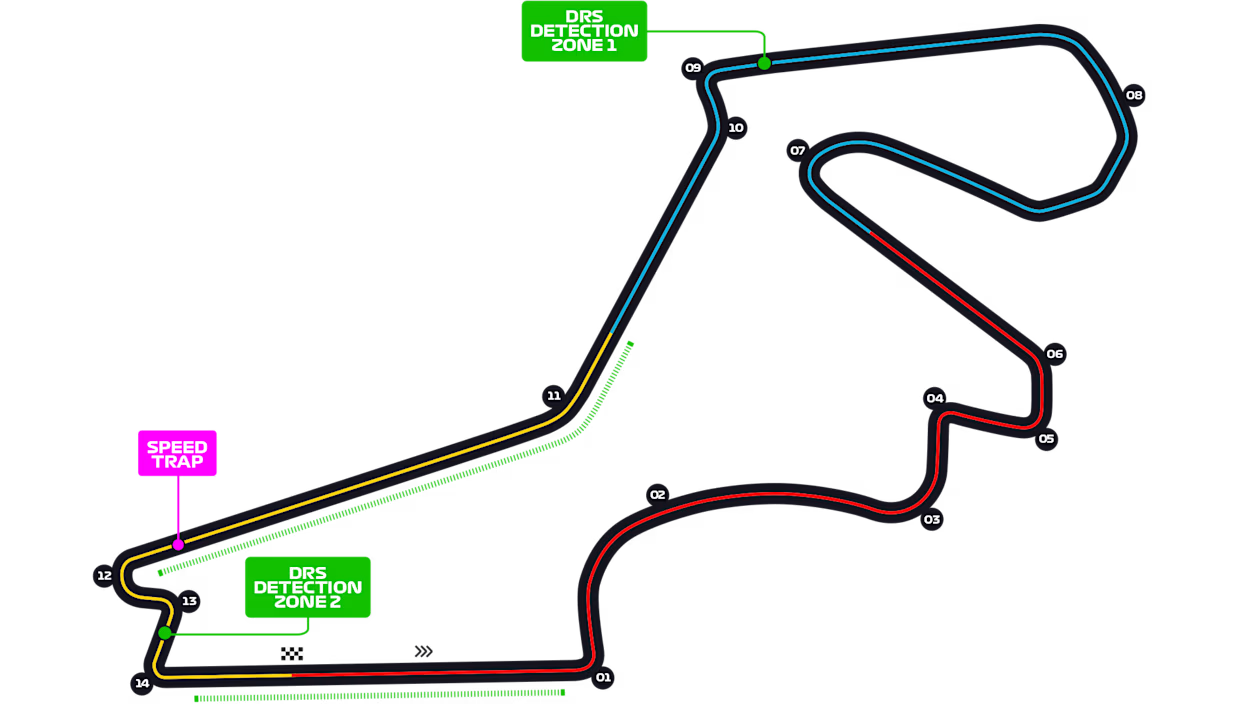
Career timeline
Signature numbers
- Career
- 2005 – 2021
Era
About Istanbul Park
Istanbul Park, opened in 2005 on the Asian side of the Bosphorus Strait, is widely regarded as Hermann Tilke's masterpiece — a 5.338-kilometre layout running counter-clockwise (one of only a few modern F1 circuits to do so) with the legendary Turn 8, a quadruple- apex left-hander where drivers experience over 5G of lateral force for nearly 8 seconds. The Turkish Grand Prix was on the F1 calendar from 2005 to 2011 before commercial pressures forced its removal, returning briefly in 2020 and 2021 before falling off again.
Origins
The Turkish government, led by Prime Minister Recep Tayyip Erdoğan, commissioned Istanbul Park in 2003 as part of a broader strategy to position Turkey as a European-Middle Eastern crossroads. The project was driven by Erdoğan's personal interest in international sporting events and his desire to leverage F1 as a tool for European Union accession discussions. Hermann Tilke designed the layout to incorporate the natural elevation changes of the Asian-side Istanbul countryside, with deliberate focus on creating high-speed, multi-apex corners that would test driver skill more than aerodynamic dependence. The counter-clockwise direction was chosen specifically to put the high-G Turn 8 at the most challenging point of the lap, when drivers would be at peak fatigue. Construction took 18 months and was completed in early 2005. The inaugural race on August 21, 2005 was won by Kimi Räikkönen's McLaren. From the first race, drivers and engineers universally praised the layout — Damon Hill called Turn 8 "the best corner in F1," and Lewis Hamilton later said Istanbul was "my favorite circuit on the calendar." The Turkish Grand Prix was on the F1 calendar from 2005-2011 before being dropped due to declining attendance and rising hosting fees. The race returned briefly in 2020 (replacing the cancelled Suzuka race due to COVID) and 2021 (replacing Singapore for the same reason) before falling off the calendar again.
Layout
The 5.338-kilometre lap has 14 corners arranged in a flowing counter-clockwise configuration. The opening sector includes the fast Turn 1 left-hander and the long Turn 2-3 combination that flows downhill into the slow Turn 4 hairpin. The middle sector is built around the famous Turn 8 — a quadruple-apex left-hander that is taken at speeds exceeding 270 km/h with sustained lateral G-forces of 4.5-5.0 for nearly 8 seconds. The corner is regularly cited by drivers as the most physically demanding in F1, and the apex transitions test both car balance and driver fitness. The 985-metre back straight from Turn 11 to Turn 12 is the longest on the circuit, with cars exceeding 320 km/h before the heavy braking into the slow Turn 12 hairpin. DRS-aided overtaking is common. The final sector includes the medium-speed Turn 13 sequence and the slow Turn 14 hairpin that returns to the start-finish straight.
Legendary Moments
The 2008 race produced Felipe Massa's most controversial victory — the Brazilian driver winning after Lewis Hamilton's puncture on the penultimate lap forced Hamilton to drop from second to fifth. The result swung the championship momentum decisively, ultimately deciding the title in Hamilton's favor at Brazil. The 2010 race featured one of F1's most spectacular crashes when Mark Webber and Sebastian Vettel collided at Turn 12 while both running 1-2 for Red Bull, with Webber leading. The incident eliminated both Red Bulls and handed McLaren a 1-2 finish. The collision and post-race tension between the two teammates marked the beginning of the toxic Webber-Vettel rivalry that defined their later years together. The 2020 race produced one of Lewis Hamilton's greatest career drives — the seven-time champion winning in damp-to-dry conditions on a new track surface that produced near-zero grip. Hamilton's masterclass in tyre management was the key to his seventh world championship being clinched at Istanbul that day.
Quirks & Curiosities
Turn 8 is widely regarded as the most physically demanding corner in modern F1 — drivers experience sustained lateral G-forces of 4.5-5.0 for nearly 8 seconds, with the corner's quadruple-apex configuration testing both car balance and driver fitness. Lewis Hamilton has publicly stated that Turn 8 is the "best corner in F1," and many drivers cite it as the corner they most miss when Istanbul is off the calendar. The circuit's counter-clockwise direction makes it one of only a few modern F1 venues with this configuration (others include Interlagos, Imola, and Marina Bay). The counter-clockwise direction places extra physical strain on the right-side neck muscles, making fitness preparation for the race uniquely challenging. The 2020 race was held in apocalyptic conditions — a new track surface that had been resurfaced just weeks before the race had not yet matured, producing near-zero grip in dry conditions. The race was also held in continuous rain across the entire weekend, producing the most slippery F1 race conditions in modern history. The Istanbul Park venue is one of the few F1 circuits located on the geographic crossroads of Europe and Asia — the circuit sits on the Asian side of the Bosphorus Strait, with the European side of Istanbul visible from the main grandstand. The unique geographic positioning has been a frequent topic of F1 broadcasting commentary.
Modern Era
The Turkish Grand Prix has not been on the F1 calendar since 2021, with the race being dropped due to a combination of commercial pressures and Turkish government priority changes. The circuit continues to host the Turkish national motorsport championships, World Superbike, and various other international events. There have been periodic discussions about a potential F1 return, particularly given the universally-positive driver feedback about the layout. As of April 2026, no formal agreement has been reached, but Liberty Media has indicated openness to a return if Turkish hosting fees can be negotiated to a sustainable level.