

AutódromoJosé Carlos Pace
 BrazilSão PauloEntry 1973Active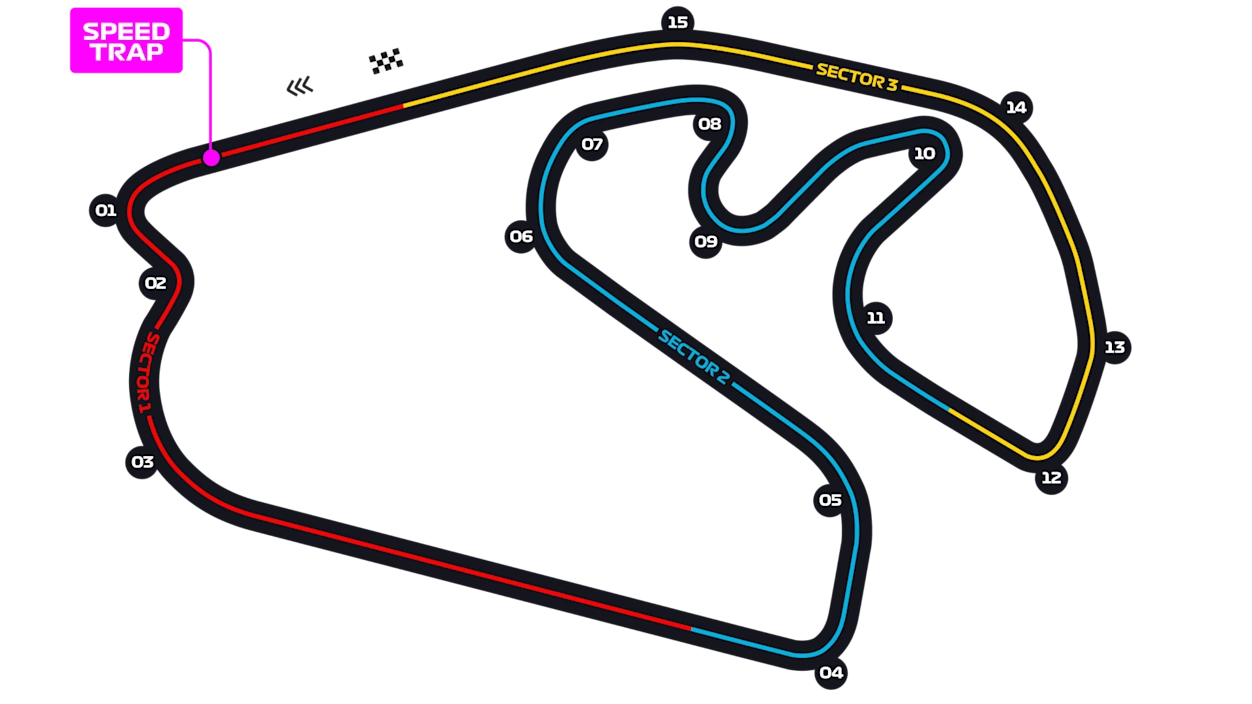
Career timeline
Signature numbers
- Career
- 1973 – 2026
Era
About Autódromo José Carlos Pace
Autódromo José Carlos Pace — known to everyone as Interlagos — is the spiritual home of Brazilian Formula 1 and one of the few circuits on the calendar where the racing reliably matches the cultural temperature. Set in the southern São Paulo neighbourhood from which it takes its colloquial name (Portuguese for "between lakes"), the 4.309-kilometre anti-clockwise layout is short, hilly, often wet, and uniquely capable of producing season-defining drama. The Brazilian Grand Prix has decided five championships outright in the modern era, more than any other venue.
Origins
Interlagos was built in the 1930s on swampland between two artificial reservoirs (Guarapiranga and Billings), explicitly modelled by its architects Alfredo Mosca and Ricardo Belmonte on European prewar circuits like Brooklands and Roosevelt Raceway. The original 7.96-km layout opened in May 1940 and hosted local sportscar racing for three decades. Its first F1 race came in 1972 as a non-championship event, won by Carlos Reutemann. The first World Championship Brazilian Grand Prix at Interlagos was held in 1973 and won by Emerson Fittipaldi, then the reigning World Champion and local hero. F1 raced there annually until 1980 (with Rio's Jacarepaguá taking over from 1978), then the championship moved entirely to Rio from 1981 to 1989. Interlagos returned permanently in 1990 with a heavily shortened 4.325-km layout — essentially the modern circuit — and has hosted every Brazilian Grand Prix since. The renaming to Autódromo José Carlos Pace honoured the popular Brazilian driver who died in a 1977 light-aircraft crash. He had won his only Grand Prix at Interlagos in 1975.
Layout
Interlagos runs anti-clockwise — one of only four counter-clockwise circuits on the calendar (with Imola, Yas Marina and COTA) — which produces distinctive neck strain on right-handed drivers, since the longest sustained G-forces load the left side of their bodies. The lap begins on the long uphill main straight, ending at the famous Senna S complex (Curva do Sol / Subida do Lago) — a downhill left-right combination that is the most popular overtaking spot on the lap. The car plunges through Curva do Sol onto the long Reta Oposta back-straight, the fastest section of the lap. Then comes Pinheirinho, a slow technical hairpin; Bico de Pato (the "duck's bill") and Mergulho (the "dive"), the slow infield section; and the long Junção corner — a 270-degree right-hander that opens onto Subida dos Boxes, the climb back up to the start-finish line. This climb is over 800 metres long with a 30-metre elevation gain, putting enormous strain on engines and producing memorable late-race overtakes (including Lewis Hamilton's race-winning move past Sebastian Vettel in 2008). Lap times are among the shortest on the calendar — about 1:09 in qualifying. The 71-lap race distance is similarly compressed, often finishing in well under 90 minutes.
Legendary Moments
The 2008 Brazilian Grand Prix is the most dramatic championship climax in F1 history. Lewis Hamilton needed fifth place to clinch his first title; Felipe Massa needed to win and have Hamilton finish sixth or worse. Massa won; Hamilton dropped to sixth on the penultimate lap as it began to rain. The Ferrari pit wall was already celebrating the championship when, in the very last corner of the very last lap, Hamilton overtook Timo Glock (struggling on dry tyres) to finish fifth and snatch the championship by a single point. The broadcast remains the most replayed clip in F1 history. The 1991 race delivered a different kind of drama. Ayrton Senna, leading his home race for the first time, had his McLaren stuck in sixth gear for the final laps. He won by 2.9 seconds over Riccardo Patrese while physically wrestling the car around 14 corners per lap; he had to be lifted from the cockpit and carried to the podium suffering from heat exhaustion and shoulder cramps. He celebrated with the Brazilian flag and an upturned gearshift. The 2012 race produced the second-most-dramatic finale of the modern era. Sebastian Vettel needed only to finish ahead of Fernando Alonso to clinch his third title; he was punted into a spin on lap one, dropped to last, and spent two hours fighting through the field in worsening rain to recover to sixth — enough for the title. Alonso won the race and lost the championship by three points. In 2003, Giancarlo Fisichella's Jordan won a chaotically wet race — a victory only confirmed days later, after the original podium for Kimi Räikkönen was stripped via a results review. The trophy was handed over to Fisichella in Imola three weeks later in F1's most awkward podium ceremony.
Quirks & Curiosities
Interlagos is the only F1 circuit where the public can hike to the viewpoint above Junção and see almost the entire infield from a single vantage point — a tradition that Brazilian fans have used for generations. The mass of orange-and-yellow Senna shirts in those grandstands is a broadcast staple. The track's anti-clockwise direction means cars carrying loaded right-hand drivers (which is most of them) experience predominantly left-side neck loading — a phenomenon all drivers cite as taking a session or two to acclimatise to. Some teams adjust mirror positions and pedal rakes specifically for Interlagos. The circuit is the only F1 venue with consistent reservoir-driven weather systems: hot air over the city above 30°C combined with the 700-metre elevation creates afternoon thunderstorms with predictable regularity. The Brazilian Grand Prix is the rainiest race weekend on the modern calendar. The pit complex was rebuilt in 2014 in time for that year's race, after years of complaints about its cramped 1980s configuration. The new pits remain unmistakably Brazilian — the bright colours, the favela-adjacent acoustic chaos, the music spilling from the support paddock — preserving the venue's soul.
Modern Era
Interlagos's contract was extended through 2030 in 2024. The Brazilian Grand Prix consistently delivers the highest TV ratings in South America and is among Liberty Media's "premium" events. The 2025 edition coincided with the introduction of an upgraded medical centre and additional run-off at Curva do Sol, after several near-misses in recent years. The circuit's continued relevance owes much to its capacity to produce unpredictable, weather-influenced racing in a sport that has spent two decades chasing artificial drama. Interlagos provides drama naturally. Senna's ghost, the Reta Oposta thunderstorms, and the 70,000 fans in the permanent grandstands make it one of F1's last truly atmospheric venues.