

AutodromoEnzo e Dino Ferrari
 ItalyImolaEntry 1980Active
Career timeline
Signature numbers
- Career
- 1980 – 2025
Era
About Autodromo Enzo e Dino Ferrari
Imola — officially the Autodromo Enzo e Dino Ferrari — is the Italian circuit Formula 1 always returns to. Located 35 kilometres east of Bologna in the Emilia-Romagna region, it has hosted the Italian, San Marino and Emilia-Romagna Grands Prix at various points since 1980, including the darkest weekend in F1 history: the 1994 San Marino Grand Prix, where Roland Ratzenberger and Ayrton Senna died in successive accidents on consecutive days. The shadow of that weekend made Imola synonymous with both racing tragedy and the modern safety revolution that followed.
Origins
Construction of Autodromo di Imola began in 1948 on a parcel of land between the Santerno river and the medieval town of Imola. The 5.0-km original layout was largely uninterrupted by chicanes — fast, flowing, genuinely dangerous. It was inaugurated in 1953 with a sportscar race won by Salvador Roca, and immediately became a fixture of Italian motorsport. The name Autodromo Dino Ferrari was added in 1970 in honour of Enzo Ferrari's son, who had died of muscular dystrophy in 1956 at age 24. After Enzo Ferrari's death in 1988, the circuit was renamed again to honour both. Ferrari has used Imola as a private testing facility throughout its history, and the circuit's atmosphere is unmistakably Maranello-flavoured. The first F1 race at Imola was the 1980 Italian Grand Prix, held there because Monza was undergoing renovation. It became a permanent F1 fixture from 1981 as the San Marino Grand Prix (Italy was already represented at Monza), a clever bit of FIA naming that allowed two Italian rounds. Originally a 5.0-km lap with a fast left-handed Tamburello bend, multiple chicanes were added through the 1980s and 1990s. After 1994 the layout was heavily modified for safety and reduced to 4.909 km in its current form.
Layout
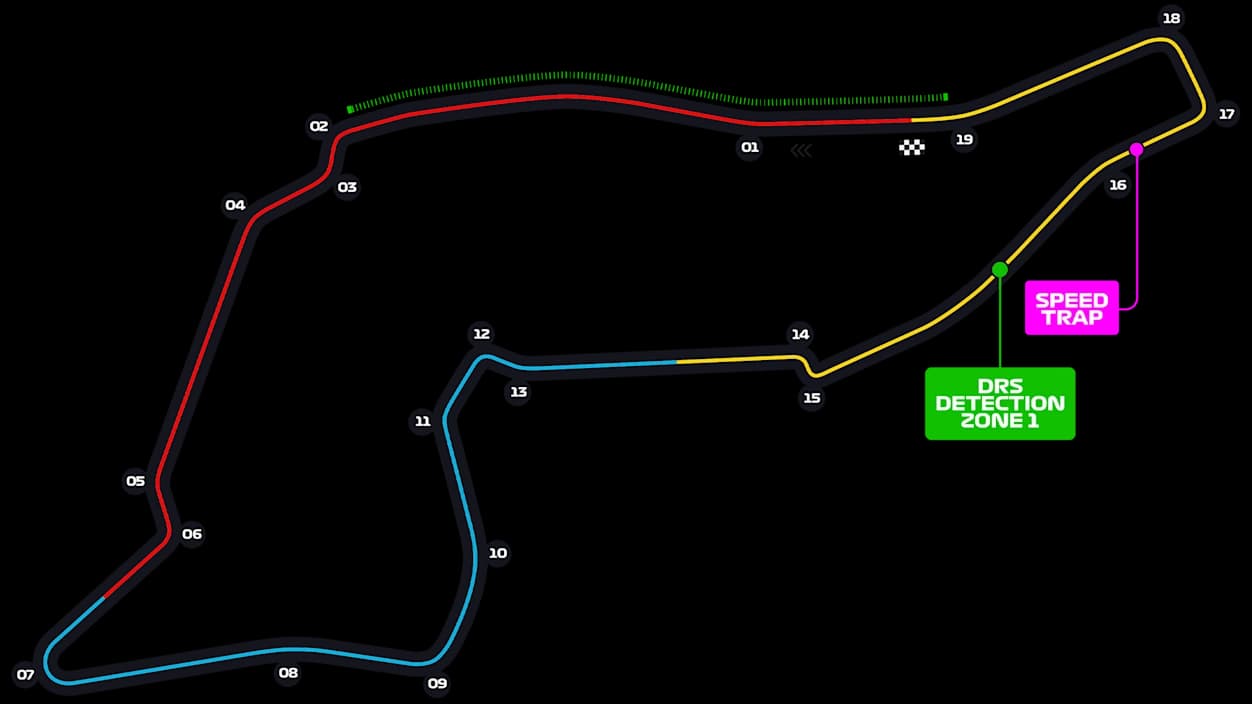
The current Imola layout runs anti-clockwise in seven sectors of mixed character. The lap begins at the Tamburello chicane (added in 1995 to replace the fatal bend), then through Villeneuve and Tosa — a slow hairpin that is one of the few overtaking points. The road climbs to Piratella, a fast left-hander, and descends through Acque Minerali — a left-right complex named after a nearby spring. The Variante Alta (a chicane) and Rivazza (a fast double-apex left descending towards the finish line) define the back of the circuit. Imola is famously narrow — overtaking is difficult, and races regularly hinge on strategy and pit stops. Lap times under modern regulations are around 1:14-1:16. The circuit's surface is technically demanding: bumps and crowns from the natural terrain remain after every resurface.
Legendary Moments
The 1994 San Marino Grand Prix is the most-discussed weekend in F1 history. Friday: Rubens Barrichello survived a 220-km/h flip at Variante Bassa with only a broken nose. Saturday: rookie Roland Ratzenberger died when his Simtek's front wing failed on the approach to Villeneuve and the car hit the wall head-on at 314 km/h. Sunday: Ayrton Senna, leading the race in his Williams, lost control at Tamburello on lap 7 and hit the concrete barrier at 211 km/h. He died of head injuries hours later in hospital in Bologna. JJ Lehto and Pedro Lamy were also injured in a start- line incident; Michele Alboreto and a Lotus mechanic were hurt in a wheel detachment. The weekend triggered the most thorough safety overhaul in sporting history — the FIA Safety Commission, the GPDA's reformation, high-cockpit sides, the head-and-neck device, the eventual Halo. Senna's funeral in São Paulo drew three million people; the FIA renamed the corner that killed him simply "Tamburello" with a memorial plaque, and his blue cap is buried in concrete behind the wall. The 2005 race produced a magnificent battle between Fernando Alonso's Renault and Michael Schumacher's Ferrari. Alonso held off Schumacher for 12 laps in the closing stretch, his championship victory ride producing some of the most precise defensive driving of the modern era. The two men crossed the line 0.215 seconds apart in one of F1's classic finishes. The 2020 Emilia-Romagna Grand Prix, held over a one-day format because of COVID restrictions, was the first F1 race at Imola in 14 years. Lewis Hamilton won; Imola has held the race annually since. In 2022, Charles Leclerc spun his Ferrari out of fourth place in the wet race and crashed into the barriers, ending what had been a championship- threatening start to his season. Verstappen won and effectively turned the title fight; the Leclerc spin became one of the era's most-discussed driver errors.
Quirks & Curiosities
Imola runs anti-clockwise, the only Italian circuit on the F1 calendar with that characteristic. This is partly why drivers describe it as physically demanding compared to clockwise circuits — neck loading asymmetry plus the substantial elevation change. The circuit is set in a public park (the Parco delle Acque Minerali), which is why Acque Minerali corner is so named. The park remains open during non-race weekends; Italians picnic on the grass that becomes spectator banking during the Grand Prix. The Tamburello memorial plaque, set into the wall where Senna died, remains an active pilgrimage site. Drivers, mechanics and fans visit it during Grand Prix weekends. The wall itself was rebuilt in concrete and moved 20 metres back in the 1995 redesign. The Ferrari museum in Maranello is 50 km from Imola and routinely combines a tour package with the Imola race weekend. Tifosi attendance at Imola is consequently second only to Monza among Italian fans.
Modern Era
Imola was added to the calendar permanently in 2020 after years of lobbying by the Emilia-Romagna regional government. The circuit's contract runs through 2025 with a strong likelihood of extension. F1's owner Liberty Media regards Imola as the natural complement to Monza: classic Italian heritage, Ferrari proximity, modest but enthusiastic crowd, technical challenge. The 2024 race was significantly disrupted by major flooding in the Emilia-Romagna region in May 2023, which damaged paddock facilities; the race was cancelled that year and returned in 2024 with modernised pit buildings. The 2025 edition — exactly 31 years after Senna's death — was broadcast with extensive memorial coverage. Imola will not be allowed to forget what happened there.