

Rouen-Les-Essarts
 FranceRouenEntry 1952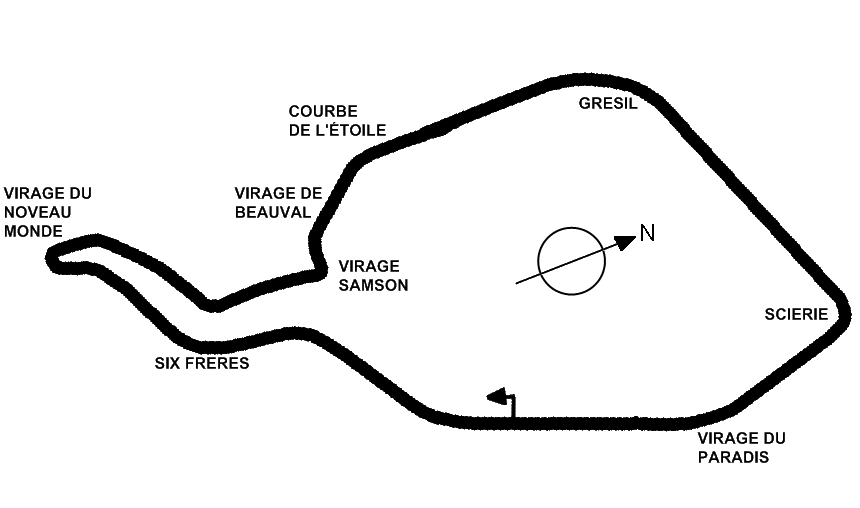
Career timeline
Signature numbers
- Career
- 1952 – 1968
Era
About Rouen-Les-Essarts
Rouen-les-Essarts was a 6.5 km road circuit south of Rouen in Normandy, France — a fast, downhill-and-back layout through forest that hosted the French Grand Prix five times between 1952 and 1968. The circuit's defining feature was the descent from the start through Nouveau Monde hairpin and the long climb back, all on closed public roads with cobblestone sections in the lower areas. Rouen produced great races and crushing tragedies — Jo Schlesser's death in the air-cooled Honda RA302 at the 1968 French GP led to that circuit's removal from the championship rotation. The shortened track survived for sports car and motorcycle events into the 1990s before being demolished entirely.
Origins
The Rouen Automobile Club identified the wooded valley south of the city as suitable for road racing in the early 1950s. The circuit, named for the Essarts village it bordered, opened in 1950 with an initial 5.1 km layout and was extended to 6.542 km in 1955. The French Grand Prix arrived in 1952 and rotated through Reims, Rouen, Charade, and Le Mans across the 1950s and 1960s as France distributed its premier event among multiple circuits.
Layout
The lap began with a fast descent — the track dropping over 90 meters from start to the bottom of the valley — leading to Nouveau Monde, a tight hairpin with cobblestones on the inside. From Nouveau Monde the road climbed steeply back through Six Frères, a fast right-hander, then up through Beauval and Gresil to the upper plateau. The final sequence returned to the start through medium-speed bends. Top speeds touched 270 km/h on the descent before braking for Nouveau Monde. The cobblestones at the bottom of the valley were genuine 19th-century stones, slick when wet and treacherous always.
Legendary Moments
Alberto Ascari won the inaugural 1952 race in the Ferrari 500. Mike Hawthorn took victory in 1957 for Ferrari, a year before his championship. The 1962 race was won by Dan Gurney in the Porsche 804 — Porsche's only F1 victory until the V6 Turbo era of the 1980s. 1964 saw Dan Gurney win again, this time in the Brabham, the first F1 victory for the Brabham marque. The 1968 race was a tragedy: Jo Schlesser, in only his second F1 race, was driving the experimental air-cooled Honda RA302 — a car widely considered unsafe and which Honda team leader John Surtees had refused to race. Schlesser crashed at Six Frères on the second lap; the magnesium-bodied car caught fire and Schlesser was killed. The Honda RA302 program was abandoned, and the French Grand Prix moved permanently away from Rouen after 1968.
Quirks & Curiosities
The cobblestones at Nouveau Monde gave Rouen one of the most distinctive surfaces in championship Formula 1 — the bottom of the descent literally transitioned from asphalt to centuries-old paving stones, requiring drivers to manage radically different grip on the same lap. Spectator vantage was extraordinary: the valley shape created a natural amphitheater with views from both sides of the descent, and grandstands at Nouveau Monde could see the cars approaching for over half a kilometer. The pits were located on the upper plateau near the start. Schlesser's death prompted the immediate withdrawal of the controversial Honda; the magnesium body had been chosen for weight savings and was known to be highly flammable.
Modern Era
Rouen-les-Essarts has not hosted Formula 1 since 1968. The shortened circuit (3.4 km, removing the most dangerous sections) continued to host European Formula 2, motorcycles, and sports cars into the 1990s, but financial difficulties closed the circuit entirely in 1994. Demolition followed in 1999; today the area is partially returned to forest with a major motorway (A28) cutting through the former layout. Public roads still mark portions of the original route, and a small memorial commemorates Jo Schlesser at the site of his fatal crash. Rouen's history exemplifies the postwar French circuit tradition — fast, beautiful, dangerous, and ultimately incompatible with modern Formula 1 demands.