

Circuitde Barcelona-Catalunya
 SpainBarcelonaEntry 1991Active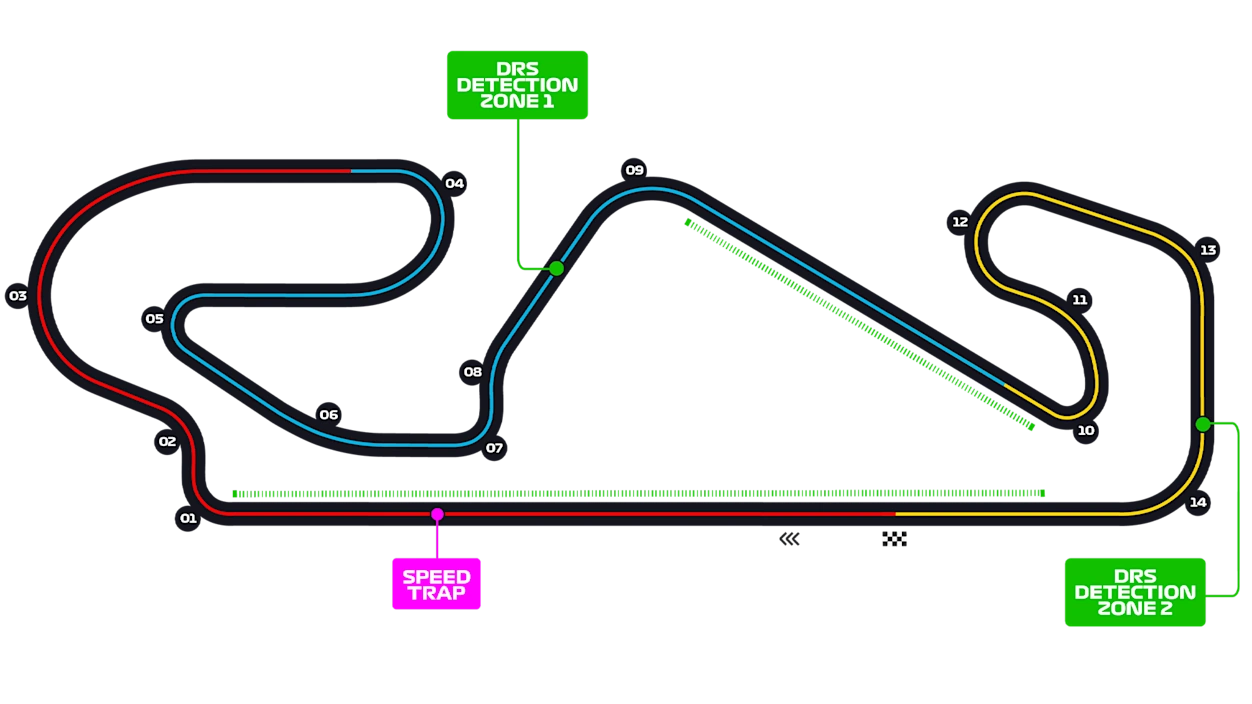
Career timeline
Signature numbers
- Career
- 1991 – 2026
Era
About Circuit de Barcelona-Catalunya
The Circuit de Barcelona-Catalunya, opened in 1991 in Montmeló, 30 kilometres north of Barcelona, is the spiritual home of Formula 1 preseason testing and one of the sport's most analytically important circuits. Its 4.657-kilometre layout combines virtually every type of corner used in modern F1 — high-speed curves, long medium-speed sweeps, slow hairpins, and a long DRS straight — into a single lap that engineers treat as the gold-standard benchmark. If a car works at Catalunya, it works everywhere; if it doesn't work here, it won't work anywhere.
Origins
The circuit was built in record time — 13 months from groundbreaking in August 1990 to the first F1 race in September 1991 — funded by a public-private partnership between the Generalitat de Catalunya and a consortium of regional businesses led by ASN, the Spanish national motorsport authority. The project was driven by Catalonia's regional government's desire to use the 1992 Barcelona Olympics as a vehicle to showcase the autonomous community to the world; F1 was viewed as a companion piece to the Olympics in the same regional-promotion strategy. The original design by Spanish engineers was modified by F1's Hermann Tilke before construction to incorporate runoff areas and safety features that met the FIA's emerging post-Senna safety standards. The inaugural race on September 29, 1991 was won by Nigel Mansell's Williams in conditions of intermittent rain, with one of the most famous side-by-side battles in F1 history when Mansell and Senna ran wheel-to-wheel for several hundred metres at full throttle down the main straight. The circuit was renamed in 2013 from "Circuit de Catalunya" to "Circuit de Barcelona-Catalunya" to capitalise on Barcelona's stronger international brand. Locals continue to call it Montmeló, after the village where it sits.
Layout
The lap begins with a fast right-hand sweep at Turn 1, followed by the slow Turn 2 left-hander where DRS-aided overtaking is common at the end of the long main straight. The middle sector — the test bench of F1 — combines the long high-speed Turn 3 right with a series of medium-speed esses (Turns 4-7) that demand perfect balance. The infamous Turn 10 — Campsa — is a flat-out left-hander on the exit of which understeer can cost a tenth or more per lap; engineers use it as the benchmark for evaluating front-end grip across new aero packages. The slow Turn 13 hairpin and the new chicane (added in 2007 to slow the cars before the start straight) form the final sector. A 2023 modification removed the chicane that had stood since 2007 and restored the fast final two-corner sequence, returning the layout closer to its original 1991 configuration. The change was driven by driver feedback that the chicane provided no overtaking opportunity and slowed lap times unnecessarily.
Legendary Moments
The 1991 inaugural race produced perhaps the most famous side-by-side duel in F1 history: Mansell and Senna ran wheel-to-wheel for over 600 metres down the main straight at full throttle, sparks flying from both cars, before Mansell finally edged ahead. The image of Mansell's Williams and Senna's McLaren side by side, doing 320 km/h, has been reproduced on more posters and t-shirts than possibly any other F1 moment. The 2016 race produced Max Verstappen's first F1 victory at age 18 — the youngest winner in championship history — after Lewis Hamilton and Nico Rosberg eliminated each other on lap 1. Verstappen had been promoted to Red Bull from Toro Rosso the week before; he became the first teenage F1 winner. The 2021 race delivered Lewis Hamilton's most controversial late-career victory, a one-stop strategy by Mercedes that left him chasing Max Verstappen with 24 laps remaining; he caught and passed the Red Bull with six laps to go in a duel that defined the 2021 title fight. The 2024 race was Lando Norris's coming-out party, his first F1 victory after years as McLaren's young star — a tactical drive that exploited Red Bull's strategic missteps to break Verstappen's dominance.
Quirks & Curiosities
Catalunya is the only F1 circuit that hosts preseason testing every year (with rare exceptions for COVID and Bahrain alternatives). All ten teams ship their new cars here in February or March for typically 6-8 days of testing across two weeks. The track surface, ambient temperatures, and corner characteristics are so well understood that engineers can predict their car's race pace within tenths of a second. The track is also famous for being relatively dust-free thanks to a unique drainage and surface design developed by Spanish engineers in the late 1980s. The asphalt mix — 30% recycled rubber from old tyres — produces unusually consistent grip across temperature variations. A 2.5-kilometre walking trail runs around the perimeter of the circuit and is open to the public year-round; the trail crosses over the back straight via a pedestrian bridge that is one of the few publicly-accessible viewing points for non-race-weekend visitors. The circuit's ownership transferred from the Generalitat to a private consortium in 2019, and the racing future was uncertain through 2022 when the Spanish government and Liberty Media negotiated a new hosting contract that runs through 2026.
Modern Era
Catalunya's F1 hosting contract runs through 2026, with renegotiation underway as Madrid's IFEMA Madring street circuit becomes operational in 2026. The Spanish Grand Prix could become a rotating fixture between the two venues, or Madrid could permanently take the slot. As of April 2026, no formal decision has been announced. The circuit continues to host preseason testing and a busy national calendar of MotoGP, World Superbike, and F2 races. The Lleida-based RACC (Royal Automobile Club of Catalonia) operates the circuit day-to-day on behalf of the consortium ownership and has invested in upgrades to the pit garage facilities and a renovated media centre that opened in early 2025.