

BakuCity Circuit
 AzerbaijanBakuEntry 2016Active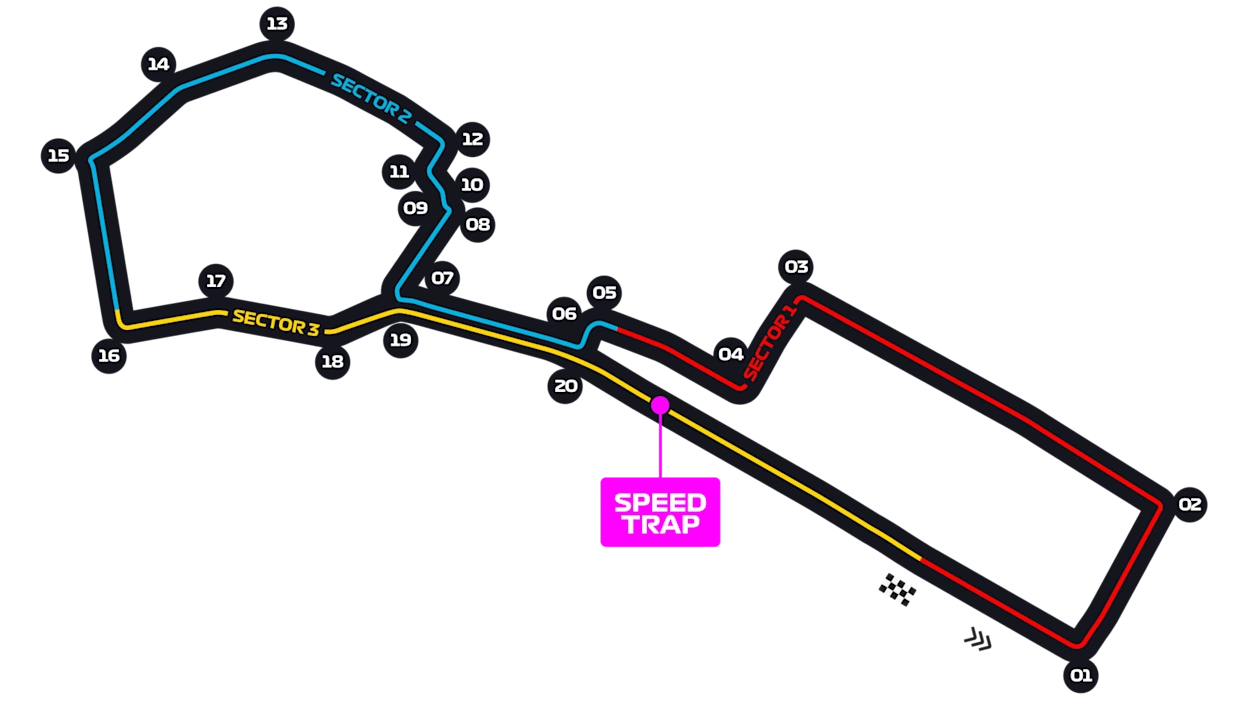
Career timeline
Signature numbers
- Career
- 2016 – 2026
Era
About Baku City Circuit
The Baku City Circuit, a 6.003-kilometre street layout that wraps around Azerbaijan's capital from the medieval Old City walls to the Caspian Sea waterfront, is one of Formula 1's youngest and most unpredictable venues. Since debuting in 2016, it has produced more chaotic, last-lap-deciding races than any other modern street circuit — the brutal combination of a 2.2-kilometre flat-out blast down Neftchilar Avenue, hairpin-tight medieval-quarter sections where walls touch the racing line, and a temperature-sensitive surface that catches drivers out has made Baku synonymous with carnage.
Origins
The Azerbaijan Grand Prix was the brainchild of President Ilham Aliyev's government, part of a sustained campaign in the 2010s to position Baku as an international sporting capital. The country had hosted the 2012 Eurovision Song Contest and the 2015 European Games, and saw F1 as the natural next step. Hermann Tilke designed the layout to thread through Baku's most photogenic neighbourhoods: the medieval İçerişəhər (Old City), now a UNESCO World Heritage site, the Soviet-era Government House on the seafront, and the modern skyscraper district along Neftchilar Avenue. The total project cost — paid entirely by the Azerbaijani government — was over $250 million, including infrastructure upgrades to the host city. The first race in 2016 was branded the "European Grand Prix" because the second Spanish race had ended and there was no naming-rights sponsor for "Azerbaijan"; from 2017 it has been the Azerbaijan Grand Prix, with the official name updating to reflect Baku's strategic position between Europe and Asia. The current contract runs through 2026 with extension talks ongoing as of early 2026.
Layout
The 6.003-kilometre lap is the longest on the F1 calendar after Spa, and is organised into two contrasting halves. The first sector winds through the medieval Old City — Turns 7-12 form a tight sequence with walls inches from the racing line, including the world-famous Turn 8 "castle" section where the track passes within metres of the Maiden Tower, an 8th-century stone fortress. The middle sector flows through Government Square and onto Azneft Square — where the famous Turn 16 'Tagiyev's Chicane' has caused multiple safety-car periods since 2016. The track then opens onto the Neftchilar Avenue back straight, a flat-out 2.2-kilometre blast that ends at the slow Turn 1 hairpin. The 2.2-kilometre straight is the longest flat-out section on any modern F1 circuit, with cars exceeding 360 km/h before braking. DRS overtaking is consistent, and the Turn 1 braking zone has been the site of multiple race-deciding manoeuvres.
Legendary Moments
The 2017 race, only the second running, produced one of the most chaotic F1 races of the modern era: a red flag, multiple safety cars, Sebastian Vettel deliberately driving into Lewis Hamilton during a safety-car period (Vettel was given a 10-second stop-go penalty post-race), and Daniel Ricciardo winning from 10th on the grid. The 2018 race delivered Lewis Hamilton's victory after Sebastian Vettel locked up at Turn 1 trying to overtake Valtteri Bottas; Hamilton had been outside the points before that, and the result swung the championship momentum decisively. The 2021 race featured one of F1's most dramatic moments: Max Verstappen, leading by a comfortable margin, had a tyre failure at 300+ km/h on Neftchilar Avenue with three laps to go. The incident forced a red flag; on the restart with two laps remaining, Lewis Hamilton — now in clear position to win — locked up at Turn 1 and ran wide, handing the win to Sergio Pérez. Pierre Gasly took an unexpected podium for AlphaTauri. The 2023 race was the first F1 sprint weekend in Baku — a controversial addition that produced a strategy-driven race won by Sergio Pérez and a sprint won by Max Verstappen.
Quirks & Curiosities
The Turn 8 "castle section" passes within four metres of the Maiden Tower, an 8th-century stone fortress that is one of the oldest structures on any F1 circuit's racing line. The proximity is intentional — Tilke designed the corner specifically to feature the historic landmark in trackside photography. The track surface in the medieval Old City section uses a blend of asphalt and granite chippings to mimic the appearance of cobblestones while providing modern grip. The result is a surface that produces unusually high tyre wear in the first sector — engineers regularly build tyre conservation strategies around the medieval-quarter section. Baku is one of only two F1 circuits that uses concrete-block kerbs (the other is Singapore), which produce a distinctive sharp impact when struck and have been blamed for multiple aerodynamic-floor failures. The kerbs were redesigned in 2018 to be slightly lower, reducing — but not eliminating — the failure rate. The race is held in early-summer heat that can exceed 35°C ambient temperature; the late-afternoon start time produces dramatic shadow patterns across the medieval Old City section that have made Baku one of the most visually distinctive F1 venues for television.
Modern Era
The Azerbaijan Grand Prix's contract runs through 2026 with extension negotiations ongoing as of April 2026. The race has become the calendar's "wild card" — a venue where fortunes can swing dramatically, where small teams can score points, and where strategic gambles often pay off. The circuit underwent a partial resurfacing in 2024 to address a recurring issue where heat caused asphalt softening in the Old City section. The resurfacing was conducted overnight in the weeks before the race and used a higher-bitumen asphalt blend designed for the specific solar exposure of the area. Baku has also become important for F1's geopolitical and commercial strategy — it sits at the intersection of European and Asian markets, and the race has helped Azerbaijan establish diplomatic and commercial ties with several major economies. The Azerbaijani government has signaled willingness to extend the contract and modernise the pit-paddock facilities, ensuring Baku remains a calendar fixture into the early 2030s.