

BahrainInternational Circuit
 BahrainSakhirEntry 2004Active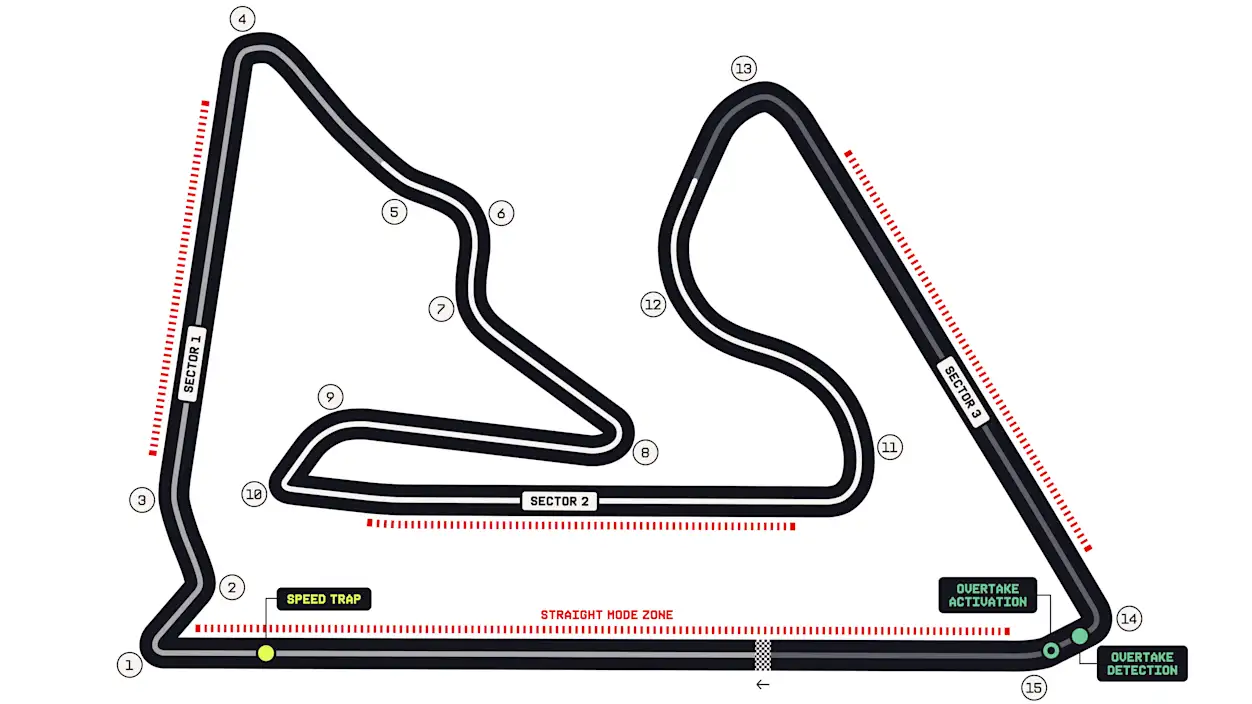
Career timeline
Signature numbers
- Career
- 2004 – 2025
Era
About Bahrain International Circuit
The Bahrain International Circuit, opened in 2004 in the desert town of Sakhir, was the first Formula 1 venue in the Middle East and remains the calendar's most reliable season-opener. Set in a sunbaked plain where temperatures routinely reach 35°C and where the racing surface is constantly threatened by drifting desert sand, the 5.412-kilometre layout combines long straights with heavy braking zones that have made it a tyre-management showcase since its first race. Across two decades it has hosted championship-deciding battles, the surreal "outer track" 2020 race, and the calendar's only F1 night opener.
Origins
The circuit was conceived by Sheikh Salman bin Hamad Al Khalifa, the Bahraini Crown Prince, who in 2002 announced an $150 million project to bring F1 to the Middle East. The project was driven by a regional geopolitical strategy: the Bahraini government wanted to position the country as the Gulf's sporting and entertainment capital, beating neighbours Dubai and Abu Dhabi to F1 by several years. Hermann Tilke designed the layout to deliberately incorporate the desert environment — wide runoff areas to handle drifting sand, multiple long straights to allow the cars to clean their tyres of sand particles, and a unique "Oasis" pit-paddock complex with elaborate Arabic-influenced architecture that distinguished it visually from any other F1 facility. Construction took 16 months and was completed in early 2004. The inaugural race on April 4, 2004 was won by Michael Schumacher's Ferrari, his second consecutive race victory at the start of his seventh world title campaign. The Bahraini government bought a long-term hosting contract that has been renewed multiple times; the current contract runs through 2036 and includes ongoing investment in venue upgrades and a planned sustainability initiative converting the facility to 100% renewable energy by 2028.
Layout
The standard 5.412-kilometre Grand Prix layout has 15 corners and three significant DRS zones. The opening sector includes the long Turn 1-3 sequence, where DRS-aided overtaking is common and where the heavy braking into Turn 1 has been the site of multiple race-deciding manoeuvres. The middle sector winds through the technical Turn 4-9 section, with Turns 6-7 forming a fast esses sequence that rewards a precise line. The infamous Turn 10 hairpin — the slowest corner on the circuit and historically the site of several lockup-induced spins — leads onto the back straight. The back straight from Turn 10 to Turn 11 is one of F1's longest at 1,090 metres, with cars exceeding 320 km/h before the heavy braking into Turn 11. The final sector includes the medium-speed Turn 12-13 sequence and the slow Turn 14 hairpin that returns to the main straight. The 2020 Sakhir Grand Prix used the rarely-employed "Outer Track" layout — a stripped-down 3.543-kilometre version that bypassed the infield section and produced the shortest race in F1 history at 87 minutes. George Russell's substitute Mercedes drive at that race — where he was on for victory before a bungled pit stop and a tyre puncture dropped him to 9th — became one of the great might-have-been stories.
Legendary Moments
The 2014 race produced one of the great Mercedes-era duels: Lewis Hamilton and Nico Rosberg battled wheel-to-wheel for the entire 57 laps, with the lead changing 11 times and the margin at the finish under one second. The race was a preview of the toxic teammate rivalry that would dominate the next four years. The 2020 Bahrain Grand Prix saw Romain Grosjean's terrifying first-lap crash — his Haas split in two on a barrier at over 200 km/h, igniting into a fireball that he escaped from with second-degree burns. The incident — survivable only because of the halo cockpit-protection device introduced in 2018 — was the most violent F1 accident of the 21st century. The 2020 Sakhir race (the second Bahrain race that year on the Outer Track) gave George Russell his first Mercedes drive in place of COVID-positive Lewis Hamilton; he was on for victory before a catastrophic pit-stop error involving Bottas's tyres being fitted to his car. The 2023 race — the first under the new ground-effect aero regulations of 2022 — produced Max Verstappen's emphatic statement of intent for the season, leading every lap and beating Sergio Pérez by 12 seconds.
Quirks & Curiosities
The Sakhir Desert Resin treatment — a polymer compound applied to the runoff areas around the circuit perimeter — prevents desert sand from blowing onto the racing surface during practice and races. The treatment is reapplied annually and is one of the largest non-track maintenance costs at the circuit. The Bahrain pit-paddock complex includes a series of palm-tree gardens and a small zoo featuring desert wildlife, both visible from the main grandstand. The complex is purpose-built to host non-F1 events including the FIA Sport Conference and various corporate-hospitality weekends throughout the year. The 2009 race was the first F1 race held under floodlights in the Middle East, with Bahrain investing $40 million in a custom floodlighting system that was later partially adopted at other Gulf circuits. The race start time of 18:00 local was chosen specifically to suit European prime-time TV audiences. The "Sakhir 1000" — a 1,000-mile endurance race held annually as part of the FIA World Endurance Championship — uses a slightly modified layout and serves as a warm-up event for the F1 weekend.
Modern Era
Bahrain has been the F1 calendar's season-opener since 2010 (with 2020 being a notable exception due to COVID rescheduling). The February-March race date allows teams to use the preceding 8-10 days for preseason testing — Bahrain hosted the 2021 and 2022 preseason test seasons, replacing Catalunya during the rush to prepare for the new ground-effect regulations. The circuit's hosting contract runs through 2036 and is one of F1's longest-term financial relationships. The Bahraini government's sustained commitment, combined with the venue's role in the preseason-test/season-opener combination, makes Bahrain one of the most strategically important venues on the calendar despite the human rights concerns periodically raised by activist groups about the country's political environment.