

Circuitof the Americas
 USAAustinEntry 2012Active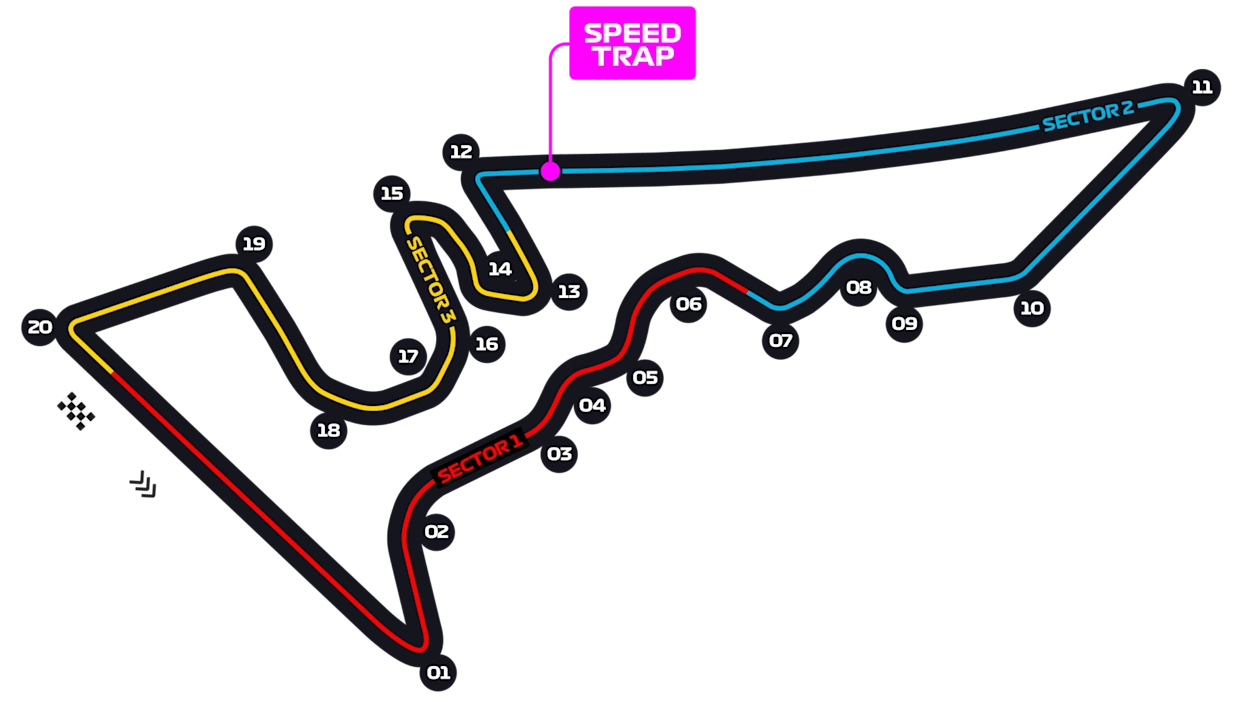
Career timeline
Signature numbers
- Career
- 2012 – 2026
Era
About Circuit of the Americas
The Circuit of The Americas, opened in 2012 outside Austin, Texas, is the first purpose-built Formula 1 facility constructed in the United States and the venue that finally gave the sport a stable American home after decades of false starts at Watkins Glen, Long Beach, Detroit, Phoenix, Indianapolis, and Caesars Palace. Designed by Hermann Tilke with explicit homage to Europe's most beloved corners, COTA is the rare modern circuit that drivers actually praise — a 5.513-kilometre roller-coaster of elevation, fast sweepers, and a punishing 133-foot climb to Turn 1 that has produced genuinely memorable racing in every one of its first thirteen seasons.
Origins
The story of COTA begins with Tavo Hellmund, an Austin-born promoter and amateur racer whose father had been a friend of Bernie Ecclestone since the 1970s. In 2010, Hellmund secured a contract for a US Grand Prix at a greenfield site east of Austin, a deal that surprised the paddock — there was no track, no infrastructure, and no indication that Texas had any appetite for Formula 1. Construction began in late 2010 on 1,500 acres of ranchland near Elroy, with billionaire Red McCombs (San Antonio Spurs, Minnesota Vikings) bankrolling the project after Hellmund's original financing collapsed. Construction was nearly halted twice — once by a contractor lawsuit, once by a financing crisis in early 2012 — but the inaugural race went ahead on November 18, 2012, won by Lewis Hamilton in his final season with McLaren. Hellmund was forced out of the project before the race; the circuit's ownership and operation was taken over by McCombs and Bobby Epstein, who run it through Circuit Events LLC to this day. Tilke designed COTA with explicit references to other circuits: the Turn 1 climb is inspired by Istanbul's old Turn 1; sectors 2 and 3 quote Silverstone's Maggotts-Becketts and Hockenheim's stadium section; the back-straight hairpin echoes Hockenheim's old north loop.
Layout
Turn 1 is the signature corner — a steep 133-foot climb from the start line to a blind, decreasing-radius left-hander where drivers brake while still climbing. From the apex, the track plunges back down into the long, fast esses of Turns 3-6, modeled on Silverstone's Becketts but tighter and with more elevation change. Turn 6 leads into a long left-hand drag down to Turn 11, the slowest corner on the lap. The back straight from Turn 11 to Turn 12 is one of the longest in F1 at 1,016 metres, with a brutal 90-degree left at the end where DRS-assisted overtakes are common. The final sector winds through the stadium section — a multi-storey grandstand wraps around Turns 16-18 — before returning to the start line. The track surface has been a persistent issue. Drainage problems caused significant subsidence in 2018-2020, with the bumps so severe that several drivers complained of physical pain after the race. A full resurface was completed in 2024.
Legendary Moments
The 2012 inaugural race delivered Lewis Hamilton's defeat of Sebastian Vettel — at the time leading both the championship and every Sunday — in a wheel-to-wheel duel that justified the entire project. The 2015 race was held in apocalyptic rain from Hurricane Patricia, with qualifying eventually cancelled and the start delayed multiple times. Hamilton won, but Nico Rosberg's deflated body language at the finish became iconic — the championship had effectively been decided. The 2018 race produced one of the great late-career drives from Kimi Räikkönen, his only victory since 2013, snapping a 113-race winless streak. The 2024 race was Charles Leclerc's masterclass — a one-stop strategy that Ferrari nailed perfectly, holding off Verstappen and Norris with a margin of less than three seconds.
Quirks & Curiosities
The Observation Tower above the paddock, designed by Miró Rivera Architects, is 251 feet tall and is one of the highest viewing platforms on any F1 circuit. It contains a wraparound observation deck and is visible from much of the layout. The Austin Grand Prix is the only F1 race in the calendar with a weekend-long music festival attached: Taylor Swift, Bruno Mars, Stevie Wonder, and Pearl Jam have all headlined the COTA stage in recent years. The crowd skews younger and more female than any other F1 venue. The track has a reputation for being one of the bumpiest on the calendar due to the underlying clay subsoil, which causes seasonal heaving. The 2024 resurface used a polymer-modified asphalt blend developed specifically for the site. A regional-airport runway sits less than a mile from the back straight; during the race weekend, private-jet movements are tracked closely and the circuit operates a temporary FAA tower.
Modern Era
COTA hosts MotoGP, IndyCar, IMSA, and the W Series in addition to F1, and is one of the few US circuits with the financial muscle to bid for major international championships. The 2024 race drew over 432,000 spectators across the weekend — an F1 attendance record at the time, eclipsing Silverstone. With the addition of Miami (2022) and Las Vegas (2023) to the F1 calendar, COTA is no longer the only American GP, but it remains the sport's classic American venue — purpose-built, drivers' choice, and financially stable through 2026 with a contract through 2028 currently under negotiation.