

AlbertPark Grand Prix Circuit
 AustraliaMelbourneEntry 1996Active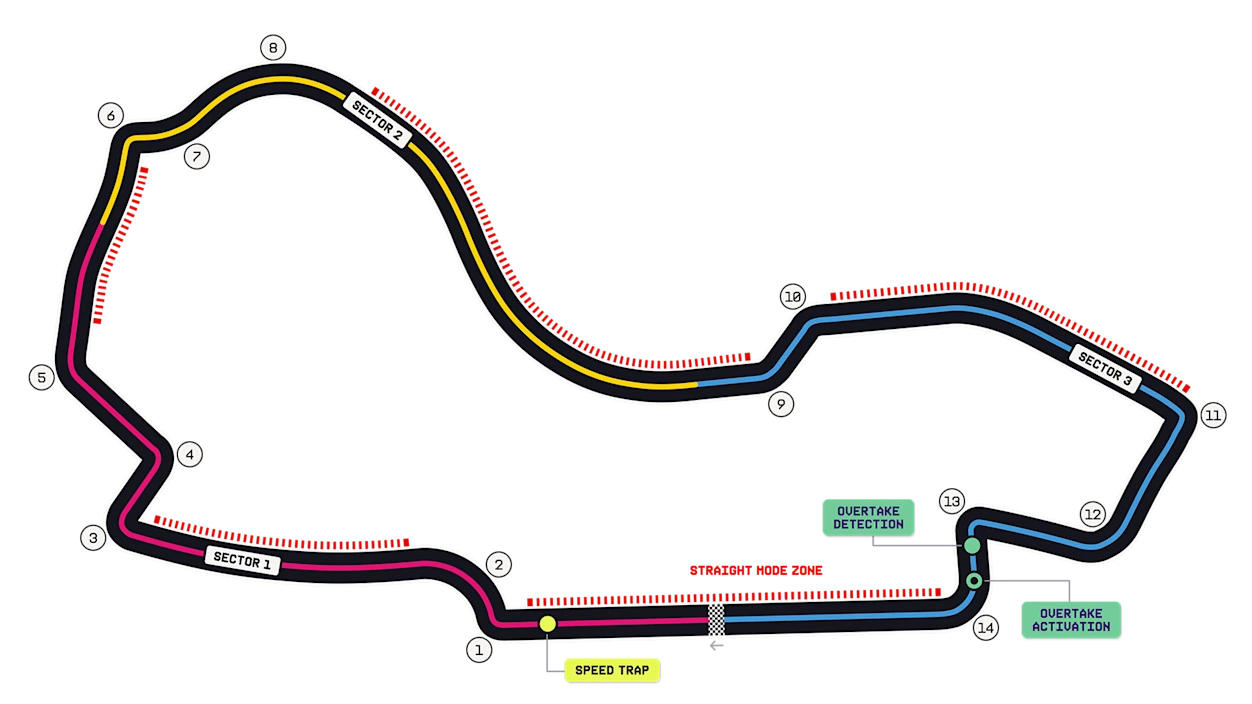
Career timeline
Signature numbers
- Career
- 1996 – 2026
Era
About Albert Park Grand Prix Circuit
The Albert Park Circuit, a 5.278-kilometre semi-permanent street layout that wraps around a man-made lake in central Melbourne, has been the home of the Australian Grand Prix since 1996 and the calendar's season-opener for most of the modern era. Built around a public park that hosts joggers, dog-walkers, and amateur cricket teams 51 weeks of the year, Albert Park transforms each March into one of F1's most visually striking venues — palm-tree-lined back straight, lakeside chicanes, and the city's downtown skyline as a backdrop.
Origins
Australia's Grand Prix had been held at Adelaide's Victoria Park street circuit since 1985, with great success — the South Australian event drew massive crowds and was beloved by drivers and teams. But in 1993, the Victorian state government, led by Premier Jeff Kennett, launched an audacious bid to steal the race for Melbourne, leveraging the city's superior international airline connections and corporate hospitality infrastructure. The deal was finalised in late 1993, and Albert Park — a 225-hectare public park near the Melbourne CBD that already had a perimeter road — was selected as the venue. The park had hosted minor motorsport events in the 1950s but had been a dedicated public space since the 1960s; the return to motorsport was controversial, with the "Save Albert Park" campaign organising protests for years afterwards. The first race was held on March 10, 1996, won by Damon Hill's Williams in dramatic fashion — Martin Brundle's spectacular first-lap crash (his Jordan flipped end-over-end through the gravel after launching off the back of David Coulthard's McLaren) became one of F1's most replayed accidents. Albert Park has hosted the Australian Grand Prix every year since except 2020 (cancelled due to COVID just hours before practice was due to begin) and 2021 (cancelled due to international travel restrictions).
Layout
The 5.278-kilometre lap has 14 corners arranged around the perimeter of Albert Park Lake. The opening sector includes the heavy-braking Turn 1-3 sequence — historically the site of multiple first-lap incidents — and the long Turn 4-5 sequence that winds along the lake's western edge. The middle sector includes the famous Turn 9-10 chicane, where DRS- aided overtaking is common and where the high-speed change of direction has caused multiple aerodynamic-floor damage incidents since the 2022 ground-effect regulations. Turn 11 — a fast right- hander — leads onto the back straight. The 2022 layout revisions removed the previous Turn 9-10 chicane and added a fast left-right combination (the new Turn 9-10) that has become one of F1's most spectacular corner sequences. The change also extended the back straight, which now runs uninterrupted for 1,200 metres along the lake's southern edge. The final sector includes the slow Turn 13 hairpin and the long Turn 14 sweep that returns to the start-finish straight.
Legendary Moments
The 1996 inaugural race produced Martin Brundle's spectacular first- lap crash — the Jordan flipped end-over-end through the gravel after launching off the back of David Coulthard's McLaren. Brundle escaped unhurt and famously got into the spare car for the restart, finishing the race. The 2002 race was Michael Schumacher's emphatic victory after the two-hour build-up was interrupted by a freak hailstorm that delayed the start by over an hour. Schumacher dominated the race in conditions that suited his Ferrari perfectly. The 2010 race delivered Jenson Button's masterclass in unexpected weather — a brief Sunday-morning rain shower turned the afternoon into a tactical chess match, and Button's bold call to switch to slicks before any other front-runner gave him the win for McLaren in his debut race for the team. The 2024 race produced Carlos Sainz's emphatic victory just two weeks after his appendectomy surgery — a result that became his audition for his post-Ferrari seat at Williams. The race also saw Max Verstappen's rare retirement with brake failure on lap 4, the most surprising result of the early 2024 season.
Quirks & Curiosities
Albert Park is a public park 51 weeks of the year, with circuit preparation taking approximately three weeks before each race and removal taking another three weeks. The total annual preparation cost is approximately AU$15-20 million, paid by the Victorian state government as part of its hosting agreement. The track surface uses asphalt overlays applied to the existing public roads — the temporary surface produces unusually high tyre wear in the first race weekend each year (Friday practice times are typically 2-3 seconds slower than Sunday qualifying). The 2018 resurface introduced a new asphalt blend designed to mature faster, reducing the practice-to-race lap time delta. The Australian Grand Prix is famously F1's "social weekend" — the race coincides with Melbourne's autumn social calendar, including the Australian Tennis Open's spillover events and various corporate- hospitality functions. Hotel rates double during race week, and the Melbourne Cricket Ground's nearby pubs and restaurants are routinely overbooked weeks in advance. The circuit is the only F1 venue where pelicans, ducks, and other waterfowl regularly cross the racing line during practice sessions — the Albert Park Lake is a designated wildlife sanctuary, and bird- strike incidents have been reported in F1, F2, and support series races over the years. The 2017 race was briefly safety-car-led after a flock of pigeons appeared on the back straight.
Modern Era
Albert Park's hosting contract runs through 2037, making it one of F1's longest-term financial relationships. The Victorian government's sustained commitment, combined with the venue's role as the calendar's traditional season-opener (replaced briefly by Bahrain in 2021-2024 due to COVID and scheduling concerns), makes Melbourne one of the most strategically important venues on the calendar. The 2022 layout revisions — which removed the previous Turn 9-10 chicane and added a fast left-right combination — produced an immediate improvement in race quality and lap times. The race has returned to its position as F1's traditional season-opener as of 2025, a slot it had held from 1996 to 2019 with brief exceptions.