

AinDiab
 MoroccoCasablancaEntry 1958
Career timeline
Signature numbers
- Career
- 1958
Era
About Ain Diab
Ain-Diab was a 7.6 km road circuit on the outskirts of Casablanca, Morocco, hosting the only Moroccan Grand Prix in Formula 1 history — the 1958 championship round that decided the World Championship in favor of Mike Hawthorn over Stirling Moss, and in which Stuart Lewis-Evans suffered fatal burns. The circuit looped through coastal cliffs and beach roads, combining fast straights with sweeping bends overlooking the Atlantic. Ain-Diab's lone championship appearance produced a moment of historic significance: it crowned Hawthorn as Britain's first Formula 1 World Champion, but in tragic circumstances that contributed to his retirement at the end of the year and to the eventual abandonment of the circuit.
Origins
Morocco had a long automotive racing tradition dating to the colonial French era, with sports car races held on various closed road circuits from the 1930s. The Royal Automobile Club of Morocco constructed the Ain-Diab circuit on a coastal area west of Casablanca in 1957, using closed public roads. The first race held there was a non-championship F1 event in October 1957, won by Jean Behra. The 1958 Moroccan Grand Prix joined the World Championship as the season-closing round, scheduled deliberately to maximize drama in the championship fight.
Layout
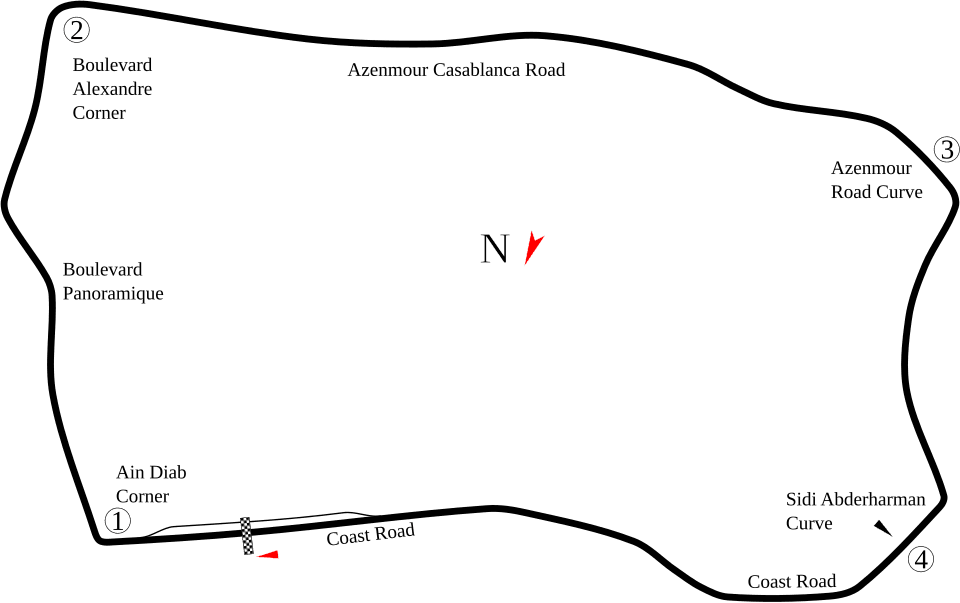
The 7.6 km layout was fast and flowing — predominantly medium-to-high-speed corners with a long start-finish straight that featured cars hitting around 270 km/h. The circuit ran near the Atlantic coast, with sections offering ocean views, then turned inland through Moroccan countryside before returning to the coast. Surface quality was inconsistent — sections of newly-laid asphalt mixed with older repaired road, and dust frequently blew across the circuit from surrounding areas. Spectator areas were rudimentary, with hay bales and snow fencing as primary safety features.
Legendary Moments
The 1958 Moroccan Grand Prix was a championship decider. Stirling Moss in the Vanwall needed to win and have Hawthorn finish lower than second; Hawthorn in the Ferrari needed only to finish second to take the title. Moss won the race brilliantly, dominating from pole, but Hawthorn's second-place finish gave him the championship by one point. The race produced Britain's first F1 World Champion. But the celebration was muted: Stuart Lewis-Evans, in a third Vanwall, crashed in the closing laps when his engine seized; the magnesium-bodied car caught fire and Lewis-Evans suffered severe burns. He died in hospital six days later. Hawthorn's championship was overshadowed by the tragedy of his close friend's death; he announced his retirement weeks later, then died himself in a road accident in January 1959. The Moroccan Grand Prix was never held again as a championship event.
Quirks & Curiosities
The 1958 Vanwall team's tragedy was compounded — Lewis-Evans's death came in a car designed by Colin Chapman with magnesium bodywork chosen specifically for weight savings, the same material that would later contribute to multiple F1 fatalities. The flames were exceptionally hard to extinguish given magnesium's properties. Mike Hawthorn's championship win at Ain-Diab made him the first British driver to win the Formula 1 title, but it required only one race victory all season — Hawthorn won at Reims while Moss won four races. The points system at the time (only best six results counting) favored Hawthorn's consistency over Moss's victories. Lewis-Evans was the third Vanwall driver killed in 18 months (after others in non-championship and other category events).
Modern Era
Ain-Diab has not hosted a championship Formula 1 race since 1958. Morocco's economic and political situation through the 1960s and 1970s meant no return to top-line international motorsport for decades. The circuit roads remain in use as part of Casablanca's coastal route — visitors can drive sections of the old layout and find period landmarks. Morocco has hosted Formula E events at Marrakesh starting in 2016 and continues to develop its motorsport infrastructure. Discussions of a Moroccan Grand Prix return have surfaced periodically but no concrete proposals have advanced. Ain-Diab remains historically important as the site of Britain's first F1 World Championship victory and as a poignant reminder of the costs paid in 1950s Grand Prix racing.